A Glimpse of the "Future Leadership 2014" Conference
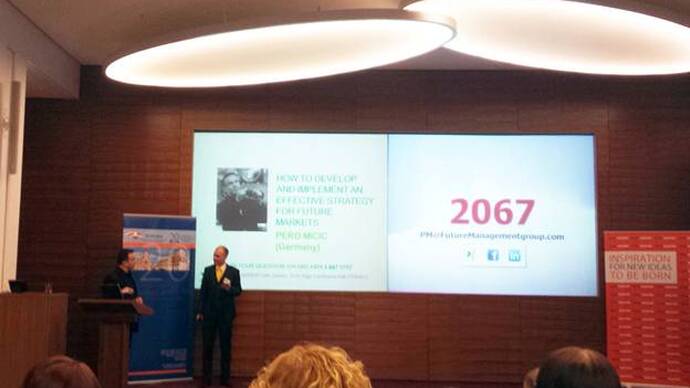
Yesterday there was the opportunity to attend the "Future Leadership 2014" conference. My favourite speaker of them all was future leadership expert Pero Micic. Particularly interesting was his Five Future Glasses theory. His closing wish to everyone was - "Save will power!" Any small change in the present, any small decision or action, is later reflected in our future.
Yesterday, 24 January, there was the opportunity to attend the conference "Future Leadership 2014" held at the Citadele Conference Hall and organised by RISEBA. While it cannot be compared in scale to FORUM ONE, it is still gratifying that here in Latvia one can also listen to foreign speakers and broaden one's perspective.
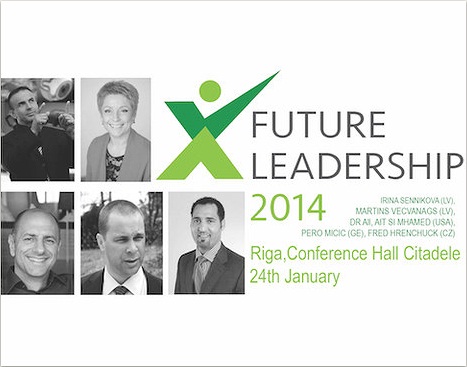
Event poster from www.ideahouse.lv
The Citadele Conference Hall is well equipped and pleasant for both speakers and listeners, though getting there by car is rather inconvenient, as is locating the hall itself within the building. For example, if you park on the 3rd floor of the car park, you have to walk down to the 1st floor, go outside, and then re-enter the building and walk back up to the 3rd floor. At least to me this logic was incomprehensible, so after the conference I asked the organisers to let me out through the 3rd-floor staff door directly to the car park - and there was no problem at all.
But let us return to the conference itself, which had a moderate turnout - at a rough glance, around 40 people. Five speakers took the stage, two of them Latvian. It was a pleasure to hear Mārtiņš Vecvanags, whose English was good and easy, and who was quite at ease on the stage - able to engage the audience and hold their attention, even though he spoke at the very end of the conference day. He spoke about work-life balance and shared many valuable insights drawn from personal life experience. Though the very title strikes me as a contradiction - but I hope to discuss that with Mārtiņš another time.
Dr. Ali Ait Si Mhamed's (USA) topic on risk management was fairly heavy going for a full-day conference, and was delivered in a very academic style. Similarly, the presentation slides of RISEBA Rector Irina Sennikova were extremely packed with various diagrams and charts that were impossible to read from the third row of the audience, let alone from further back. One could not help but think that Latvian speakers would do well to learn from their foreign colleagues - their simplicity and ability to convey an idea to the audience, rather than demonstrating how deeply versed the speaker is in theory (and not even their own theory at that).
By contrast, Bite CEO Fred Hrenchuck (Czech Republic) brought the audience back to life with a delivery full of humour and lightness. The speaker asked several times about his Canadian accent - whether everyone could understand him - but that was no problem at all. You could agree or disagree with his view of things, but the speaker's straightforwardness and openness were well received by the audience.
One useful example from Fred's experience: he divided the team into three groups and asked each group to write down their view on three questions - 1. What should the company start doing? 2. What should the company stop doing? 3. What should the company continue doing? This allowed management and everyone together to look at the company as if from the outside and analyse their own activities. The takeaway from Fred's presentation: "Partner in Crime – Exercise" :)
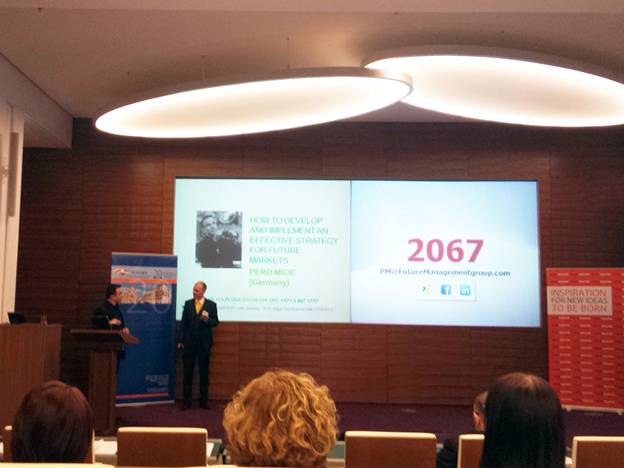
My favourite speaker of them all was lecturer, business consultant, future leadership expert, and head of The FutureManagementGroup AG, Pero Micic (Germany), whose narrative and theory seemed sufficiently thought-provoking - and most directly relevant to the event's title and idea. Below are some insights I took away from his talk.
The only place where the future exists is in our heads. Otherwise the future as such does not exist - it cannot be seen, touched, or felt. And leadership is built on assumptions about the future. Without a clear idea, a clear picture in your head, it is impossible to achieve anything.
Future trends are already among us. Pero showed a slide with his own genetic map, which any internet user can order: register on the relevant website, receive a small vial in the post, leave a saliva sample in it, send it off, then receive a notification and access credentials to a web portal and view and print your own genetic map - enabling you to potentially foresee the future course of your life, predispositions, illnesses, and so on.
Why can a qualified employee today no longer feel certain about their future at work? Because a whole range of technologies is emerging that will be able to replace a whole range of specialists. There is already an iPhone app that can take a cardiogram - so why would a person need to visit a clinic? There are already 3D printers that can print tablets from combinations of various powders - so why will pharmacies be needed?! Artificial intelligence in computers can already compose a musical piece or create a painting - though still very primitive ones for now.
Why will physical labour become extinct in the future? Robots will enter the majority of factories - capable of imitating and repeating human actions, and potentially doing so far more precisely than a human, never getting tired, without good moods or bad ones, and so on. Amazon already uses flying drones for parcel delivery. In the future these could replace an entire postal and courier network.
Lenses are being developed which, when placed over the cornea, allow a person not only to see the objects and people around them, but also information about them. Pero painted a vision in words: you are walking around Beijing, but you see all the signs in Latvian.
But at present, the vast majority of people live only for the present - I feel good right now and I need nothing more. People thought this way thousands of years ago and still think this way. But the world is changing rapidly and human thinking must change along with it - otherwise humanity could reach the point of resource exhaustion on earth, of overpopulation, of global catastrophe.
We cannot change human nature, which perpetually moves in a cycle of "Liking > Learning > Wanting > Liking > Learning > Wanting …", but we can start to change our thinking. Thinking for the future - future thinking.
Not "how do I feel right now", but "how will I feel in the future if I do such-and-such now, if I decide such-and-such now, if I change such-and-such now".
Pero told an example about a woman who had fallen on the street, bleeding. The default reaction for many is to get away from that place as quickly as possible. But those who walk away carry the image of that woman in their memory for a long time, and many are even haunted by their conscience - or by thoughts that they are insecure, unfeeling, cowardly, and so on. Whereas the person who chooses not to ignore what has happened, calls an ambulance, or helps in some other way, leaves that place with a certain sense of pride - and has simultaneously done something good for that person, for the world, and for themselves. They leave as a winner, as a successful person, as someone capable of controlling their own life.
Why does this aspect matter - how I feel? Because the emotional system is far more powerful than the pragmatic one. We cannot change much by reason alone - deciding to do something, writing New Year's resolutions and adhering to them rigidly - if there is no emotional backing: the desire to do it.
Particularly interesting was the Five Future Glasses theory outlined by Pero. It is essentially based on five pairs of coloured glasses (the colours here are chosen intentionally and carry their own symbolic meaning) through which you must look at the future:
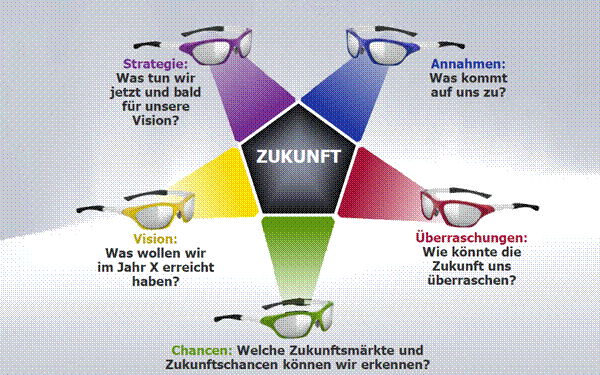
Image from www.oekohuman.org
1. Blue - assumptions and expectations. Moreover, people tend to talk about general assumptions, but what must be addressed are specifically personal assumptions and expectations. Write and compare two lists: Where will you invest if the world does not change at all over the next three years? Where will you invest if the world changes at a very rapid pace over the next three years?
I particularly liked an exercise here - a slide with hundreds, perhaps even thousands, of current trends and their application to a company's product or service. How will it change if adapted to each of the trends listed?
2. Red - the analysis of surprises. There is a saying: everything bad that we desperately don't want to happen will inevitably happen. Role plays or "war games" help here (the latter term is preferred by men).
3. Green - developing opportunities. People do not pay for the time spent, your efforts, or the meticulous work put in - they pay for the effect (the result).
4. Yellow - vision. When doing a jigsaw puzzle there is always a reference image - a picture of what it should look like at the end. The same applies to vision. The leader's task is to show the picture; the employees' task, by following it, is to put the puzzle together correctly.
5. Purple - strategy.
Pero's closing wish to everyone was: "Save will power!" Any small change in the present, any small decision or action, is later reflected in our future.
comments