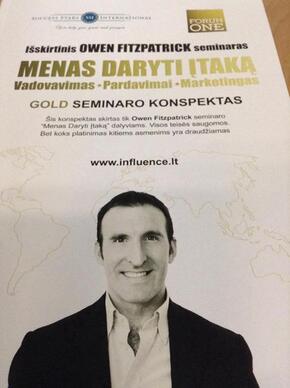
Owen Fitzpatrick: The Rhetoric Strategy
Last weekend, on 4–5 October, there was the wonderful opportunity to attend a two-day seminar by Irish coach Owen Fitzpatrick, "The Power of Influence", in Vilnius. The rhetoric strategy was compelling for its vivid examples drawn from politicians' speeches, in which the main source of influence over the audience is by no means the content of what is said, but rather how it is said.
Last weekend, on 4–5 October, there was the wonderful opportunity to attend a two-day seminar by Irish coach Owen Fitzpatrick in Vilnius - "The Power of Influence". I had heard this speaker at the FORUM ONE leadership event in Kaunas, so when I received an invitation, I agreed immediately - a truly good, charismatic speaker is an opportunity you don't let pass.
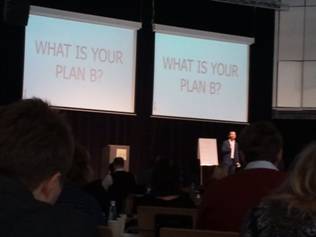
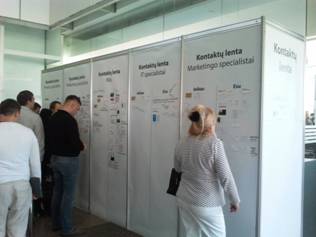
Photos from the event: Owen Fitzpatrick's talk and the contacts wall (a very good idea)
Many good things were said, heard, and tried out in practical exercises over the two days. This time I want to outline a small portion of what was heard at the seminar. The second day was devoted to advanced persuasion strategies - strategic influence, the motivation strategy, the rhetoric strategy, the brand influence strategy, and the nudging strategy. The rhetoric strategy was compelling for its vivid examples drawn from politicians' speeches, in which the main source of influence over the audience is by no means the content of what is said, but rather how it is said.
Owen Fitzpatrick highlighted seven core principles that every public speaker should observe in order to engage and captivate an audience.
1. Rhythm and tone of voice
Rhythm and cadence in speech, much like in music, have a wonderful power to make an audience receptive. A good speaker must attend to emphasis and pace. An effective speech pattern might look something like this: "v--, v--, v--, vvv", where "v" is the emphasised word and "-" represents less-stressed syllables. Moreover, you begin at a larger interval and gradually increase the pace, finishing with slow, deliberate stresses.
A speaker's voice must not be monotone if it is to "hold" the audience. Volume, pace, and pauses must vary so that the listener does not lose attention for a single moment. Attention to what, of course - because, as I mentioned, content plays a secondary role here. What matters most is the idea and the key words that must be carried through to the listeners' consciousness - or even subconscious.
2. The use of contrasts
Everything is known by comparison. "We want a better, safer, more stable future - not one that is uncertain, anxious, and threatening."
3. Repetition
Constant repetition of key words. Until you start really listening to or analysing the speech of a skilled orator, you don't even notice how insistently certain things are being drilled into you. Only when asked to retell what you heard will you retell exactly the words that were constantly repeated throughout the talk.
By ceaselessly repeating phrases, words, and parts of sentences, it is recorded in the person's consciousness much like a track on a record. So if you want what you said to be remembered - repeat, repeat, and repeat again. Many times over.
4. The rule of three
People love the trinity, and everything stated in threes is well received - received as a Biblical truth. "We must hear, we must understand, we must be able to repeat."
5. Quotation
Quoting someone well known to everyone - an industry guru - is a wonderful way to deliver an idea to the audience. When you quote someone, two things happen simultaneously. First, the listener does not perceive it as your lobbied idea but hears a famous person's opinion on the matter and accepts it as truth (even though in reality it is your new idea, simply illustrated with a well-known old figure). Second, you thereby imply that your idea already has countless followers - since this quotable person truly does have them (even if yours may not yet have even a few).
6. Rhetorical questions
Ideal in that you can both ask the question and later answer it contextually yourself. Moreover, by using values that are close to everyone, these questions feel very immediate and relevant to most people (as though each person had posed them themselves). "Can you imagine how much happier you would be if you didn't have to think about everyday routine questions?"
7. Metaphors
These are an excellent way to make the audience emotional, to touch the heartstrings, to draw people into shared experience. They should not be scattered about, but woven into the talk at key moments, using powerful words that create visual images. Compare two examples of how you would feel if a speaker said - "I was bleeding out" - so what? But if the speaker said - "It is an early, blossoming spring morning, and yet I was bleeding out" - immediately there rises before your eyes a scene like a cherry blossom field, and a poor soul at the threshold of death who will never be destined to see this beauty again.
Owen Fitzpatrick used Barack Obama's speech from the 2008 presidential election campaign as an excellent example of all seven of these core principles. First we listened to it from start to finish - it really did seem gripping, and had it gone on longer, one would almost have joined the rapturous, cheering crowd. Listening a second time, we dissected it phrase by phrase and examined the content (which turned out to be complete rubbish). Yet it had everything: constant repetitions, powerful metaphors, contrasts, rhythm, the rule of three.
For reference:
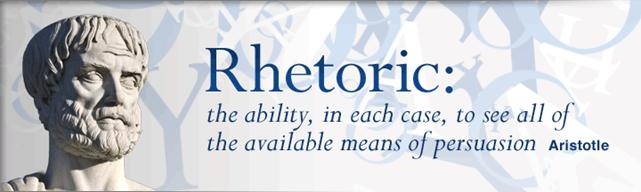
Rhetoric (Greek: ῥητορικός, rhētorikós - "public speaking") is a field within the humanities that examines the theory and practice of oratory. Rhetoric originated in Ancient Greece. The most notable theorists of rhetoric in the ancient world were Aristotle, Cicero, and Quintilian. Rhetoric also refers to the presentation of content in an outwardly embellished linguistic form, lacking deeper justification or purpose.
https://en.wikipedia.org/wiki/Rhetoric
comments