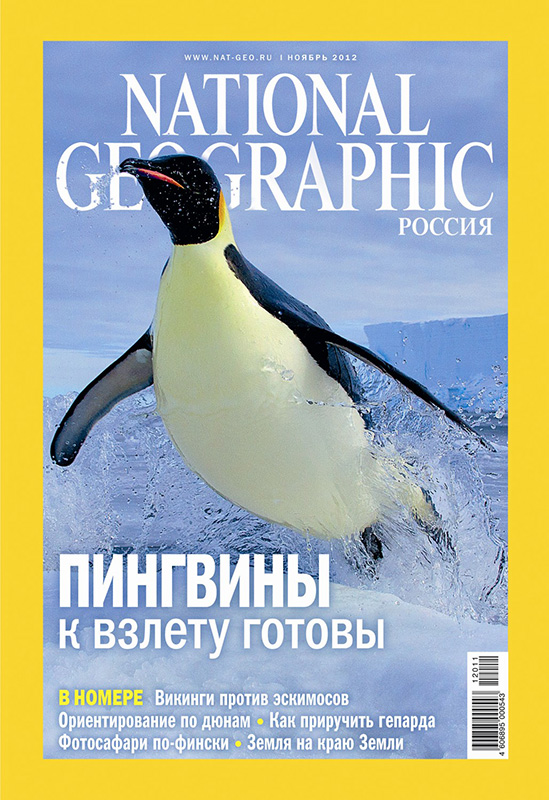
National Geographic November 2012 Issue on Penguins
When an emperor penguin swims, the friction between its body and the water limits its maximum speed to 1.2–2.7 m/s. However, in brief bursts of acceleration, penguins are able to overcome this limitation and increase that speed two or even three times by releasing tiny air bubbles from their plumage. The air bubbles reduce the density and viscosity of the surrounding water, reducing friction and allowing significantly greater speeds. The secret is hidden in the feathers. While most birds have feathers growing directly from the skin, penguins have tiny hair-like filaments at the base of each feather that are capable of trapping air bubbles - so small that they act as a lubricant across the feather surface layer. Read more in National Geographic (Russia), November 2012 issue.
National Geographic (Russia), November 2012 issue reads:
When an emperor penguin swims, the friction between its body and the water limits its maximum speed to 1.2–2.7 m/s. However, in brief bursts of acceleration, penguins are able to overcome this limitation and increase that speed two or even three times by releasing tiny air bubbles from their plumage. The air bubbles reduce the density and viscosity of the surrounding water, reducing friction and allowing significantly greater speeds.
The secret is hidden in the feathers. While most birds have feathers growing directly from the skin, penguins have tiny hair-like filaments at the base of each feather that are capable of trapping air bubbles - so small that they act as a lubricant across the feather surface layer.
comments