Key Person of Influence: How to Become a Key Person
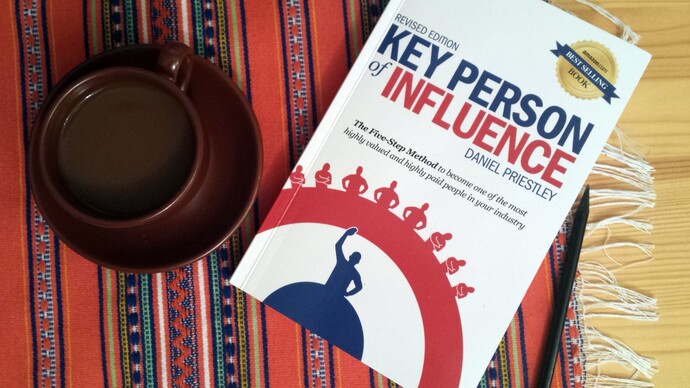
Another reason why it is worth attending networking events is the chance to stumble upon new ideas or sources from which to draw those ideas or inspiration. So it happened this time too - on 16 March I attended the Riga500 networking event at Gaismas Pils. As one of the early bird ticket buyers, I received as a gift from the event organisers Daniel Priestley's book "Key Person of Influence. The Five-Step Method to become one of the most highly valued and highly paid people in your industry".
At first, having carried it home and sceptically examined the cover design with its latest-bestseller tag, I put it aside. But later, one Saturday, after initially flipping through it casually, I began reading voraciously. Soon I had a pencil in hand with which I underlined the most valuable insights and wrote comments in the margins. Now that the book has been read, I have the feeling it will become my working handbook for the near future.
What initially drew me in - "hooked me" - is that the book's author talks about the personal brand and its purposeful development. A topic that is relevant to my business and one I speak about in my seminars and consultations.
At this moment, your greatest value or most valuable asset is the number of people who know you, like you, and trust you. In the future, what will be valued is your unique perspective on things, your success story, and your ability to create, adopt, and implement innovations. Every opportunity will open up if, when a collaboration partner or client types your name into Google, they find complete and professional information about you as an entrepreneur, manager, or industry specialist. Every deal will be closed based on the ability to present yourself successfully - not on what is written in your CV or on your business card.
In today's economy, hard work is no longer a competitive advantage. Most people work hard. The competitive advantage is thinking globally, finding the right contacts, and making use of the new opportunities that technological development and the open world offer us.
The prerequisite for a successful person is not functionality but vitality. Functionality simply demands that you do your job well; vitality demands that you be consistently energetic and full of zest for life. That pleasant little word "positivity", which increasingly appears in job advertisements under candidate requirements.
Being the owner of a micro-niche in your industry is as valuable as being a landowner. If you are known in your field as a key person, you will like a magnet attract all the opportunities and money circulating in that field. Personal brand - who you are - is what matters. You must stop being a consumer on this planet and become a creator, a producer, an inventor, an inspirer.
It's the time to say, - I won't try to be all things to all people. What I do is special and I have my own unique way of doing it. Anything else isn't for me. [..]
You are already standing on a mountain of value. Your story is valuable, your experience is unique, and you are highly valuable … just as you are!
In the book, the author uses the abbreviation KPI - which in business is traditionally understood as "Key Performance Indicator" - but here KPI stands for "Key Person of Influence".
To develop yourself into a key person, ask yourself the following questions and find the answers:
- What do you do?
- What makes people trust you?
- How do you earn?
- Are you known, do people like you, do they trust you?
- What and who can lead you to a deal?
The book sets out five key-person methods, which the author recommends mastering in the following order - pitch; publish; product; profile; and partnership.
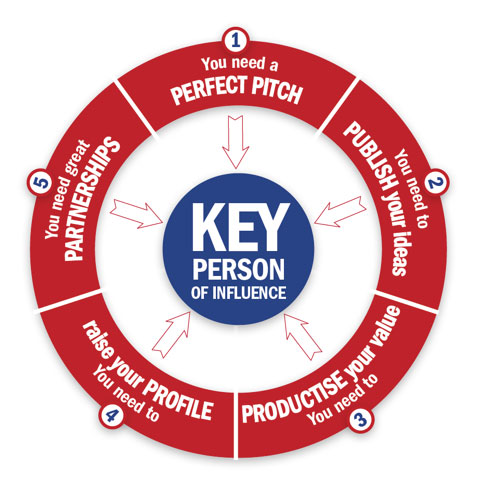
Image from www.keypersonofinfluence.com
There is useful advice and examples for crafting your pitch, because no networking event - whatever its internal agenda - can do without participants and guests introducing themselves: a brief presentation of who you are, your business, its competitive advantages, uniqueness, values, and so on. It is important that the listener hears value and usefulness for themselves and their business in your pitch.
Here is one example from the book of how to transform a dull pitch into a compelling one:
From: "I'm an M&A consultant. I help businesses grow through acquisitions."
To: "I specialise in mergers and acquisitions. I help companies to buy out a competitor without using any cash. Many of my clients have doubled their revenue in a single deal."
I thought to myself that it would be worthwhile to sit down and write at least 10 different pitches that, in 20–30 seconds, would convey a clear message about your business, service, and vision. That task is still ahead of me, even though every week I have to think up a pitch for the Thursday early-morning BNI business breakfast events. In BNI's case, those need to be at least 50 short but powerful pitches over the course of a year.
Daniel Priestley's book set me thinking not only about a blog and articles in the press and online media, but also about a book dedicated to the core themes and methods of my business - recruitment marketing and personal branding in the job market. A book as your business card.
The more people have, the more they want, so share your ideas freely. [..] If you share powerful ideas, people will come to you to implement them and you can have a valuable service offering that does that.
Fortunately, the book in PDF format can also be found online - http://www.entrevo.com/downloads/Key-Person-of-Influence-Revised-Edition.pdf - or it can be purchased on Amazon.com if you prefer, as I did, to experience it with a pencil in hand. Highly recommended!
comments