
Night Train to Lisbon (2013)
No person's life is insignificant; no one is superfluous or incapable of finding someone for whom they matter and are needed. The latter happens precisely when you are fully honest with yourself and concentrate not on licking the wounds life has carved but on what is happening around you, on the people beside you, on the goal that must be reached in order to reduce suffering and increase love for humanity.
If the "Cinema" section had not been introduced, I would put this under "iinuu recommends." One is always glad of good films that serve as a counterweight to mass production with predictable plots and templates.
The film is based on the novel Nachtzug nach Lissabon (2004) of the same name by Swiss writer and philosopher Pascal Mercier (born 1944).
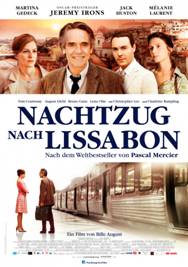

The film begins with an event that turns the life of Raimundus Gregorius (played by Jeremy Irons), an ageing teacher of classical languages at a Berne university, completely upside down, wrenches him from everyday routine and stability and sends him off - ultimately to find himself. On a rainy morning, on his way to work, he notices a young woman apparently about to commit suicide by jumping from a bridge. Raimundus holds her back from this step. The girl leaves, forgetting her red raincoat, in whose pocket the teacher finds a small book in Portuguese.
The author of this book is a certain Portuguese writer, Amadeu di Prado, who lived during the time of Lisbon's last dictator, António de Oliveira Salazar, and was one of the participants of the resistance movement. What captivates the teacher is not these historical events or personalities, but the thoughts about life, love, solitude, friendship and death expressed in the book. Raimundus perceives in Amadeu a man who lived life to the full and was always honest with himself. For this reason a train ticket to Portugal found by chance in the book compels the teacher to go to Lisbon and step by step reconstruct all the events of that time, untangle Amadeu's life and fate and come to know him as a person - even though the man himself has long since departed this world.
Raimundus meets Amadeu's sister, his beloved woman, his loyal friend, his comrade in struggle, and a fated woman - an optometrist who repairs his glasses accidentally broken in the street. Raimundus is as if bewitched by Amadeu's life story, forgetting his duties at school, forgetting his own life, and given over to the observation and discovery of another's life. As a result he brings together people who for many years had maintained their distance or nursed a deep grievance within themselves; and he also causes belief in the fact that a life lived was not in vain, that the struggle was not in vain, that the feelings were not in vain - even if they had clouded reason at the time.

Fulfilling this truth-revealing mission (as if Amadeu's spirit had guided him), Raimundus understands that he himself has now begun to live fully - has broken free from the greyness of everyday life and met a person who finds him interesting.
No person's life is insignificant; no one is superfluous or incapable of finding someone for whom they matter and are needed. The latter happens precisely when you are fully honest with yourself and concentrate not on licking the wounds life has carved but on what is happening around you, on the people beside you, on the goal that must be reached in order to reduce suffering and increase love for humanity.
How hard it is to keep this in mind. Disappointment and disbelief take the upper hand. Then one needs some chance occurrence that wrenches one from the everyday and sends one off on a journey. The main thing is not to be frightened and not to trust the inner critic in one's head, who always holds one back from the unknown. To feel that one is alive.
Sources used:
http://en.wikipedia.org/wiki/Night_Train_to_Lisbon_(film)#cite_note-Berlin-2
http://www.imdb.com/title/tt1654523/
comments