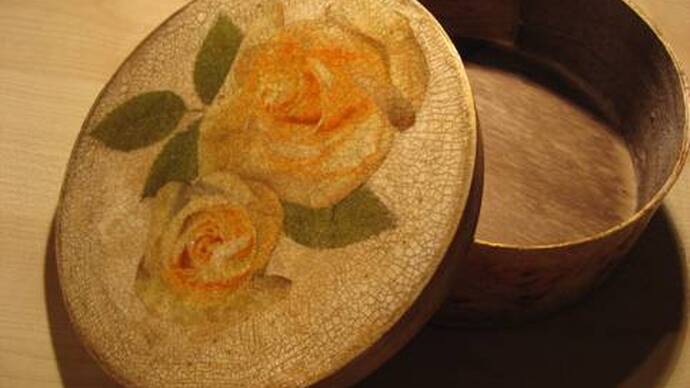
A Box in Vintage Style
Since I am very fond of vintage-style things, the decoupage or ageing technique on various wooden surfaces was a wonderful discovery. Now that the skill is in hand, I can make an antiqued box as a gift or simply for storing jewellery, of which every woman has no shortage. What follows is about the making process, the materials used and the result.
Since I am very fond of vintage-style things, the decoupage or ageing technique on various wooden surfaces was a wonderful discovery. I learnt decoupage skills at "Svētku darbnīca". Now that the skill is in hand, I can make an antiqued box as a gift or simply for storing jewellery, of which every woman has no shortage. What follows is about the making process, the materials used and the result.

Required:
- a natural unvarnished wooden box (any size and shape - round, oval, heart-shaped, square);
- decoupage paper or napkins with a floral (rose) pattern;
- special two-stage craquelure (lacquer) for wooden surfaces;
- water-based decoupage glue for the napkin technique;
- bitumen;
- gold paste for filling the ageing cracks;
- scissors;
- brush;
- a piece of foam;
- rubber gloves.

Where to buy? - At the shop "Marina" (Stabu Street 49a, Riga): decoupage paper (LVL 1.90 per sheet); napkins available individually (LVL 0.20 each); glue (LVL 5.99); craquelure (LVL 20.49); bitumen (LVL 4.70); gold paste (LVL 4.98). At "Tiimari" (shopping centres Spice, Alfa, Olympia, Origo): wooden box (LVL 1.25).
Step 1.
Cut roses from the napkin or decoupage paper strictly along the outline.

Step 2.
Glue onto the surface of the wooden box. Decoupage paper flowers should be briefly soaked in water and blotted with a napkin or paper towel before gluing. For napkin flowers, separate all the layers and use only the top one with the pattern.


After gluing the flower, a further layer of glue can be applied over the entire surface, making sure no unwanted wrinkles or unglued edges form anywhere.
Step 3.
Apply the step 1 craquelure and allow to dry. The impatient can use a hair dryer, just make sure there is no hot airflow concentrated in one spot.
Step 4.
Apply the step 2 craquelure and allow to dry again. Now you can watch as fine cracks form across the entire lacquered wooden surface.
Step 5.
Using a brush or piece of foam, work bitumen into the cracks. This makes the cracks and the ageing effect stronger and more visible. Bitumen can also be applied to the inside of the box to enhance the vintage authenticity effect.


While the box is not yet fully dry, gilded edges can be worked in - simply take gold paste and rub it in with a finger. This creates a finishing and luxurious effect.
Step 6.
Leave to dry naturally for at least twenty-four hours, or preferably 2–3 days. The smell of bitumen is quite strong, so it must be allowed to dissipate gradually.


Finally, place a gift inside the box - a handmade brooch, for example - and tie it with a transparent gold ribbon.
Enjoy both the result of your work and the joy of the gift recipient! :)


comments