An Introduction to the RigaBrain Method
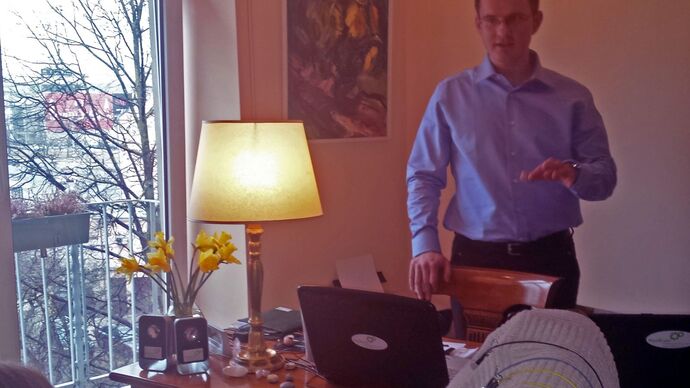
On a full-moon Saturday, at midday on 1 March, we headed to Brīvības Avenue to take part in a RigaBrain introductory event. There were 14 of us in attendance. After the talk, Pēteris took us to the adjoining room where the sessions take place. He showed us the chair, the sensors, the computer he works with, and assured us there was nothing unusual about any of it.
On a full-moon Saturday, at midday on 1 March, we headed to Brīvības Avenue 232–54 to take part in a RigaBrain introductory event. Although we had been following and reading about RigaBrain on social media, the decision to come was impulsive - we saw a post on Facebook and signed up by email the previous day. We didn't have to wait long for a confirmation; it arrived in our inbox within an hour. It also came with quite comprehensive information on where and how to find the place. There was also free parking on the street.
Initially, a little confusion was caused by the residential building, whose entrance is from the courtyard side and has no external signage indicating that RigaBrain is located there. We rang the intercom, were buzzed in, and climbed to the fourth floor, where we were warmly welcomed at the door of the flat by Pēteris Urtāns - the director of RigaBrain. An entirely ordinary flat in an entirely ordinary Riga neighbourhood, with the typical old multi-storey apartment layout. My feeling was that we had simply come to visit someone and forgotten to bring a cake, as we were about to be invited to sit at the tea table for an informal, friendly chat.
Several people had already arrived and were seated on chairs and a sofa in the room that doubles as a kitchen. To one side stood a desk with a laptop, a lit candle, five yellow tulips in a vase, printed handout materials and a cash register. Pēteris invited everyone to pour some tea or water and make themselves comfortable.
There were 14 of us in attendance - of varying ages and interests: a young couple, a family with a child, two female friends, sisters, one guy on his own, an older gentleman, a talkative woman, and the two of us. We started with introductions - each person said their name, how they had heard about RigaBrain, why they had come, and what they were looking for. Then Pēteris began talking about himself and why he had started all this. The pastel colour scheme of the room, a painting also in pastel tones - a still life with a vase and fruit - lit candles and spring flowers all lent a calm, settled mood.
What Is It?
Pēteris has been running training sessions for more than six years, holds a medical education with a specialisation in psychiatry, and has worked with people of all ages at the well-known institution on Tvaika Street and at the Dardedze Centre. That, at least for me, immediately inspired a certain respect - the man has a background. The method he applies in his sessions he brought from America, where he studied for a time. It is grounded in neurofeedback theory and practice.
The question that led Pēteris to this method: is there truly nothing better than drug-based treatment? And it turns out there is, and a quite effective one at that (approximately 80% of people feel positive, tangible results after a RigaBrain session; for the remaining 20%, the method simply is not suited to them).
The method is not new. Brain activity research has been conducted for quite some time and continues to this day, but in research institutes and accessible only to a narrow circle or for serious money. During the Soviet era in Jūrmala, such a method was used at the Partnov Institute; today it is popular across Europe, particularly in the Netherlands, as well as in America and Canada. In Latvia, Pēteris is currently the only practitioner, making it accessible to anyone interested.
How Does It Work?
A session lasts 1.5 hours, of which 33.5 minutes is the actual brain training. The client relaxes in a comfortable chair with four sensors attached to the head (one each on the left and right sides of the head, and two at the ears). The person listens to music or watches a film, in which occasional clicks appear in the audio and flashes of light in the image. These are produced not by a specially made recording or editing, but by the processes occurring within the person's own brain - which is why the diagram that appears on the computer monitor is different and unique for each person. After the first session, 2–3 weeks must pass, during which the person observes the changes that occur in them. During this time, alcohol and kvass should be avoided. For some, this one session is sufficient; others need to complete a set number of sessions.
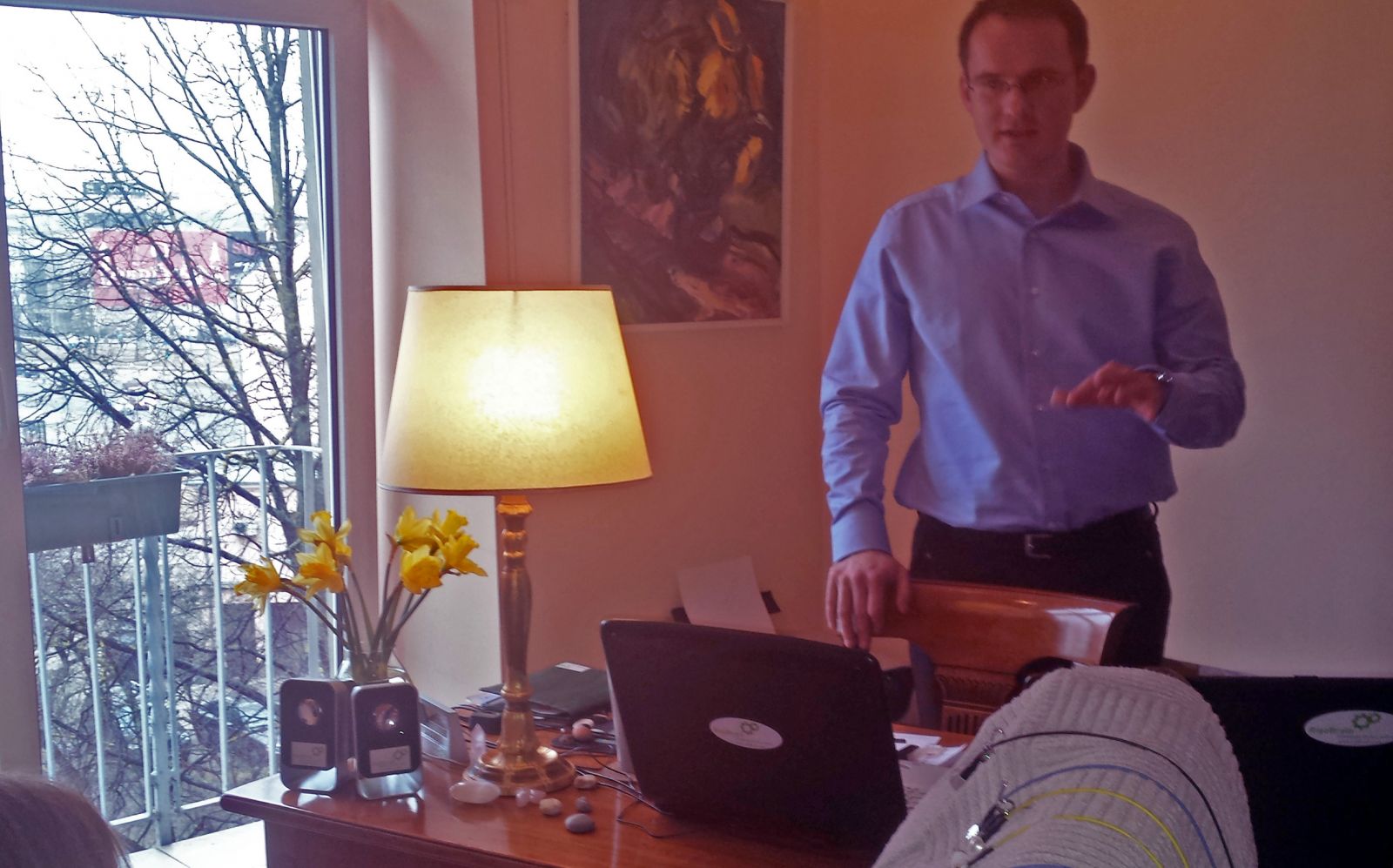
Later, after the talk, Pēteris took us to the adjoining room where the sessions take place. He showed us the chair, the sensors, the computer he works with, and assured us there was nothing unusual about any of it. I liked the large floor-to-ceiling window - through which I would definitely choose to look during a session. On the balcony, a bird feeder hung from a branch. I imagined a robin or a great tit flying in for a meal. In the middle of the room, a light wooden table with carved details, on it yellow narcissi in a transparent glass vase, two laptops and many various small stones. I recognised a kindred spirit in this arrangement - my own work desk looks very similar, with its spring yellow flowers, computer and self-collected snow-white pebbles.
On the right wall stood bookshelves, which - like the owner's body language and gestures - were open to the curious gaze of visitors. On the left wall, a few children's drawings from past visitors to the room.
I also liked a formulation from Pēteris's narrative: "The brain is a dynamic, chaotic and self-regulating system." The last part is especially important, because by working on oneself and observing the principles of brain hygiene, one can put a great deal in order inside one's head. Meditation and psychotherapy also help with this. On the other hand, if a person takes medications, the brain's self-regulation processes are suppressed.
Brain Hygiene:
1. Awareness (being conscious of the present moment, here and now).
2. Sleep (getting enough rest).
3. Nutrition (and also drinking plenty of plain clean water).
4. Exploration (at least once a week, engaging in something that captivates you so completely that you lose track of time and space while doing it).
5. Physical activity (blood supply to the brain).
6. Communication (and in person at that, not via Skype).
What Affects Brain Function?
We all exist somewhere on a spectrum between schizophrenia and complete peace of mind and clarity of thought. Brain function can be affected by:
• Various traumas. Moreover, the consequences of a concussion are usually not felt immediately, but rather 15 or even 20 years later.
• Intoxication, i.e. various inflammations.
• Stress. Most worrying of all are those people who outwardly appear very cheerful and happy, but whose brain rhythms are chaotic. For such people, there will come a moment when just one more drop will be enough for them to break or snap. Holding oneself together while a completely opposite set of feelings rages within consumes an enormous amount of energy.
• Prolonged uncertainty. As a result, the subconscious begins to deceive us, and objective assessment of the situation simply disappears.
Why Were We There?
Unlike Ēriks, who came to the meeting guided by scientific scepticism, I wanted to understand - or rather, to intuitively sense - whether Pēteris is the kind of person in whose company I would feel comfortable and safe, and would be open to yet another process of self-discovery and personal growth. Being able to sense whether I can trust a particular person matters to me.
An equally important keyword for me is "stress" - of which there is quite enough in daily life. Reducing anxiety and finding balance - that too matters to me. The method offered by RigaBrain could be one way to achieve it (at least the articles posted on the website suggest as much).
P.S. I wrote this article on the very same day, but deliberately did not publish it on the blog, as I wanted first to experience the effect of a RigaBrain session for myself (or rather, on my own head).
To be continued…
comments