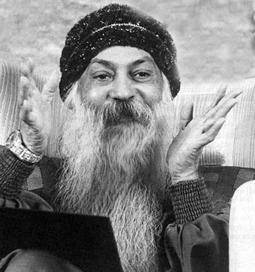
The OSHO Teaching
Osho said that he had been "the guru of the rich", for only the (materially) wealthy person is the poorest, and only such a person comes to find answers to the unsolvable problems of life, because there is nowhere left to go. A poor person still has so much to do, so much to achieve, so much to become. Who is interested in philosophy, theology, art? All that is too much for them. His followers have developed Osho meditation-based programmes for stress management, which they have also successfully sold to companies such as BMW and IBM, generating considerable profit.
The founder of the OSHO teaching is Acharya Rajneesh. Born on 11 December 1931 in India, in a small village. During his lifetime he changed his name several times before adopting the name Osho in 1980.
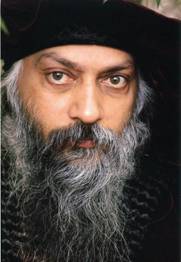
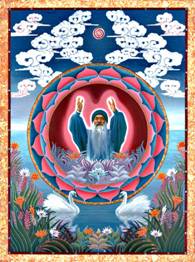
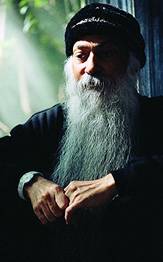
The OSHO teaching inherits very greatly from Buddhist philosophy. After all, the author himself also comes from India. The goal of this teaching is a free and happy person. It declares a struggle against prejudices, false societal values, bureaucratic states, bureaucratic church faith, and families not grounded in spiritual values. Meditation is the means to achieving these goals.
At the foundation of the teaching is the whole (undivided) person, who through meditation strives to explore their self, their Ego. To explore fear, weakness, boredom, jealousy, joy and love. Through this exploration, the Ego becomes unnecessary. Freed from the Ego, the person is capable of discovering the highest revelation - bliss. Upon realising bliss, the person merges with it and now there is no longer a person either, but rather a unified whole.
Osho believed that a person is for the most part unhappy because of their Ego. It is precisely the Ego in tandem with the mind that is what makes a person ambitious, miserly, driven, sensual and aggressive. If all this energy were released, there would be enough of it to attain bliss. There is a certain difference between joy, happiness, satisfaction and bliss. The accent is placed on bliss, because all the preceding states are more or less connected with the physiological and the Ego and are transient.
Buddha says: "There is satisfaction, and there is bliss. Renounce the first to gain the second."
Osho said that he had been "the guru of the rich", for only the (materially) wealthy person is the poorest, and only such a person comes to find answers to the unsolvable problems of life, because there is nowhere left to go. A poor person still has so much to do, so much to achieve, so much to become. Who is interested in philosophy, theology, art? All that is too much for them.
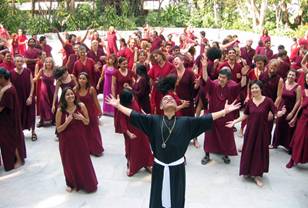
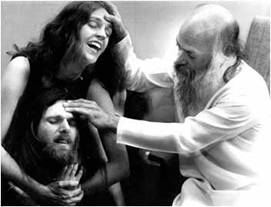
An essential component of the OSHO teaching is meditation, which is not merely an exercise. It is a process, complete awareness and being awake. Unlike other meditation techniques, Osho employs various methods and means - sound, noise and even dance. Various meditation techniques have been developed - active meditation, and the Osho Dynamic Meditation, which is the most popular today. It consists of five stages. For the first ten minutes the person breathes rapidly through the nose. In the next ten minutes expression takes place - "Let everything that must happen, happen", i.e., laughter, shouting, jumping and clapping. Whatever one feels at that particular moment. In the next ten minutes the person jumps up and down with raised arms, calling out "Hoo!" each time they land. In the following minutes, in the so-called silent stage, the person freezes, remaining static for fifteen minutes while being aware of everything that is happening to them. In conclusion, fifteen minutes are spent in dance.
His followers have developed Osho meditation-based programmes for stress management, which they have also successfully sold to companies such as BMW and IBM, generating considerable profit.
Osho himself did not write books. He either dictated books, or they were written up as Osho's conversations with some group or individual. Various contradictions are observable in the teachings.
To which Osho himself replied: "My friends are puzzled: 'Yesterday you said one thing, but today already something different. Which should we listen to?' I can understand their confusion, for they grasp only the words. In my eyes, conversations have no value whatsoever - value lies in the gaps between the words. Those do have value. Yesterday I opened the door using one set of words, today I do it using another. That gap between the words - that is what matters to me. The door can be of wood, gold, silver; it can be adorned with leaf and flower ornaments. Regardless of what the door is like - that does not matter. Only the open door, that gap, has value. For me, words are merely an instrument that helps to open the gap."
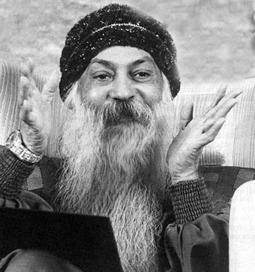
Osho was not an adherent of any systems or rules, yet in answer to a journalist's question he formulated ten commandments:
1. Never follow anyone's guidance unless it accords with your own;
2. There is no God, unless it is life itself;
3. Truth is with you - do not seek it elsewhere;
4. Love is the prayer;
5. Becoming nothing is the door to truth. Nothingness itself is meaning, goal and achievement;
6. Life is here and now;
7. Live awake;
8. Do not swim - float;
9. Die every moment, so you can be new every moment;
10. Do not seek. That which is - is. Stop and see.
Osho wished that after his death a new "living" teacher would be found, but this was not done. Followers established countless Osho centres in various parts of the world (Osho International Meditation Resort). The most famous of them is located in Pune, India.
Osho's attitude toward AIDS was peculiar. The teacher himself explained it as follows - the body obeys the mind, and if the mind has no desire to live, it gives the body a command. AIDS is not an ordinary illness in its classical sense; it is the body's inability (unwillingness) to fight its destroyer. For this reason those infected with HIV are denied entry to Osho centres. [3]
[1] OSHO Joy, Happiness Within You; The Key to a New Perception of Life, Sētava – 2008
[2] Osho; http://en.wikipedia.org/wiki/Osho
[3] Aids: An Existential Disease? http://www.osho.com/Topics/TopicsEng/AIDS.htm
comments