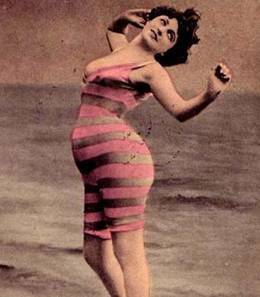
The Swimsuit Through the Ages
During the Jomas Street festivities on 5 July, we also wandered into the Jūrmala City Museum, where an exhibition dedicated to the history of the Jūrmala and Ķemeri resorts was on display. The most amusing items there seemed to be the old swimsuits - in faded colours, definitely one-piece, with little frills and made from stretchy knitwear. Those black-and-white ones with thick horizontal stripes were simply in a class of their own. :) This sparked an interest in learning more about the history of the swimsuit.
During the Jomas Street festivities on 5 July, we also wandered into the Jūrmala City Museum, where an exhibition dedicated to the history of the Jūrmala and Ķemeri resorts was on display. The most amusing items there seemed to be the old swimsuits - in faded colours, definitely one-piece, with little frills and made from stretchy knitwear. Those black-and-white ones with thick horizontal stripes were simply in a class of their own. :) This sparked an interest in learning more about the history of the swimsuit.
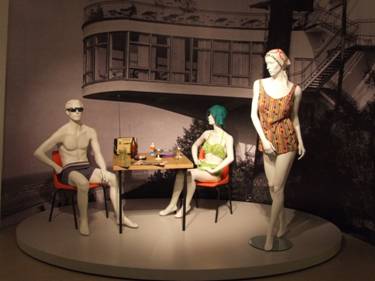
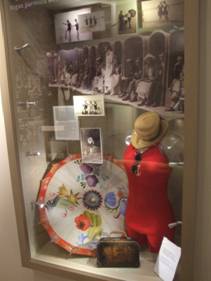
From the Jūrmala City Museum exhibition - Soviet era and the 1930s.
It turns out the Jūrmala City Museum holds the largest swimsuit collection in Latvia - twenty women's, two men's and one child's swimsuit. The majority of these exhibits date from the 1920s–30s, with a comparatively smaller range from the Soviet era. A true rarity are the men's blue swimming trunks from the 1960s–70s.

Such a retro swimsuit can be purchased in the souvenir shop next to the museum.
The earliest records of bathing attire come from ancient Egypt, where frescoes several thousand years old found at Wadi Sora show ladies dressed in costumes resembling modern bikinis. Swimming was also practiced in ancient Greece and Rome, but this was followed by a lengthy pause spanning several centuries. For a long time water, especially the sea, repelled people as a hostile element. Water was considered a dangerous substance because it could seep in everywhere, and bathing was regarded as hazardous to health. The change in attitude came only during the Age of Enlightenment, in the late 18th century, when the development of the natural sciences also changed attitudes towards hygiene standards and what constituted a healthy lifestyle. The first resorts appeared in Europe, including on seacoasts. Spending the summer by the sea was fashionable and signified that such a leisure enthusiast belonged to high society and was educated.
Around 1800, special attire for seaside promenades came into fashion in Europe and the ladies' swimsuit became more elaborate and refined. Instead of a shift, ladies chose a bathing dress that was long and little different in cut from everyday wear, only the fabrics used were usually light and airy. The bathing dress was complemented by a bonnet, long gloves and fabric shoes. In the mid-19th century ladies desired to move more freely in the water and the swimsuit changed radically - it became two-piece: voluminous long trousers narrowing at the ankle and a coat-like dress down to the knees. Towards the end of the 19th century the trouser length shrank to the knees, while the jacket extended only to the hips. In 1890 a "princess"-cut dress to the knees came into fashion, along with equally long trousers, stockings and ballet-slipper-style footwear with long ribbons tied crosswise. It must not be forgotten that ladies also wore a corset under the swimsuit. Voluminous hairstyles were protected from sea water by waxed wide-brimmed bathing caps. At the hem of the bathing dress, pieces of lead were usually sewn in - lest the wind, heaven forbid, flapping the skirt hem, reveal to strange eyes the hips and legs clad in the short trousers beneath. One can only imagine how well swimmers felt in garments that, weighed down with such ballast, pulled them downward. Moreover, swimsuits were usually made from woollen fabric, which when wet was already heavy enough.
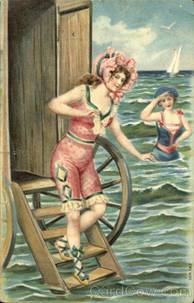

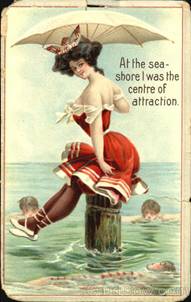
Depictions of bathing habits (one cannot call it swimming) in early 20th century postcards.
At the start of the 20th century a new type of swimsuit appeared - a sort of "unisex" one-piece jumpsuit-style bathing garment worn by both gentlemen and ladies alike. These swimsuits were usually sewn from striped wool or cotton jersey. After World War I, swimsuits with considerably shorter trouser legs came into fashion - ladies permitted themselves to bare their legs several centimetres above the knee. In the 1920s, gentlemen bathed not only in swimsuits but also in swimming trunks.
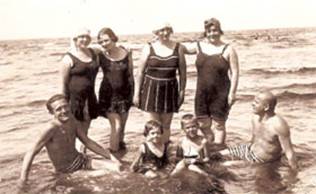
Jūrmala in the 1920s.
Bathing traditions and regulations at Rīga's Jūrmala differed considerably from the rest of Europe. Unlike England, France, northern Germany and Poland, where mixed bathing hours for ladies and gentlemen had been established as early as the late 19th century, our bathers - who were predominantly Rigans and, before World War I, very many summer visitors from Russia - were extremely conservative, and attempts to introduce mixed bathing hours ended unsuccessfully. Only in the 1920s were timidity and prejudices overcome. And as views began to emerge in the 1930s that sunlight and a tan were beneficial to health, two-piece swimsuits for ladies appeared, and here and there on the beach one could spot bathers enjoying "sunbathing".


1950s–60s.
In the 1940s, two-piece models became popular - a substantial bra top and longer shorts or voluminous skirt. Baring the thighs and midriff was still not accepted. In the 1950s, European women began wearing bikinis, although they were banned in several US states until as late as 1960. Particularly provocative was the strapless bikini demonstrated in 1953 at Cannes by the 15-year-old Brigitte Bardot. In the 1960s, swimsuit cuts became more sporty; the shorts resembled brief boy-style shorts with a lowered waistline. The trend of the 1970s was a small bikini or an asymmetrically cut one-piece swimsuit. In the 1980s, swimsuits became thin and close-fitting, as the highest virtue was a toned, athletic body that required no visual enhancement.



Modern bikinis.
In the 1990s, luminescent colours began to appear in swimsuit prints, and fabrics with a pearlescent, metallic or wet-look effect emerged. Swimsuit cuts became more feminine and sexy, and thong bottoms gained wide popularity.
Sources used:
http://www.muzeji.lv/resource/show/180
http://www.liepajniekiem.lv/lat/aktiva-zona/stils---mode/2008/06/10/no-garam-peldkleitam-lidz-stringa-biksitem/
http://www.liveinternet.ru/users/la_belle_epoque/post84326665/
http://www.letonika.lv/groups/?id=2438346&g=3&r=
comments