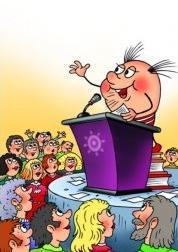
Antonija Apele "The Art of Public Speaking"
The book emphasises throughout that developing correct diction must be attended to from earliest childhood - neither rushing the child's voice development process nor encouraging the adoption of incorrect pronunciation patterns. With adults it is harder, as we do not need to learn to speak anew, but rather to break speech habits formed over years. And oh, how difficult that is!
The very recently published and quite widely advertised in the media (with endorsements from LNO director A. Žagars, journalist K. Streips, LTV news service head Dz. Kolāts and others) book by speech pedagogue Antonija Apele from Zvaigzne ABC publishing house also caught my attention. Moreover, lately I find myself speaking before audiences ever more frequently, so I decided it would be useful to read the advice of a professional.
 The book's title, however, led me to expect something slightly different in terms of content - for instance, how to conduct oneself correctly before an audience (body language), what to say or not say, what "gems" to use during a presentation and the like. Something similar I had heard in R. Gandapas's oratory masterclass. But no - this book is about the most fundamental basics: clear diction, correct breathing, exercises for the articulatory apparatus, the logical analysis of text, and the structure of speech. And it is entirely true that "one can persuade listeners only if they understand what is being said to them."
The book emphasises throughout that developing correct diction must be attended to from earliest childhood - neither rushing the child's voice development process nor encouraging the adoption of incorrect pronunciation patterns. With adults it is harder, as we do not need to learn to speak anew, but rather to break speech habits formed over years. And oh, how difficult that is!
It was also interesting to read the various text exercises, ranging from tongue twisters familiar since childhood - which in competition we would try to rattle off quickly just for fun - to texts that develop the pronunciation of a specific vowel or consonant. Here are a few of them:
Splash - suddenly by the puddle
A grey, puffed-up puffball burst.
The little mouse was quite terrified,
In panic hid beneath the fence-post.
Over the wide courtyard rose
Half a pood of grey powder.
Hissing, darting through the bushes, parting the undergrowth - the wind.
Swift with bundles and sharp clefts it tears the fibres apart.
An empty crossroads seems sad, foreign, dark, dreadful,
Here crosswise thawing splashes whistle past.
A sudden crack above slices the dark blanket open,
A bright spear of lightning illuminates the forest here.
(Exercise composed by Arnolds Liniņš)
On whirlwind steeds the devils ride -
In dark infernal cavalcades -
Sharp spits they fling and hurl about,
Threatening, frightening,
Running, hurtling in mad commotion,
Gallows-ravens greedily cawing,
Wind-wolves howling fiercely,
Cursing, raging,
Chasing dark spirits on their heels,
So that they may stand against the white light.
(Poem by Vilis Plūdonis)
A CD is also enclosed with the book, on which these text exercises have been recorded. I listened to it with pure envy. You know, there is something to aspire to!
Reading about diction, I noted one significant insight for myself - during speech one should not shy away from lively facial expressions, active lip movements or a wider opening of the mouth (i.e. a lower drop of the jaw), as all of this improves diction and makes it easier for the listener to understand us.
Incidentally, the book contains several examples of exercises for the lower jaw, lips, tongue and breathing, with illustrations and descriptions. I particularly liked the relaxation exercises for the muscles of the head, shoulders, arms and torso. Every speaker, before a public appearance, has felt greater or lesser bodily tension. At such a moment it seems that nerves and fear are completely paralysing all the muscles in one's frame, hands, legs and face. It is therefore very important to "shake off" this tension before going before the audience. For otherwise, no matter how much superhuman willpower one applies to concealing one's anxiety, body language will betray us.
Exercises, practice - and I would also add experience (frequent appearances), since a person is such a creature that, unfortunately, mostly learns only from their own mistakes. I fully agree with the author's statement: ".. not a single word of yours will have any persuasive power if you are not convinced of what you want to say, and do not know how to convey your conviction to the listener."
comments