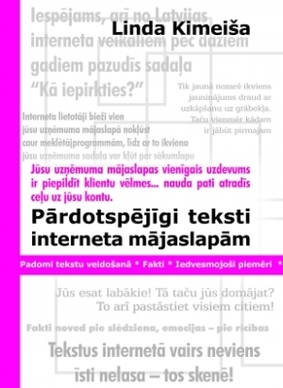
Sellable Texts for Websites. Linda Kimeiša (2013)
The book is easy to read, well-structured and full of key insights on building an effective website for commercial purposes. It is pleasing that such topics now appear not only as individual articles online, but are published as books in Latvian, by local authors themselves.
I first noticed this book, I think, on Una, where its launch event was mentioned. Then last week the display window of the Roze bookshop on Barona Street was entirely filled with copies of this book and a bright advertising poster. Hmm, so it is finally in wider sale. When I asked the sales assistant, she sent me down to the computer literature shelf in the basement. Why computer literature, when this is about writing and internet marketing?! Obediently I went downstairs, and now for 7 lats the book is mine.
The book can be read in one evening. Fairly large print and many black-and-white illustrations. A mere 126 pages. 0.055 lats per page. The price immediately brought to mind the best traditions of internet ad click purchasing. I liked that the illustrations are genuinely real examples from Latvian websites rather than some American success story retelling with little real connection to the Latvian internet user audience.
The book is easy to read, well-structured and full of key insights on building an effective website for commercial purposes. The advice is simple, understandable, but not always followed by website creators. I agree with the author that from the very beginning one must answer the question of why this site is needed - for presentation (as a business card) or for selling. Although, well, what isn't selling these days?! Everything, even the "business card".
Below is a free summary of the key insights from the book, with my comments in brackets:
- Internet users are interested in only three things - information, entertainment and value.
- Whether a website achieves its goal can be assessed by:
- growth in visitor numbers;
- number of purchases made;
- number of enquiries received or incoming calls (the old familiar story of lead generation);
- increase in time spent on the page and number of pages viewed;
- growth in visitor numbers from a specific region.
- 80% of a website's success is determined by its content (a debatable claim, but one wants to believe it - it sounds good, like a slogan).
- Text formatting matters (headings, paragraphs, links, bold, images, bullet points, etc.), because nobody reads texts on the internet any more (:() - they scan them.
- Underlined text is intended solely and exclusively for indicating links.
- Quality photographs, images and icons matter. Learn to communicate visually, using all known symbols and creating new ones - your own.
- On the internet, a personal communication style dominates; the address replaces the story.
- Consistent address throughout the website (if you started with "You" formal, do not switch to "you" informal - problems arise when the strategic content creators change within a single company).
- Know your target audience!
- Speak the same language as your client (I liked the example of the company "E=mc2" whose client replied "I want to play with a ball" :)).
- The sections "about us", "staff", "contacts", "client testimonials" have enormous importance in decision-making (for the first two mentioned I breathed a sigh of relief - at business seminars I had heard that a site does not need them at all). In the "about us" section:
- story plus image (1:1);
- why us, our advantages - the internet user needs to be spoon-fed (point by point);
- awards, prizes, certificates;
- team;
- management (not just contacts - a photo with a quote);
- history;
- publications;
- corporate identity;
- social responsibility: we support, we donate, etc.;
- testimonials.
- Testimonials "rock" (yes, testimonials "rock" - and not only on a website). By email or in conversation, ask the client simple questions: 1. Why did you choose to work with our company? 2. What did you like about our collaboration? 3. Would you recommend us to your acquaintances, friends, clients? Why? (A good recipe for getting a testimonial).
- The text "Welcome to our website!" is simply superfluous (full stop).
- Any section of a company's website can become the landing page, because internet users reach websites through various search engines (and content aggregators).
- An unwritten rule - no more than 7 items in the main navigation bar.
- Convince the user that buying this product or service will be the best decision of their day.
- Facts lead to conclusions, emotions lead to action; don't sell body lotion - sell silky-soft skin; don't sell insurance - sell security; don't sell advertising space - sell the opportunity to earn more and gain popularity.
- Call internet users to specific actions - buy, learn more, sign up for a consultation, reserve a table, contact a consultant, come to the store, try it, etc.
- Trust is built by - others' positive experience, the guarantee offered, completed projects or portfolio, free delivery, fast and reliable service (I would even say the consultant - the human factor plays a big role), a certificate.
- No more than four steps when making a purchase - ideally even three: choose, order, receive the goods.
- Advice or consultation at any moment - for example, a schematic or icon-based explanation.
- Regular content updates and additions - we are alive (I subscribe to that). What to write about:
- we have introduced a new service;
- we have received recognition;
- the team participated in a competition, seminar;
- the company is celebrating its birthday;
- the big sale has begun, etc.
- Creativity is remembered.
- In the 21st century - if you are not on the internet, you don't exist at all.
- Direct advertising and campaigns to targeted pages on your own site - landing pages.
- Think about search engine-friendly website content - page title, description, keywords, phrases, headings, links tied to the right keywords, etc.
- Google likes incoming links.
- An internet banner ad costs more and is less effective than a publicity article in which a user - better yet, a well-regarded public figure - talks about a given product or service (publicity).
- The magic words of communication: the right message to the right person at the right time and in the right place.
"It is worth bearing in mind that when navigating the labyrinths of communication, one must not lose faith in success, must stay flexible and try again." /Linda Kimeiša/
It is pleasing that such topics now appear not only as individual articles online, but are published as books in Latvian, by local authors themselves, who have "decoded" the advantages of successful online communication and do not hide their light under a bushel, but share it with others - which, unfortunately, is not so typical of Latvians.
comments