The Book of Ego. Osho (2010)
Attention is energy. When someone looks at you with love, they give you food - very refined food. [...] psychoanalysts make use of this need for attention, because a psychoanalyst is a professional provider of attention.
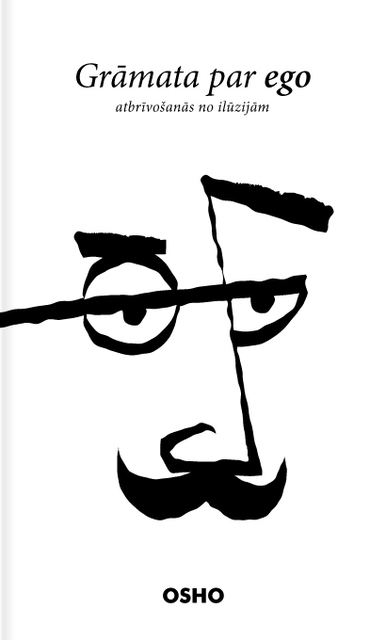
I bought this Osho book three years ago, choosing it by - however strange it may sound - its format and design. It is precisely with this book in hand that I imagined myself sitting on an aeroplane (books tend to get read on journeys). A compliment is due to the artist Toms Gūtmanis for the book's visual presentation. The black-and-white drawings and divider pages between chapters resemble a glossy gourmet magazine. Fitting for the central theme of the Ego.
 A stranger aspect still - it has never happened before - I read this book for a full three years: starting it, setting it aside, rereading it, marking the margins with exclamation marks, question marks, crosses and squiggles. Why? Firstly, "The Book of Ego" cannot be read lightly or superficially; one must periodically return to earlier sections to understand the contradictions that surface from time to time in Osho's texts. Secondly, I genuinely do not accept Osho's life philosophy, but I deliberately forced myself to read all his reflections, parables and teachings through to the end.
At a business seminar a coach made one thing clear: if there is something that irritates you in a particular person, provokes anger or intolerance, then quietly to yourself you must say: "Welcome, teacher!" For if you can deal with those negative emotions that a particular personality evokes, you will deal with one of the problems that torments you. But that is a digression from the topic.
Below I wish to share some insights or excerpts from the book that I found engaging.
• The human Ego (in the book's text it appears with a lower-case letter, but I will use the classical form) is the cause of all problems, all wars, disputes, jealousy, fear and depression. The Ego makes you wait - tomorrow, today you must suffer, sacrifice, so that you may rejoice tomorrow. But tomorrow NEVER comes.
• "Never borrow anything from others. Never use what has been taken from other hands. God loves people who are themselves. He does not love copies, clones. Be yourself, original, unique, individual, and solve difficulties with your own resources. There is only one thing I can say: the problem always contains its own solution." (chapter "Ideals", p. 41)
• Perfectionism is the cause of all illnesses.
• "I like this world because it is not perfect. It is not perfect, and that is exactly why it develops. If it were perfect, it would be dead. Development is only possible when there are imperfections." (chapter "Ideals", p. 54)
• "At the end of life, reputation and fame are of little importance; what matters is only how you lived each moment of your life. Was your life full of joy? Was it noble? Were you happy? When going for a bath, drinking tea, washing the floor, pottering in the garden, planting trees, talking with friends or sitting quietly with a loved one and gazing at the moon, or simply listening to the singing of birds... Were you happy in those moments? Was each such moment full of joy? Did it radiate? That is what matters!" (chapter "Success", pp. 62–63)
• Accept yourself as you are, for God has accepted you as you are.
• One and the same thing will never be of value again. For instance, Jesus as we know him from the Bible would today be old-fashioned, a lunatic unable to gather followers around himself. But God never repeats himself.
• In today's society, between words and money one can place an equals sign to power. Now it is not silence that is valued, but words - and the more words you speak, the more it pays off.
• Charisma lies precisely in the mind. The mind is in constant motion; it cannot be still. Peace or the mind - such is the choice.
• "Society wants to see you as copies, not originals." (chapter "The Mind", p. 92)
• ".. as soon as you are inspired by power and the awareness of its existence, this thirst for power will transform into a desire to govern yourself." (chapter "Power", p. 112)
• Saints have always feared women, which is why they condemned and suppressed them over several centuries. Women were thus stripped of all sources of competition, but one remained - their bodies. There, too, is the answer to why women always strive to appear attractive in men's eyes. The last bastion of power, before which many fall.
• Violence has great appeal, which is why identifying with action hero characters in films is part of contemporary life.

• "Individuality is neither man nor woman - it is simply one whole." (chapter "Therapy", p. 170)
• "Attention is energy. When someone looks at you with love, they give you food - very refined food. [...] psychoanalysts make use of this need for attention, because a psychoanalyst is a professional provider of attention." (chapter "Therapy", pp. 182–183)
• A meditation technique I found very engaging. The mirror effect - I see you. I only see you; I do not think. Does a mirror try to concentrate on something? No - whatever comes, it reflects. The mirror is indifferent. Meditation is simply awareness that reflects.
• Knowledge has value only when it is your own experience.
• "Such was Adolf Hitler's appeal. He was so fearless that he was absolutely certain. He never hesitated; he was completely convinced. And people who are uncertain in their very being immediately became deeply attached to this person. Here is a person who is so certain of his truth that he truly reaches it." (chapter "The Absence of Ego", p. 223)
• "Allow the world to reject or recognise you - it does not matter." (chapter "Enlightenment", p. 231)
• The difference between people lies not in possessions, but in possessiveness. A simple person is not someone who owns nothing, but someone who is not possessive. They never look back.
comments