In the Grip of the Stench. Events of a Sunday
Events of a Sunday around a suspicious service centre. A trader who has taken up residence in warehouse premises located next to a residential building has decided to carry out repair work on parts related to oil transshipment, which inevitably produces a terrible stench. The services are powerless.
Sunday began somewhat differently than usual. The usual morning routine, which is based on a late breakfast and browsing the latest news in print and online publications, was replaced by a conspicuously striking commotion in the courtyard of the apartment building. Although I did not pay particular attention to it initially, after another glance out of the window around noon, I noticed that state police representatives and a few other men - whose uniforms I did not recognise at first but who, as it turned out later, were firefighters - had joined the little group. I went down to find out what was happening.
The most interesting part I had missed, as in the early morning hours once again a smell of chemical substances had been detected - only this time not in the courtyard but accumulated in several stairwells of the residential building. Those who had come out into the courtyard and other curious onlookers also confirmed that in the early morning hours they had indeed smelled an extraordinarily caustic odour and, with good intentions, had opened doors and windows to air out the premises - thereby inadvertently destroying the evidence. The last stairwell remained untouched.
After a prolonged period of hesitation and phone calls, the State Fire and Rescue Service finally decided that measurements needed to be taken. To my own surprise, I discovered that the SFRS has measuring instruments which, although most likely imprecise, can nonetheless measure something. The firefighters were quite evasive in their comments about the results visible on the measuring device, only determining that it showed "low oxygen" and that one should wait a couple of dozen minutes. The curious little group, unable to wait for an answer, headed towards the SFRS vehicle. Instead of the hoped-for information about how good or bad everything was, they received the reply - the measuring device's batteries had run out (and there were no spare batteries). In the meantime, the state police who had arrived in response to the call had already left, and it appeared that the firefighters would have been happy to leave too. But what luck - the building's residents, not wanting the call-out to once again result in nothing more than a verbal statement of the facts, pooled together and purchased the necessary batteries themselves!
Needless to say, during this time - which lasted almost an hour - the stairwell doors and any available hatches and small windows had been left open, which inevitably aired out the premises and reduced the concentration of the unknown substance to a level that could be called harmless, leaving only a faintly detectable odour in the air. The firefighters, realising that the curious little group following them at every step was simply not going to calm down, communicated via radio with the "headquarters". Now we waited for the "headquarters" to arrive - which turned out to be a red minibus with two distinguished-looking men, apparently senior officers. So two crews, with similar-looking measuring instruments, entered the half-aired premises to take measurements. Credit where credit is due - they duly measured "something" at various locations, even in the kitchen sinks of the ground floor flats, to confirm or deny the suggestion that had been voiced, namely that the life-threatening substance might have entered the sewage system. The suggestion was not confirmed. The measuring instruments in other locations also showed the concentration of the unknown substance at an acceptable level. Out of curiosity, I asked whether the instruments were calibrated and generally capable of showing anything, and received a half-joking answer - yes, we tried it, put it inside a fuel tank, it shows something.
As no one wished to draw up any official records, a call was made to the rescue service and concerns were expressed that the services were preparing to leave without having established either the cause or extent of the contamination, nor did they wish to document the incident in any way. A moment later, the "headquarters" became more open and explained their observations and the limits of their competence, which as it turned out is limited to establishing the basic fact: whether it is life-threatening or not. As a precaution, the state police were called again, and a moment later also the municipal police. The uniformed men walked around the "potential" source of contamination (warehouse premises adjacent to the apartment building) and, within their competence, limited themselves to a commitment to include their observations in a service report. No protocols, no official records.
In the meantime, the SFRS representative called back - one whom I had seemingly already driven to the limits of patience in a previous conversation - and informed that the State Environmental Service had been notified, which has no inspector (!) who could be sent during a weekend (despite the recently acquired mobile air monitoring station, author's note), as well as the Riga City Council duty service, which, naturally, also did not see fit to attend.
And so at 16:30 everyone parted amicably.
The Source of the Stench
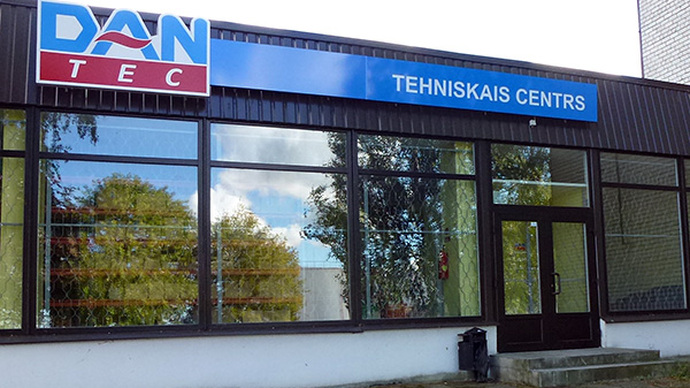
A suspicious service centre has been added to the potential stench sources in Sarkandaugava - which are oil terminals, Eko-Osta, and the ship repair factory in Vecmīlgrāvis. Having taken up residence in warehouse premises located next to a residential building, a trader has decided to carry out repair work on parts related to oil transshipment, which inevitably produces a terrible stench. None of the services - namely the state police - upon a repeat call-out considered it possible to establish either the company or the responsible person (wtf?), in order to carry out an inspection and, based on residents' complaints and the actual stench confirmed by the SFRS, halt the commercial activity.
On 3 September 2012, a week earlier, residents of the apartment building had complained about an unbearable stench. This fact was widely covered in internet news portals. As it was a working day, both the SFRS and police and SES attended. A horrifying picture emerged: next to the foundations of the aforementioned warehouse premises, pipes of various sizes with obvious oil contamination had been freshly buried, and despite being buried several centimetres underground, they produced a powerful stench. Moreover, the air monitoring station at 44 Tvaika Street also detected a significant concentration of benzene in the air, which exceeded the norm by 22 times. Although the monitoring station is located a considerable distance beyond the mentioned warehouse premises and most likely indicated contamination coming from the oil bunkers, the coincidence of several facts made it possible to identify yet another source of environmental pollution.
This time the situation is more distressing, as since 8 September the readings from the monitoring station at 44 Tvaika Street have not been available. The last reading, taken on Saturday at 9:00 in the morning, showed benzene concentration in the air exceeding the norm by 10 times. Several Riga City Council officials have been informed of the fact, including Nils Ušakovs, while Andris Ameriks writes on his Twitter profile:
The fact that you determine the amount of poison in a fly agaric
does not mean that this information will make it easier for you to eat the mushroom.
You can judge for yourselves what Riga City Council's and the state's attitude towards its residents is!
comments