The Social Portrait of N. Ušakovs and V. Dombrovskis
A study in which social portraits of two political forces - Unity and Harmony Centre - and their two most prominent political leaders were constructed on the basis of various publicly available parameters obtained from the social network Twitter.
A politician's popularity is largely determined by how many voters are willing to vote for them. Although social networks represent only one of all communication channels, let us look in and - guided by follower data - construct social portraits of two of the most prominent political forces (Unity and Harmony Centre) and their leaders (V. Dombrovskis and N. Ušakovs).
About the Study
The study used publicly available data on the followers of four Twitter accounts. Although Twitter does not contain parameters that characterise persons in depth - such as gender, age, etc. - this is an attempt, based on follower behaviour, to construct a detailed picture of what the average statistical follower of the profile in question actually looks like, which will indirectly characterise the profile owner as well.
The study also aims to prove or disprove various assumptions - for example, that a given profile is followed predominantly by "empty" followers who have not gathered a significant following of their own, and who show minimal social activity.
As a continuation of this study, the following could be explored:
- analysis of followers' social activity;
- analysis of the studied profile's activity;
- linguistic and sentiment analysis of the studied profile's activity;
The Study
1. How many total users follow the leader and the political force?
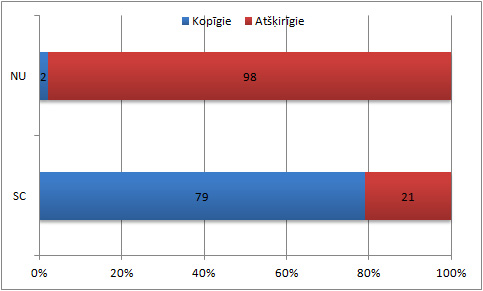
1.1. Nils Ušakovs and Harmony Centre
1.2. Valdis Dombrovskis and Unity
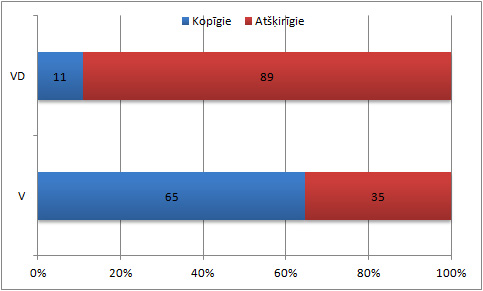
Conclusions: followers who choose to follow N. Ušakovs very rarely also follow Harmony Centre, while the reverse pattern is not observed. This split is less pronounced for Unity and its leader V. Dombrovskis. This suggests that N. Ušakovs is popular regardless of party affiliation.
2. What does a follower tell us about themselves?
Given that it was not possible to verify the accuracy of the information provided, a simplified technical analysis was used, determining how many words were listed in the description - assuming that two words indicates a First Name and Surname.
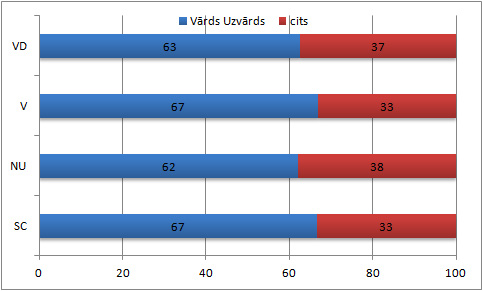
* x-axis values expressed as percentages
Conclusions: the data show that the most secretive followers belong to the leaders; slightly more open ones follow the political organisations. This suggests that anonymous users prefer to follow individuals rather than organisations.
3. What domain websites have followers listed?
Objective: to prove or disprove the assumption that left-leaning forces are followed predominantly by users living (or virtually living) in Russia.
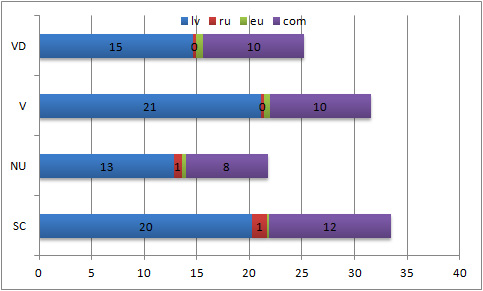
* x-axis values expressed as percentages
Conclusions: the data show that more users who chose to list an external resource are followers of organisations. A pronounced anonymisation of users is observed among N. Ušakovs' followers. The assumption that left-leaning political forces have more followers who listed a link to an external resource in the .ru domain was partially confirmed.
4. How many followers have followers of their own?
Objective: to prove or disprove the assumption that the large follower count of N. Ušakovs and V. Dombrovskis is explained by fictitious profiles (so-called "zeroes").
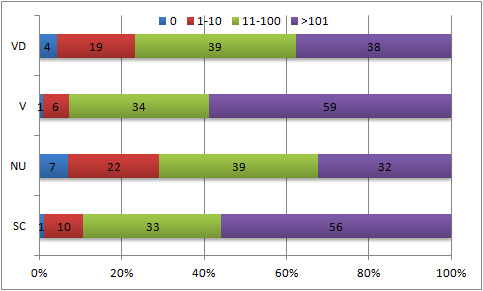
Conclusions: N. Ušakovs indeed has a considerable number (7%) of followers who themselves have no followers at all - in absolute terms, this amounts to 1,200. Political organisations, meanwhile, have a notable share of followers who themselves have more than 100 followers. This in turn raises suspicion that some followers follow everyone indiscriminately.
5. Follower activity by number of tweets posted.
Objective: similar to point 4
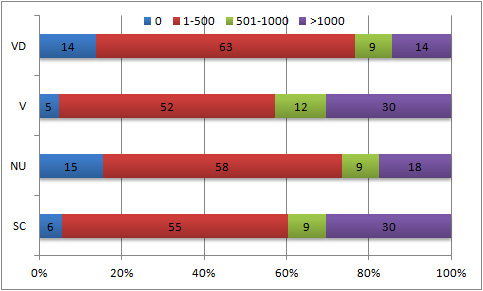
Conclusions: the data can be divided into two groups - followers who follow organisations and followers who follow individuals; those who follow organisations are considerably more active. By contrast, those who follow individuals are either more passive, or are newer users who have not yet had the opportunity to express their opinion to any significant degree.
6. When were followers' profiles created?
Note that it is not possible to obtain data on when followers began following any of the selected profiles.
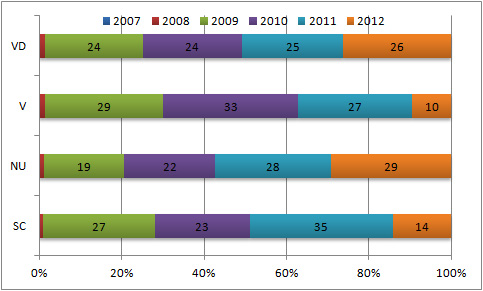
Conclusions: although Twitter was founded in 2006, it gained significant popularity among followers from 2008. A growth in new followers is observed for N. Ušakovs, while Harmony Centre experienced its peak Twitter popularity in 2011. The drop in newly created followers is most pronounced for Unity. The distribution for Unity's most prominent figure - V. Dombrovskis - is remarkably proportional.
7. What tools do followers use when writing tweets?
Objective: to prove or disprove the claim that followers of a given social account more frequently use iPhone or iPad.
Data were obtained by analysing followers' most recent posts, which only partially reflects users' habits in using various tools.
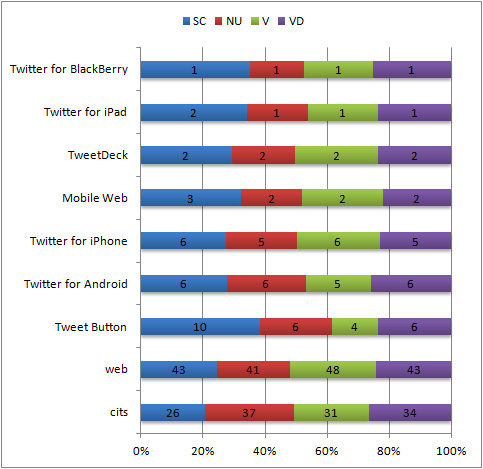
Conclusions: the data show that Harmony Centre followers use the Tweet Button considerably more - i.e. they share articles more often (possibly those relating to HC). Unity followers, by contrast, are less active in this regard, or the news sources they are interested in do not use Tweet Button technology on their websites. SC followers are seen to use a considerably wider range of tools when writing tweets.
8. How many follow both political forces?
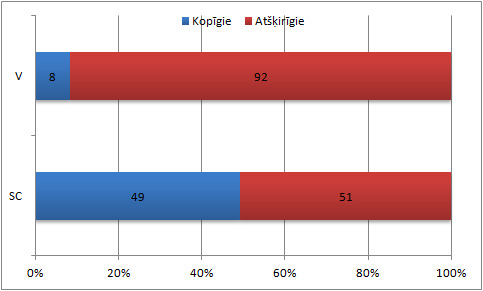
Objective: to prove or disprove the assumption from point 4, that there is a group of Twitter users who follow everyone indiscriminately.
8.1. Follow both Unity and Harmony Centre.
8.2. Follow both V. Dombrovskis and N. Ušakovs.
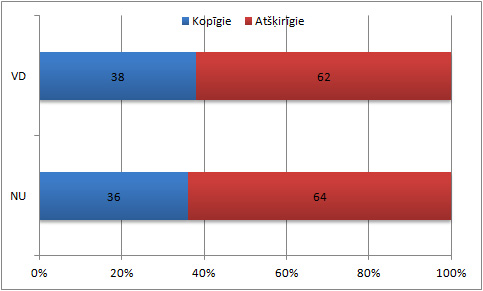
Conclusions: based on party followers, we can see that those who follow Harmony Centre also follow Unity, while the reverse tendency is not observed. Among the parties' most notable followers, such a difference is not apparent. 203 people follow all four Twitter accounts.
In Conclusion
The data used in this study were obtained on 27 October 2012.
| Following | Followers | Tweets | |
| NU | 459 | 17635 | 3378 |
| SC | 128 | 484 | 741 |
| VD | 307 | 16663 | 1329 |
| V | 608 | 2816 | 3162 |
It is a well-known fact that N. Ušakovs actively blocks followers - presumably those who ask uncomfortable questions about the work of the Riga City Council, the incompetence or carelessness of officials. The Riga City Council's view could not be established over the course of more than a month, despite repeated reminders.
comments