Croatia - Day 4
Travel diary, Day 3 - PULA, ROVINJ. And then it can no longer be described in words. Perhaps drawn, perhaps photographed, but most truthfully simply felt …
Travel diary, Day 3 - PULA, ROVINJ
The local guide Lari spoke enthusiastically about the beauty of the Istrian Peninsula and the many Croatian islands - 185 in total, of which only 62 are inhabited. That day we were able to fully savour the caressing rays of the southern sun and the turquoise, extraordinarily clear Adriatic water glittering within them.
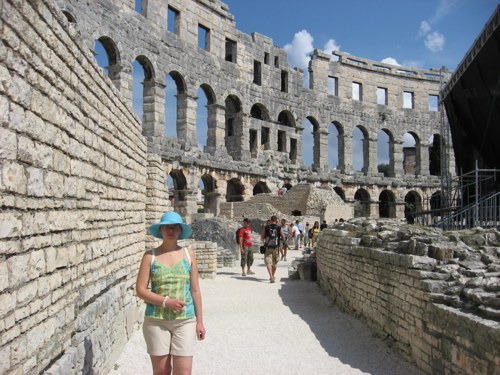
The first stop on the Istrian Peninsula was its largest city, PULA. It is centred around a hill on which a defensive bastion rises. However, it does not attract as much of the city's visitors' attention as the Roman amphitheatre, which according to Lari is the best preserved in comparison with those in Italy and Greece. This amphitheatre was built in the 1st century.
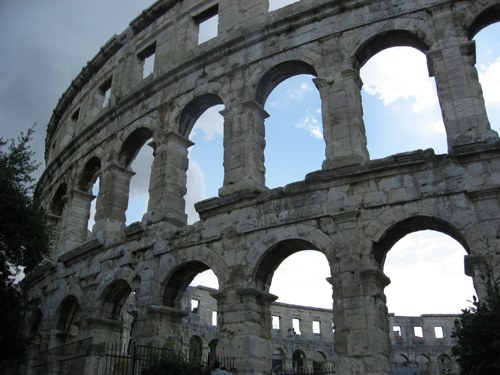
Indeed this ellipse-shaped structure tightly encloses within its walls a space with many tiers of steps. A magnificent venue for organising various concerts and performances.
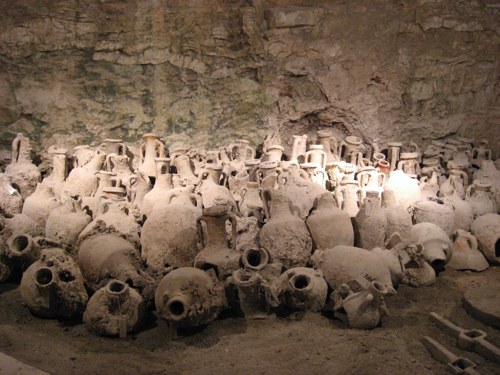
In the basement beneath the amphitheatre a museum has now been set up, where countless amphorae can be viewed, as well as tools for pressing olive oil. The archaeological museum is named "The Traditions of Wine and Olive Growing in Istria in Ancient Times."
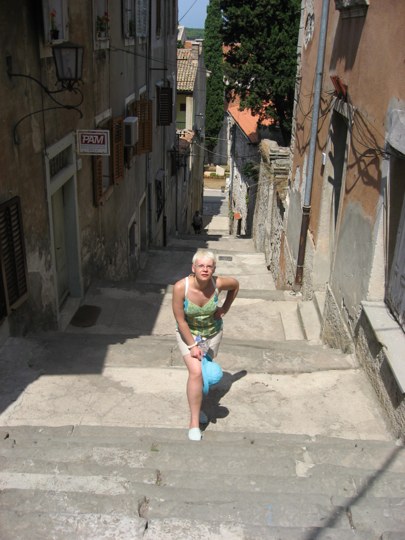
The old town is beautiful with its ancient narrow alleys, which either lead upward to the hill or wind their way down.
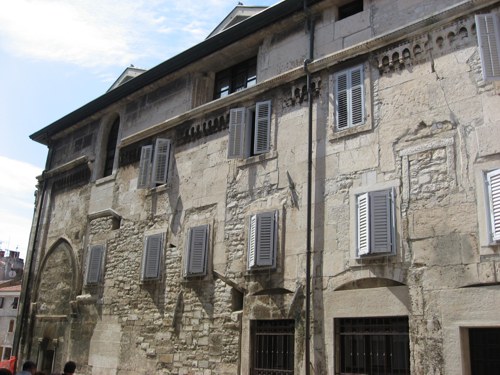
Also to be seen here are many structures from the Roman era - the Arch of the Sergii, the Temple of Augustus, as well as buildings that caught my attention with their greyish, seemingly understated wall plaster, small windows and the many shutters on their facades.
The next little town, ROVINJ, earned my admiration even more, for in addition to its antiquity and the playfulness of its narrow alleys, colourfulness was added. This has evidently developed under the influence of two cultures merging - Croatian and Italian. Not for nothing, when I purchased from a street vendor a seashell carefully shaped and smoothed by the sea waters, I heard "Grazie Signora."
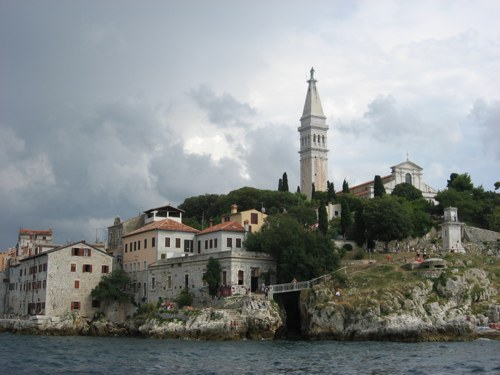
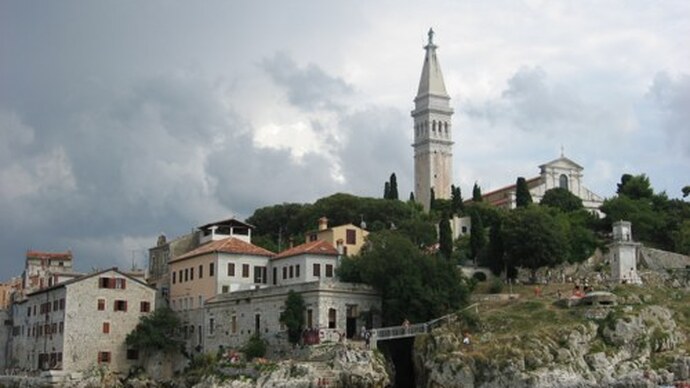
Originally it was an island that over time became a peninsula. ROVINJ has nonetheless partially retained its circular form with rocky shores, house walls that seem to rise straight from the water's surface, and the hill on which it stands. At the highest point rises the Church of St. Euphemia.
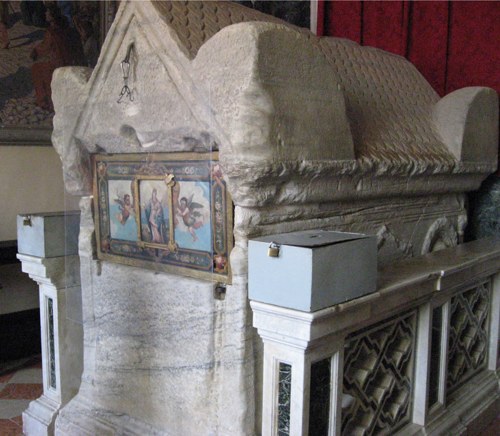
The legend of this saint tells that she was born in Chalcedon near Constantinople. Euphemia was a Christian, was pursued by Roman legionaries, captured, and thrown to lions to be torn apart. She died on 16 September 304, and her mortal remains were placed in a stone sarcophagus. Then a miracle occurred - this heavy sarcophagus travelled across the water's surface to Istria and was washed ashore at Rovinj on 13 July 800. The people took this as a sign from God and built a church on the hilltop, where the sarcophagus was placed (see photograph). Euphemia is now the patroness of Rovinj. Visitors to the church can also view the wall paintings, which depict two main scenes - the tearing apart of a girl with long blonde hair in a Roman arena, and the sarcophagus being washed in from the sea.
I have been to several European churches that amaze with their splendour, gilded altars, wall paintings, and stained glass, but this one was wondrous for the distinctive light that flowed not from the side windows but seemingly from the ceiling. The sacred feeling was heightened by the magnificent acoustics and the powerful sounds of the organ. Incidentally the organ was positioned not opposite the altar, above the entrance, but behind one of the arches near the main altar.
A symbol placed above the altar that drew attention - a fish whose scales are arranged in the shape of an eye. As is known, the fish is a symbol of Jesus. The divine eye.
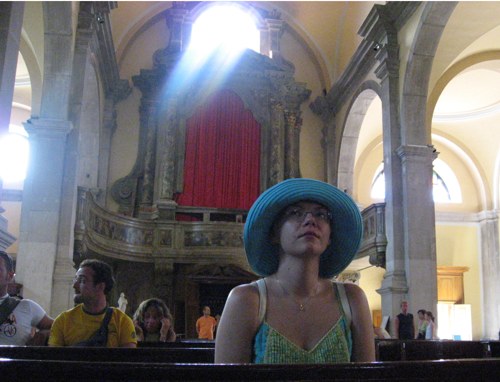
At that moment it felt as though one could wander endlessly through ROVINJ's narrow alleys, for at every moment real paintings open before the eye - garden walls, small windows, steps, the white cobblestones polished by the shoes of passers-by. How does one manage here in rainy weather? Even now one's shoe heels slip suspiciously and one must grasp the arm of the person walking alongside.
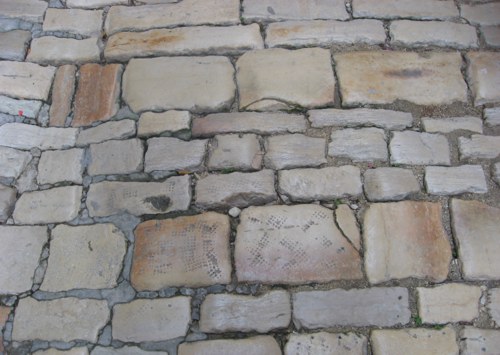
Everything so miniature, at once rough and cosy, grey and colourful. And then you understand - you are part of this little painting.
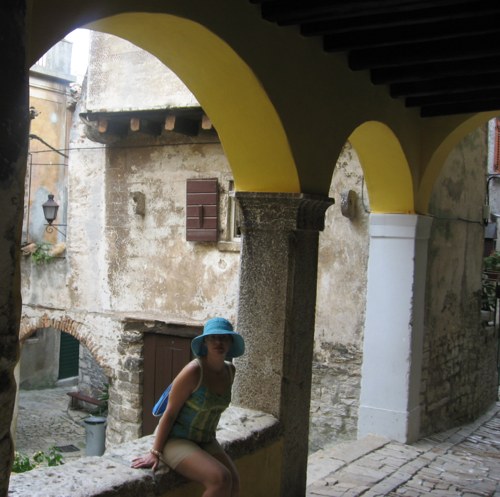
Between the houses water frequently glints. In essence we are surrounded by it and by a labyrinth of stone structures.
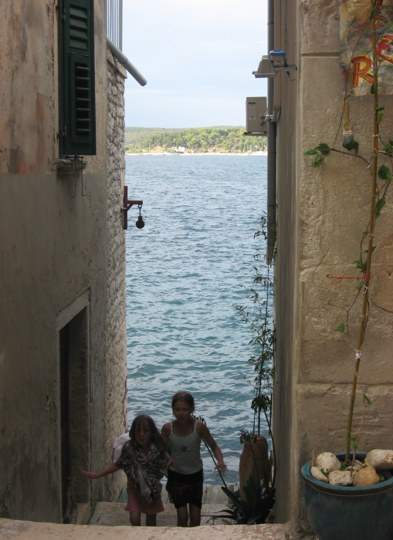
Where do these steps lead, this narrow alley? What is hidden behind the brightly green shutters?
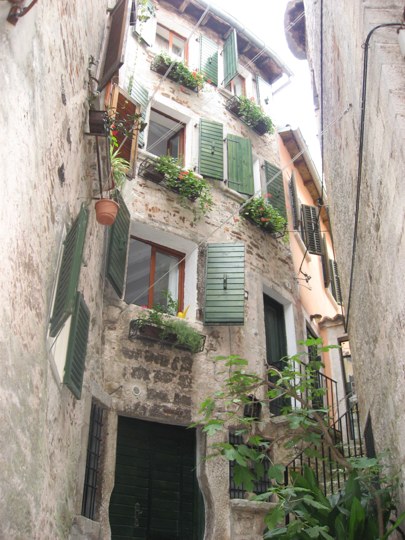
And then it can no longer be described in words. Perhaps drawn, perhaps photographed, but most truthfully simply felt …
The first stop on the Istrian Peninsula was its largest city, PULA. It is centred around a hill on which a defensive bastion rises. However, it does not attract as much of the city's visitors' attention as the Roman amphitheatre, which according to Lari is the best preserved in comparison with those in Italy and Greece. This amphitheatre was built in the 1st century.
Indeed this ellipse-shaped structure tightly encloses within its walls a space with many tiers of steps. A magnificent venue for organising various concerts and performances.
In the basement beneath the amphitheatre a museum has now been set up, where countless amphorae can be viewed, as well as tools for pressing olive oil. The archaeological museum is named "The Traditions of Wine and Olive Growing in Istria in Ancient Times."
The old town is beautiful with its ancient narrow alleys, which either lead upward to the hill or wind their way down.
The next little town, ROVINJ, earned my admiration even more, for in addition to its antiquity and the playfulness of its narrow alleys, colourfulness was added. This has evidently developed under the influence of two cultures merging - Croatian and Italian. Not for nothing, when I purchased from a street vendor a seashell carefully shaped and smoothed by the sea waters, I heard "Grazie Signora."
Originally it was an island that over time became a peninsula. ROVINJ has nonetheless partially retained its circular form with rocky shores, house walls that seem to rise straight from the water's surface, and the hill on which it stands. At the highest point rises the Church of St. Euphemia.
The legend of this saint tells that she was born in Chalcedon near Constantinople. Euphemia was a Christian, was pursued by Roman legionaries, captured, and thrown to lions to be torn apart. She died on 16 September 304, and her mortal remains were placed in a stone sarcophagus. Then a miracle occurred - this heavy sarcophagus travelled across the water's surface to Istria and was washed ashore at Rovinj on 13 July 800. The people took this as a sign from God and built a church on the hilltop, where the sarcophagus was placed (see photograph). Euphemia is now the patroness of Rovinj. Visitors to the church can also view the wall paintings, which depict two main scenes - the tearing apart of a girl with long blonde hair in a Roman arena, and the sarcophagus being washed in from the sea.
I have been to several European churches that amaze with their splendour, gilded altars, wall paintings, and stained glass, but this one was wondrous for the distinctive light that flowed not from the side windows but seemingly from the ceiling. The sacred feeling was heightened by the magnificent acoustics and the powerful sounds of the organ. Incidentally the organ was positioned not opposite the altar, above the entrance, but behind one of the arches near the main altar.
A symbol placed above the altar that drew attention - a fish whose scales are arranged in the shape of an eye. As is known, the fish is a symbol of Jesus. The divine eye.
At that moment it felt as though one could wander endlessly through ROVINJ's narrow alleys, for at every moment real paintings open before the eye - garden walls, small windows, steps, the white cobblestones polished by the shoes of passers-by. How does one manage here in rainy weather? Even now one's shoe heels slip suspiciously and one must grasp the arm of the person walking alongside.
Between the houses water frequently glints. In essence we are surrounded by it and by a labyrinth of stone structures.
Where do these steps lead, this narrow alley? What is hidden behind the brightly green shutters?
comments