Pinocchio's Ashes
This evening, thanks to two invitations won in a Twitter draw, we attended the Latvian National Theatre to see Viesturs Kairišs's new production "Pinocchio's Ashes". Initially after watching the performance I thought I would not be able to write anything about this work - it was too emotionally oppressive - but now I simply want to talk through this heaviness.
This evening, thanks to Twitter draw invitations, we attended the Latvian National Theatre to see Viesturs Kairišs's new production "Pinocchio's Ashes". Initially after watching the performance I thought I would not be able to write anything about this work - it was too emotionally oppressive - but now I simply want to talk through this heaviness. The production, made from the work of Danish writer Jokum Rohde, depicts a situation where throughout the entire country and specifically in one city it is by law forbidden to engage in art, and any artistic expression is punished and artists are tried without even going into the substance of the matter - alles klar und wunderbar!
The production consists of two parts, where in the first the tragedy of the adopted political decision is sketched - books are improvised as being burned, a hand is cut off. A poignant humour flickers through, with actors as if accidentally uttering phrases heard from the mouths of the Latvian political elite that have now become part of folk tradition. Taboo themes are touched upon - sexual perversions, incest, a child's murder. The second part becomes ever heavier, deaths and blood accumulate, murders follow one after another. Finally the judge Wolf, having realised the terrible mistake and torn by his inner contradictions and fears - he himself secretly writes poetry while punishing artists with death - submits to a conscious murder, thereby creating the possibility for culture to be reborn and for the oracle to begin speaking again.
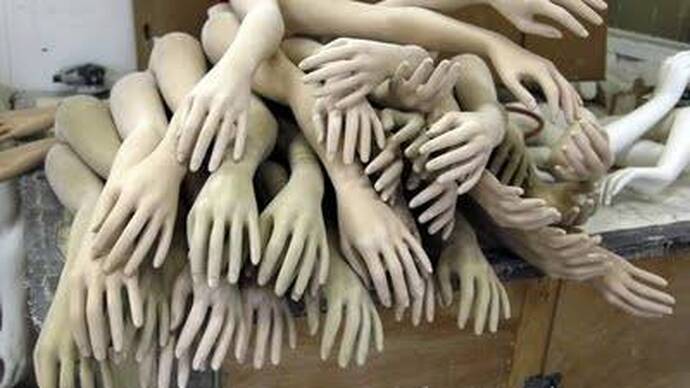
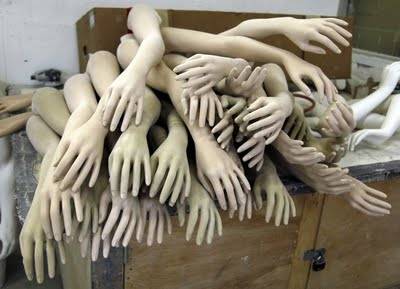
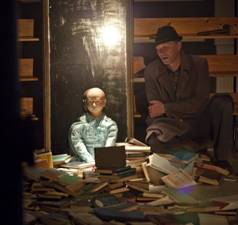
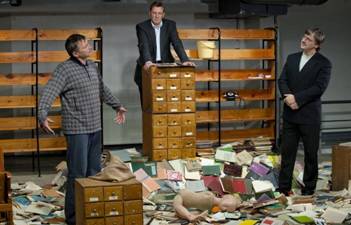
When selecting an image for this article I still did not want to use the books chaotically scattered across the floor, upon which the actors moved - treading them underfoot, flinging them, "burning" them, thus depicting the process of destroying culture and art - nor the photograph that appeared in all press releases advertising this production. I chose these mannequin hands which, in my opinion, symbolise the hands of artists severed from their bodies, and the hand of one of the production's characters, Werner Brown (Jānis Reinis), cut off when he had passed himself off as a talented artist who made a puppet.
On the whole a postmodern work, saturated with quotations, references, and historical allusions. Each viewer can take as much as their store of knowledge allows, yet still not feel shortchanged. The actors' performances are very emotional, realistic, and professional, not for a moment causing doubt that any of the events might be just a very dark All Souls' Night fantasy. Olga Dreģe portrayed conditionally three characters: Miranda - Werner's mother, the voice of a little girl and Karola Sørensen's (Daiga Kažociņa) daughter, an oracle capable of hearing the most hidden dreams, thereby foretelling future tragic events. Acting true to the bone.
The production plays out what are as if three states of matter - the artist or craftsman, the puppet he has made, and its ashes. Many atrocities and murders are committed, bodies float down the river. To solve the puzzle of the seven bridges, one of the bridges is burned, showing that an obstacle can be removed trivially by destroying its creator - a person, a reality, or a cultural stratum. A historically well-known reference - no person, no problem.
The play's director Viesturs Kairišs himself says of the production and its artistic mission: "In Latvia, terror against culture has begun at the state level. The people sinking in the economic crisis support it, seeing in culture a mystical enemy whose destruction will rapidly improve life. The theatre is a battlefield in which every individual becomes responsible for their own choice in this struggle. Perhaps this is a historic opportunity for rebirth?".
I recommend going and watching it, if you are not afraid of the heaviness that settles like a heavy block on the chest and accompanies one for a good while after leaving the theatre. Perhaps it is worth watching a second time to better perceive the nuances and all the quotations, to delve deeper into the story about the evil, animal, and unconscious in people, the incompatibility of the laws created by the state and by God, about power and its influence on the ordinary person. Personally I would not try a second time - too much blood flowing in the imagination in the dark auditorium, too much physical and mental humiliation and torment of people. Well, not a very pleasant aftertaste, but it spoke to me.
comments