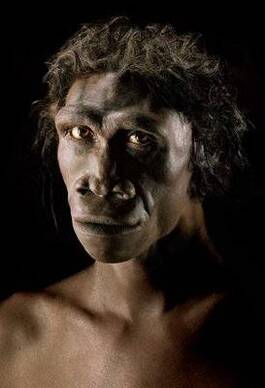
Production - Homo Erectus
Yesterday, on 17 April, we watched at the National Theatre's New Hall a version of the play "Homo Erectus" (original title "Herniated Disc") by German playwright Ingrid Lausund (1964), in director Regnārs Vaivars's staging. "Homo erectus" or "upright man" - a theatrical dissection of how this concept applies to the modern office worker who spends most of their life hunched over a computer.
Yesterday, on 17 April, we watched at the National Theatre's New Hall a version of the play "Homo Erectus" (original title "Herniated Disc") by German playwright Ingrid Lausund (1964), in director Regnārs Vaivars's staging. "Homo erectus" or "upright man" - a theatrical dissection of how this concept applies to the modern office worker who spends most of their life hunched over a computer.
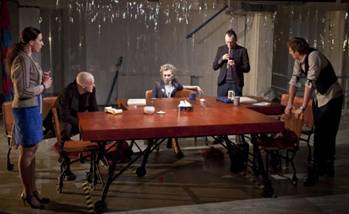
The basis of the production was an imaginary office micromodel. Five employees work in the office, three of whom are men (played by Ģirts Liuziniks, Gundars Gransbergs, Artūrs Krūzkops) and two women (played by Līga Vītiņa and Marija Bērziņa). The direction of work is unknown, but the activity takes place entirely at the computer. Work proceeds at one shared table. And of course with the indispensable attributes of any office - coffee, chairs on wheels, etc.
Each imaginary office employee is in their own right a personality with their own demands, character, positions, and of course weaknesses. The production successfully accentuates human interaction - sexual desire, fantasies, fears, rivalry. Herd instincts are palpably and recognisably present.
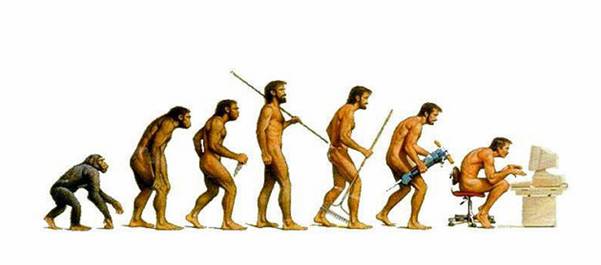
Homo erectus by definition is one of the steps in the human genus, apparently characterised by the ability to stand vertically. One might wonder - what is so special about that? It is an entire evolutionary step, because with the ability to move differently, both tools and daily life changed, and possibly mutual interaction too. The last claim, true, is my assumption - because when an additional degree of freedom arises and tools develop, it seems an inevitable situation that competition also develops, now no longer based on strength but on ingenuity and intelligence.
Be that as it may, in the production the human ability to stand vertically is shown as entirely superfluous. Because everyday work proceeds seated at, if not identical, then similar computers, and superficially observing one might think that all office employees are equal. But not at all.
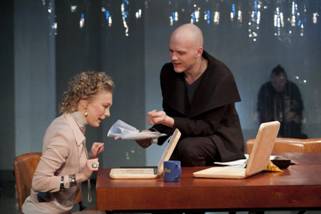
At the beginning of the production, a peculiar vision was offered of how this office and its employees might be seen by a being from the outside. Namely - on the earth's surface there is a temple with many caves and passages. In that temple are people who await a light-bringer, an aircraft, which will surely arrive and bring them light. This light-bringer they lure with incessant and monotonous tapping of fingers.
The production could be watched in two ways - as a satire with a subtle (well, at times, not so subtle) dose of irony, or as a carefully considered analysis of office work. Throughout the production I tried to discern that second dimension - which, it must be said, was not easy, because the lively and contemporary manner of the actors' speech with apt epithets, as well as the situation being played out, genuinely resonated with everyday experience and its analysis. That there would be something more in the production I understood right at the beginning, because the production booklet, prepared in good time and diligently studied in every detail thanks to its laconic content, and...
- the production team especially thanks psychotherapist Māris Siliņš.
If one tried to "tag" the episodes seen in the production, it would yield - fear, sexual drive and frustration, uncertainty, rivalry, hatred, boss, team, pain, tolerance, selfishness, courage, etc.
What I gained from this production:
- The driver of progress/regress is the individual's inner complexes and the desire to satisfy them.
- The collective chooses the individual, not the individual the collective.
- The collective is a unified energetic unit, in which its smallest particle can wreak a good deal of havoc.
- The individual's problem becomes the collective's problem. Even the privilege of falling ill is perceived as a threat to the collective's integrity. Let alone pregnancy or other long-term afflictions.
- The statement "As long as I'm all right" is activated only in cases of the individual's psychological anxiety. Perhaps sexual tension too?
- A bipolar character can be ascribed to the collective, where one pole is relations based on love and mutual respect, the other - relations based on the transactional principle.
- The boss is also a human being.
comments