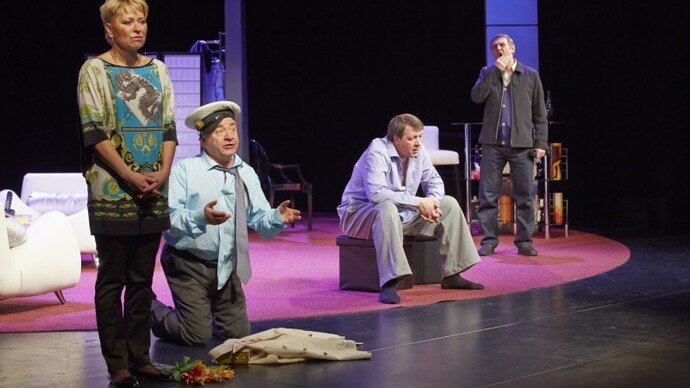
ПУТНИКИ В НОЧИ - At the Riga Russian Theatre
A story about two people who have lived together for twenty years, but have suddenly realised that the spark of love between them has faded. Both one and the other are looking for casual affairs or relationships that would bring vitality to their now settled, financially and otherwise stable everyday life. One can, of course, put it all down to a midlife crisis, but one can also think about how one would have acted, finding oneself in such a situation.
View A
For the first time I visited the M. Chekhov Riga Russian Theatre to watch, on my colleagues' recommendation, the production "Travellers in the Night" by Russian director Dmitri Astrakhan. It is a melodrama in two acts. A story about two people, a husband (played by Igor Chernyavsky) and a wife (Tatiana Lukashenkova), who have lived together for twenty years, but have suddenly realised that the spark of love between them has faded. Both one and the other are looking for casual affairs or relationships that would bring vitality to their now settled, financially and otherwise stable everyday life. One can, of course, put it all down to a midlife crisis, but one can also think about how one would have acted, finding oneself in such a situation.
Emotions boil over. Jealousy scenes that alternate with regret and incomprehension - what to do next? Neither of the characters essentially wants to leave, to separate, to say goodbye to the familiar life. They walk as if in a circle, looking for a solution, but returning again and again to old habits, vices, or inner fears.
Comic quality and a spark of irony are lent to the production by the character of Sorokin, portrayed by Yakov Rafalson, who is at heart a deeply lonely person but tries to drown his unrealised life in alcohol. Strangely, the main characters Sergei and Ira subordinate everything to their relationship crisis, not taking into account other people who have consciously or unconsciously entered their lives. The long and diligently built career, work, and duties no longer seem significant.
The production seemingly addresses a relationship problem, but arrives at nothing. Because the final scene, where both sit at the apartment's outer door waiting for the ambulance that will save them from sleeping pills taken in a suicide attempt washed down with cognac, does not suggest that, returning safely to the apartment, everything will not start again from the beginning.
View B
For the sake of order it should be noted that I personally would not have chosen to watch this production looking at the A. Chekhov Riga Russian Theatre's repertoire, as nothing particularly spoke to me, and I am even less familiar with this theatre's actors. But it was a certain challenge. The challenge of stepping into a somewhat different world, the desire to find out what some acquaintances have spoken so well about.
The production is about a family living in Moscow. The husband - a famous television programme host, a little past forty. The wife - judging by everything, a housewife, also approximately the same age. The only daughter has grown up and become independent and lives in St. Petersburg. They have just become grandparents and the wife left for a few days to visit the daughter. Meanwhile the husband has brought a twenty-year-old lover home. Well, and as befits a proper Russian melodrama, the wife returns a day early and catches them both.
The husband, apparently defending himself, plays out a scene, accusing the wife that travelling in a train compartment she certainly wasn't alone and had met someone. The wife denies it. In reality both understand that the spark of passion has gone and that what remains is only the baggage of memories. But they still love each other and, not wanting to lose their usual roles in the relationship, each tries to gain their own advantage from the situation and show who is the main one here. The squabbling continues. The husband stubbornly continues not to believe the wife's account, until the wife too gets drawn into this whirlpool of lies, now trying to refute the husband's inventions, now pouring oil onto the smouldering little flame of the husband's jealousy. On top of that the garnish of Slavic mentality - emotions, shouting, throwing objects, and commotion.
The avalanche of mutual jealousy and recriminations was about to subside, when at the door rings a bell and into the apartment enters a somewhat elderly, short-statured gentleman in white (sailor's?) dress uniform with an armful of flowers. Although the wife didn't seem to know him and, as it later emerged, this man had the wrong address, the husband's emotional eruption started with renewed vigour. After some time, another lover arrived. This time, a real one. It turned out that the train compartment journey was after all not as innocent as the wife had initially wanted to make it appear. Both having taken a step to the side, they are angry with each other for it, but still love each other.
For someone to break out of this circle, someone had to decide on something radical. And so it happened. In the escalation of emotions the husband gave up his TV show, turned away the lover he had been about to move in with, polished off a bottle of cognac even though he had given up drinking, and being unable to see a resolution to the situation, both decided to end their lives by swallowing a large dose of sleeping pills. Clinging to the last remnants of reason, they called an ambulance, gathered the necessary things and documents to go to hospital, locked the door, and remained waiting on the landing.
In the production I very much liked the actors' work, the direction and realisation, but as a viewer the production seemed bland. Throughout the entire first act I tried to work out what exactly the author wanted to say with all of this, and it must be said, if I did not know a few Russian families in which problems are resolved in approximately the same way, I would not have grasped what this production is really about and why I should be watching all of it. A production with an extraordinarily wide emotional range, the plot mostly based on Slavic clichés, a particular upbringing and culture. This production will definitely please those who gain a bittersweet pleasure from seeing someone else's "dirty laundry" aired in public, or who like to do so themselves, publicly baring their mutual emotions. But, as I already mentioned, for the acting - низкий поклон! (a deep bow!)

comments