The Film "The Discovery" (2017) - A Version of Life After Death
The film is rated nearly "good" on IMDb - that is, it has received a relatively low rating. That may well be, if judged from an artistic or plot-based perspective. But what drew me in was the film's very idea - yet another, I must say quite plausible, attempt to explain what happens to human consciousness after death.
The film begins with a chance meeting between Will, the son of scientist Thomas Harbor, and a woman who is heading to an island to end her life. As Will later learns, the woman has lost her five-year-old son, who drowned in the sea because she dozed off on the beach for a couple of minutes. The woman's grief, guilt and inner pain seem unbearable. She seems to have completely lost the ability to feel or express emotions. The existing world no longer holds her.
The world knows of scientist Thomas Harbor's discovery that life after death exists. Thousands of people in every corner of the world end their lives believing this discovery and hoping that life after death will be far better than their present one. But is it all so simple?
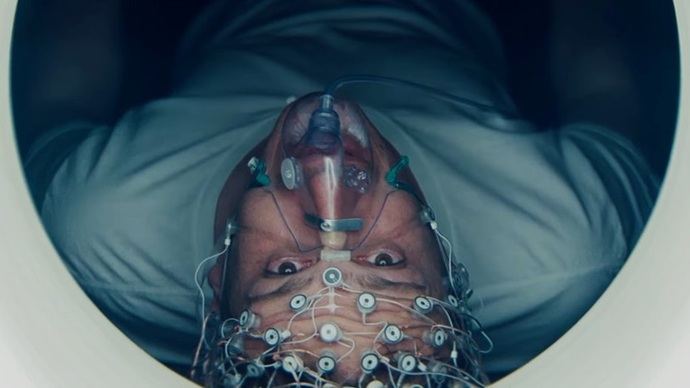
To substantiate his discovery and obtain irrefutable evidence of life after death, Thomas, together with both his sons and the woman Will met - whom he held back from taking her life and who has now become part of the scientific team - steals a corpse from the morgue and connects it to a device that reads human consciousness and records the events it reflects.
The experiment succeeds. They obtain a black-and-white film which at first they mistakenly perceive as the deceased person's memories of past events - a real place, a woman, a situation. When they begin to check the facts and watch the recording carefully again, they understand that these are not exactly memories - things experienced. Rather, it is a different parallel reality. What could have happened, but did not, because the person made a different decision.
The scientists reach the conclusion that each person's life has countless variations. Moreover, each person has turning points along the way - fairly significant decisions that turn life in one direction or another. It is precisely at these turning points that several realities are formed, which must be lived through again and again until one moves to the next level. Moving to the next level is only possible by changing the existing reality.
In the film this is shown in the plot where Will, in another version of his life, while walking along the beach, spots a small five-year-old boy playing at the water's edge, being drawn more and more into the sea by the waves. He grabs the boy and practically saves him from drowning. A woman who had been dozing on a nearby dune comes running over. For a moment Will feels as though they know each other, yet in the present reality they are seeing each other for the first time. One circle is closed; he moves to the next level. They do not become close, they do not fall in love, they do not stay together - but Will saves the little boy's life. The woman will not think of ending her life; they will not meet on the ferry going to the island.
A partial answer to the déjà vu effect - that psychological state in which a person has the sense of having been in exactly this situation before. Already experienced, yet still to come in the future. The question remains open: how much can we access our own subconscious in order to remember other versions of our lives? How many restarts are possible before we make the (one wants to say "right") choice that allows us to move to the next level? Do we meet the same people (the same souls) again and again?
A good film, if only because it prompts many questions. I recommend watching it.
comments