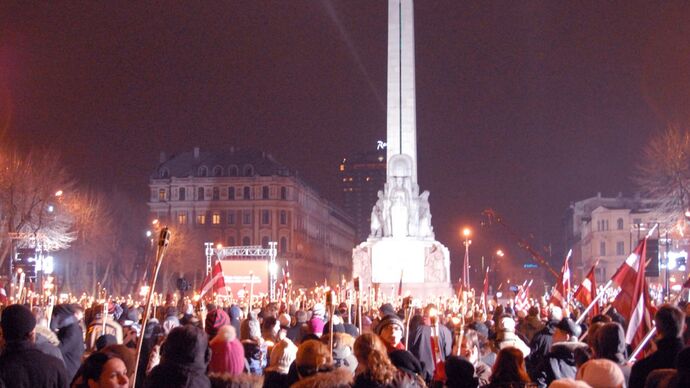
About the Freedom Monument
With the 96th anniversary of national independence approaching on 18 November, the idea arose to look into the history and gather the most interesting facts and images about one of the symbols of the people's freedom - the Freedom Monument.
With the 96th anniversary of national independence approaching on 18 November, the idea arose to look into the history and gather the most interesting facts and images about one of the symbols of the people's freedom - the Freedom Monument.
The Inauguration of the Freedom Monument
The Freedom Monument was unveiled on the 17th anniversary of the proclamation of the Republic of Latvia, on 18 November 1935. It was unveiled by the then President of the State, Alberts Kviesis, even though on the night of 15–16 May 1934, the then Prime Minister Kārlis Ulmanis had already carried out a coup d'état.
The monument was built with donations from the people.
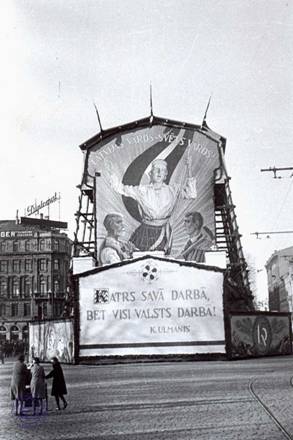
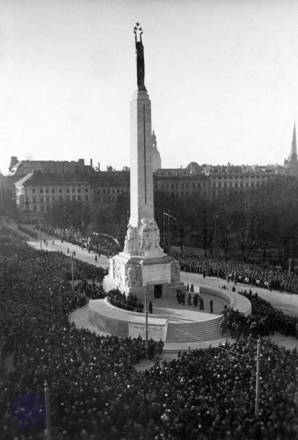
Photos from visc.gov.lv - The construction site of the Freedom Monument in Riga. Around 1935. & The inauguration of the Freedom Monument in Riga. 18 November 1935. Photographer unknown.
The Appearance of the Freedom Monument
The 42-metre-tall monument is made of Finnish granite, Italian travertine, concrete and copper. Its sculptor is Kārlis Zāle. The three gold stars, which symbolise the regions of Latvia - Vidzeme, Kurzeme and Latgale - are covered with 2,277 grams of pure gold, as during the 2006 restoration they were coated with 900 thin gold leaves.
Sculptures and bas-reliefs arranged in thirteen artistic groups illustrate events from Latvian history and culture.
Milda
The 9-metre-tall figure of Liberty is made of copper. Its prototype is considered to be the Art Academy model Milda Meikša. It is from this legend that the monument's popular name "Milda" arose.
The Soviet Years and the National Awakening
In 1945 the question was raised of its demolition, in order to restore the bronze statue of Peter I that had previously stood there. Advocacy for the preservation of the monument came from K. Zāle's student, the Riga-born sculptor Vera Mukhina, who is the author of the Soviet Union's famous sculpture Worker and Kolkhoz Woman.
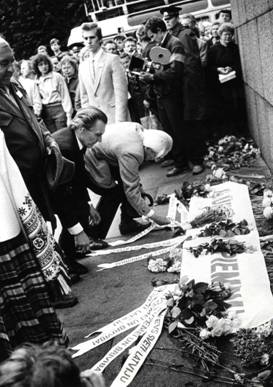
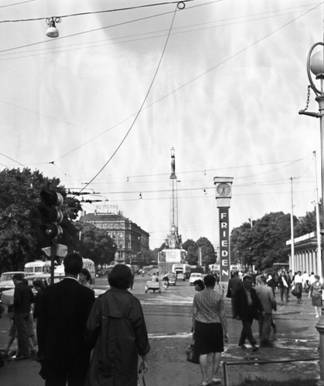
Photos from itl.rtu.lv - The laying of flowers at the Freedom Monument on 14 June 1987, honouring the memory of Latvian residents deported on 14 June 1941 & The Freedom Monument in the 1960s. Latvian State Archive of Audiovisual Documents, photo by Mecņankins.
On 14 June 1987, three years before the restoration of Latvian independence, the first anti-Soviet demonstration took place at the Freedom Monument, attended by approximately 5,000 people - a flower-laying ceremony organised by Helsinki-86 (a Latvian human rights advocacy group founded in Liepāja in June 1986 by Linards Grantiņš, Raimonds Bitenieks and Mārtiņš Bariss, with the aim of monitoring observance of the economic, cultural and individual rights of the Latvian people) at the Freedom Monument, in memory of the victims of the Soviet regime's mass deportations.
Yet in the 1988 Soviet encyclopaedia one could still read that this monument symbolises the liberation of the working people from the yoke of the German barons. An older version of the encyclopaedia offers an even more absurd explanation - the woman depicted in the monument is Mother Russia, holding the three Baltic Soviet republics in her hands.
The Present Day
Since 1990, road traffic in the street around the monument has been closed. On 11 November 1992, the guard of honour was restored. The honour guard soldier is required to meet a minimum height of 1.82 m. The guard of honour is present at the monument every day from 09:00 to 18:00. A guard must stand for 1 hour when the air temperature is between -10°C and +25°C. After an hour-long shift, the soldier is entitled to 2 hours of rest.
Flowers are laid at the monument on all Latvian public holidays, during official visits by foreign dignitaries, on days of remembrance - including the controversial 16 March - and on personal or family occasions in everyday life.
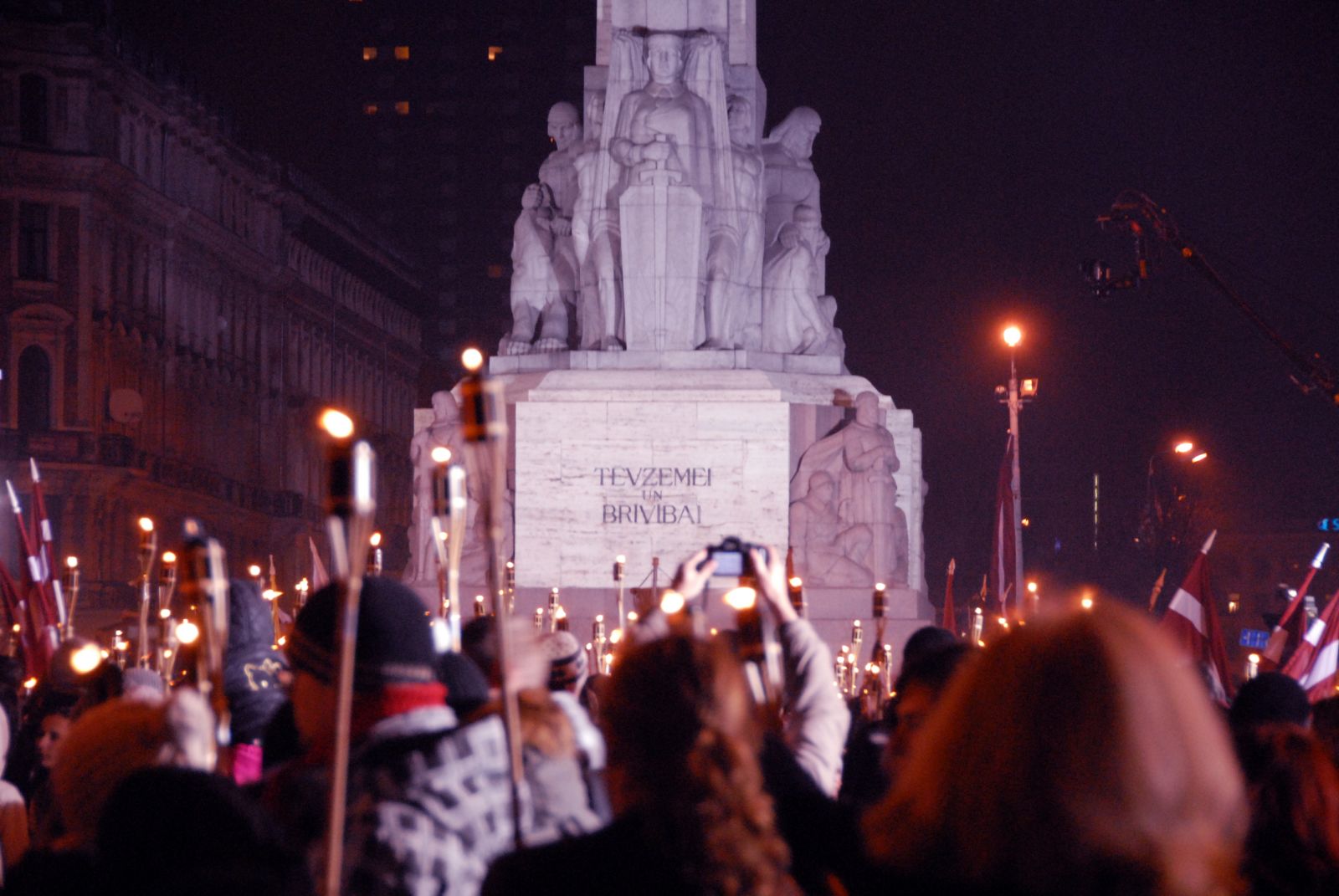
Photo: iinuu.lv, 18.11.2012
comments