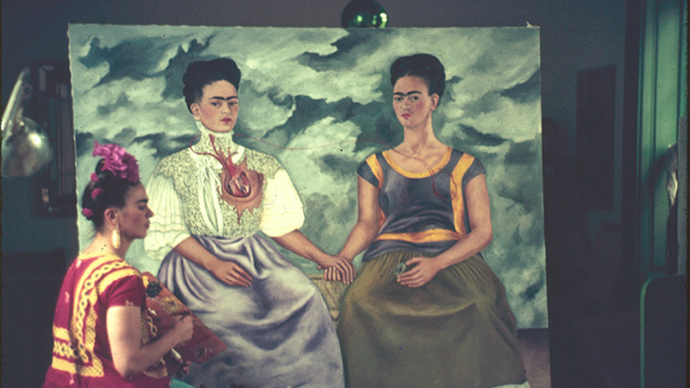
An Icon to Herself and Others - Frida
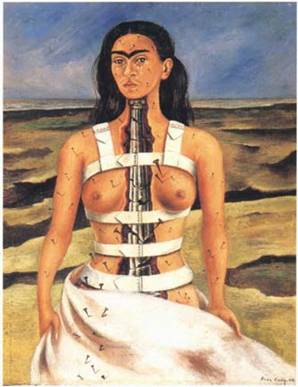
She revealed herself to me as a woman who made her mutilated body an icon and her pain into art. This explains the many self-portraits, most of which were made lying in bed, where she imagined herself torn apart, with her insides laid open, overgrown with grass and vines.
Searching for photographs of Frida Kahlo on the internet, I found and set side by side these two, which, in my view, beautifully show her character. The first - tomboyish, independent, free from social prejudices, full of vices, uncontained by the boundaries of stereotypes; the second - ordinary, warm, femininely humble, gentle, romantic, family-oriented.
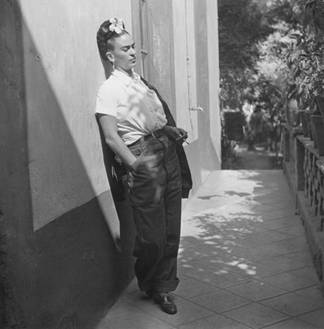
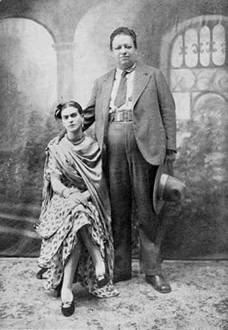
If you still know nothing about Frida, in brief -
Frida Kahlo (born 6 July 1907 in Mexico City, died 13 July 1954 in Mexico City) was a Mexican painter. Born into the family of German immigrant Guillermo Kahlo and Matilde Calderón, a woman of mixed Spanish and indigenous Mexican heritage. Her full name: Magdalena Carmen Frida Kahlo y Calderón. She painted in a mixed style of realism and symbolism, influenced by Mexican indigenous art. She is also classified among the surrealists, although Frida Kahlo herself denied this. A supporter of communism. One of the icons of feminism. At the age of six she contracted polio, which left her with a limp. In 1925 she was involved in a traffic accident and sustained serious bodily injuries. She underwent some thirty operations. While in hospital she began to paint. For the rest of her life she suffered from periodic pain. In 1929 Frida Kahlo married the muralist and cubist Diego Rivera. Their peculiar love-hate relationship lasted 25 years, with several separations and reunions. Despite her physical limitations, Frida Kahlo, like Diego Rivera, was active and inconsistent in her sexual life and was openly bisexual. In 1937 Frida Kahlo hosted Leon Trotsky, expelled from the USSR. In 1954 Frida Kahlo died of pneumonia. http://en.wikipedia.org/wiki/Frida_Kahlo
She revealed herself to me as a woman who made her mutilated body an icon and her pain into art. This explains the many self-portraits, most of which were made lying in bed, where she imagined herself torn apart, with her insides laid open, overgrown with grass and vines.
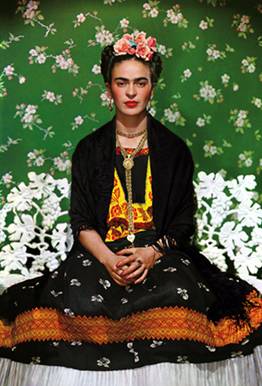
Last summer I avidly read Kate Braverman's book "I, Frida" (2007), published in Latvian, and it felt like the artist's diary. A very successful work. Some excerpts -
"They will say that I smoked cigarettes and marijuana, swore, cawed like a crow in all the languages I know, was drawn to morphine and demerol, tequila and pulque, women and men. I will merely shrug my imaginary shoulders and reply that I am a woman of water, not a ship to be steered or rented out to others."
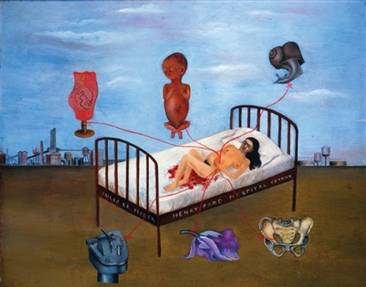
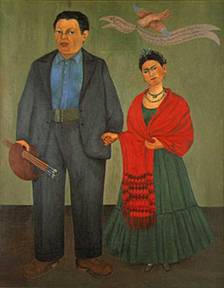
"I have crossed the borders of the canvas, - I declare. - Now I work in the realm of absence. These are not lies. Rather an approximate assumption. Marriage is an exchange. In our lives, as we perceive them, there is a lack of firmly defined certainties. We give each other assumptions, intimations. If these pitiful vignettes are comprehensible, we are happy. When our deception is unmasked, we imagine ourselves as victims. The boundary between contentment with life and a razor blade in the vein is imperceptible."
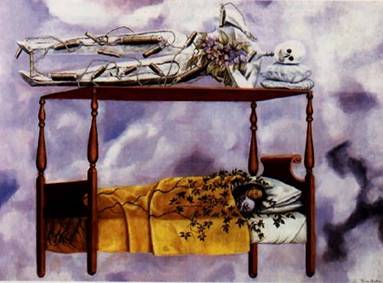
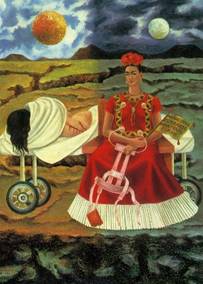
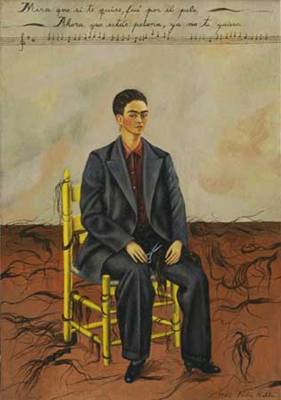
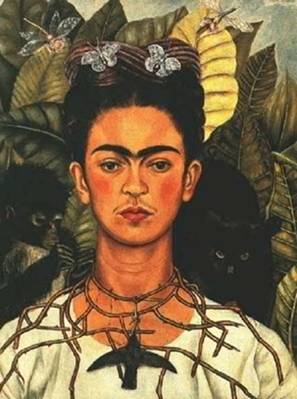
"They will say - she adorned herself with flowers, wove bright ribbon bows into her hair. She dressed as if for a celebration. Listen! That is not the point. I pinned entire flower gardens into my hair - tumours that had grown out of my brain, so to speak. I appeared with orchids not for joy but for mourning. Every day I prepared for my own funeral. I painted myself together with birds, with a necklace of thorns and a hollow where my heart had been, carved out as if with a scalpel."
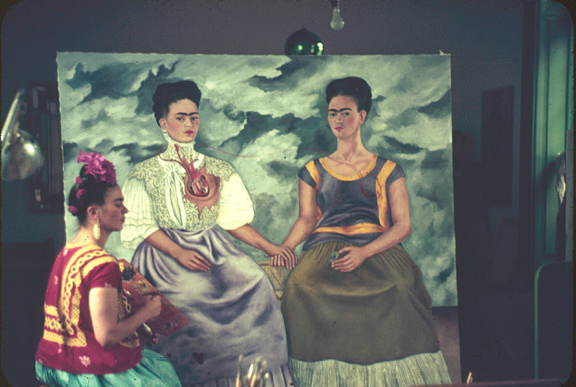
For those who have neither the time nor the inclination to read the book, the art film "Frida" (2002) with Salma Hayek in the title role is available to watch. About the film - http://www.imdb.com/title/tt0120679/
My greatest find among video materials is footage filmed during Frida's own lifetime.
comments