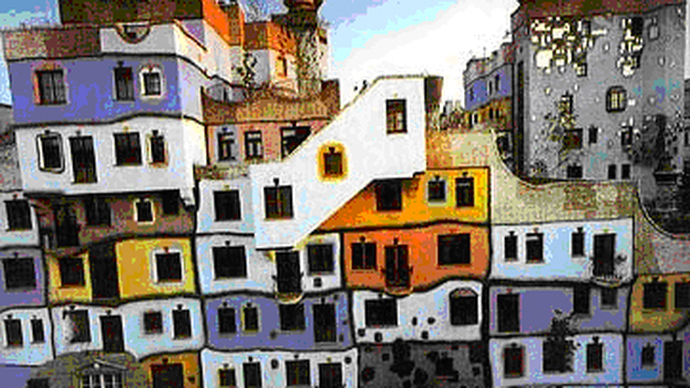
Everything Is Infinitely Simple and So Infinitely Beautiful
He believed in the idea of the unity of man and nature. His style surprises, delights, provokes indignation - but it certainly does not leave one indifferent.
 He believed in the idea of the unity of man and nature. Although his artistic education was limited to three months at the Vienna Academy of Fine Arts, his works have gained renown throughout the world. His style surprises, delights, provokes indignation - but it certainly does not leave one indifferent, with its colour, variety of forms, and unimaginable combinations of materials and details.
This artist's real name is Friedrich Stowasser, though we now know him as Hundertwasser (the name he adopted in 1949). He was born in 1928 in Vienna. In 1948 he studied for three months at the Vienna Academy of Fine Arts. He was, in effect, self-taught.
From 1949 to 1952 he travelled extensively - Morocco, Tunisia, Paris, Tuscany. These travels provided significant experience and decisively influenced his future artistic works. In 1951 Hundertwasser joined the Vienna Art Club, where his first exhibition took place. The works were dominated by abstract forms. In 1952 the artist discovered the spiral, which would become characteristic of his style as a form of expression.
In 1959 Hundertwasser was a lecturer at the University of Art Education in Hamburg. His many exhibitions, a naked speech (he walked through the streets of Vienna naked), and his revolutionary ecological ideas made Hundertwasser very famous. Today his works, especially his architecture, are world-renowned. The artist lived and worked in Vienna and New Zealand.
He died on 19 February 2000 aboard the ship Queen Elizabeth II from a heart attack. In accordance with the artist's wishes, he was buried in New Zealand in the "Garden of the Happy Dead" beneath tulips.
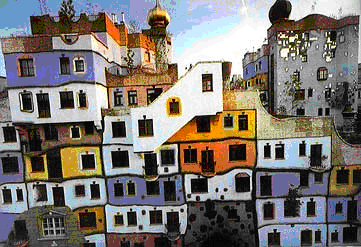
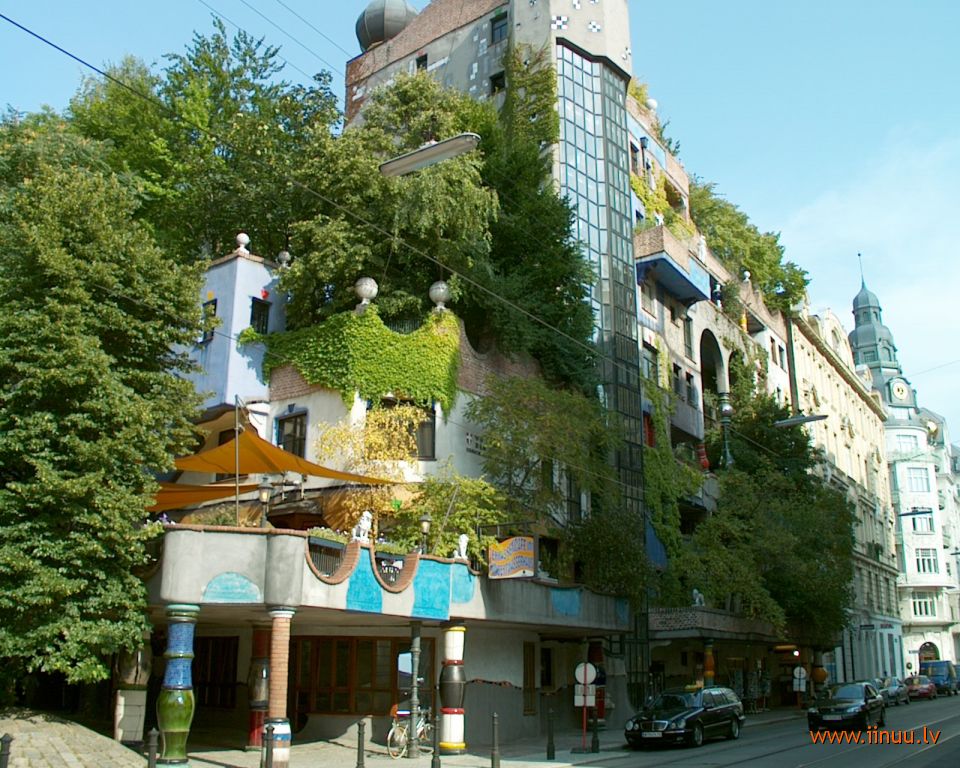
Hundertwasser House in Vienna (1977–1986)
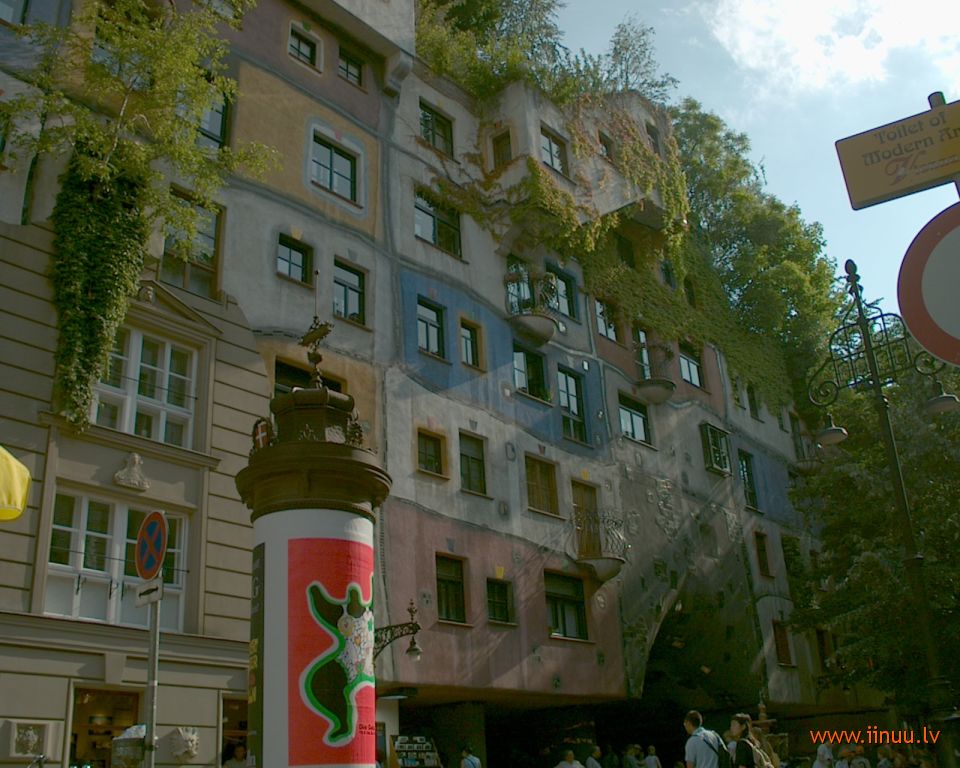
This July, while in Vienna, I went to admire Hundertwasser's architecture. It was the second time I encountered this artist's work. When I first walked along Untere Weißgerberstraße, the building in the photograph contrasted sharply with the grey winter day, surprising with the brightness of its colours and its unconventional forms and details - small windows, "slanted" walls and floors, decorative columns serving as the building's supports. This summer, when the midday temperature had reached +42°C and the sun's rays generously illuminated the building's facade, the sight revealed Hundertwasser's philosophy - to live in harmony with nature. The rooftops and balconies of the building were richly adorned with green bushes, trees, and climbing vines growing there undisturbed in the middle of a big city.
The building in the photograph is a residential apartment block where actual Vienna residents live. The residents' peace from the curiosity of many tourists is protected by doors with code locks.
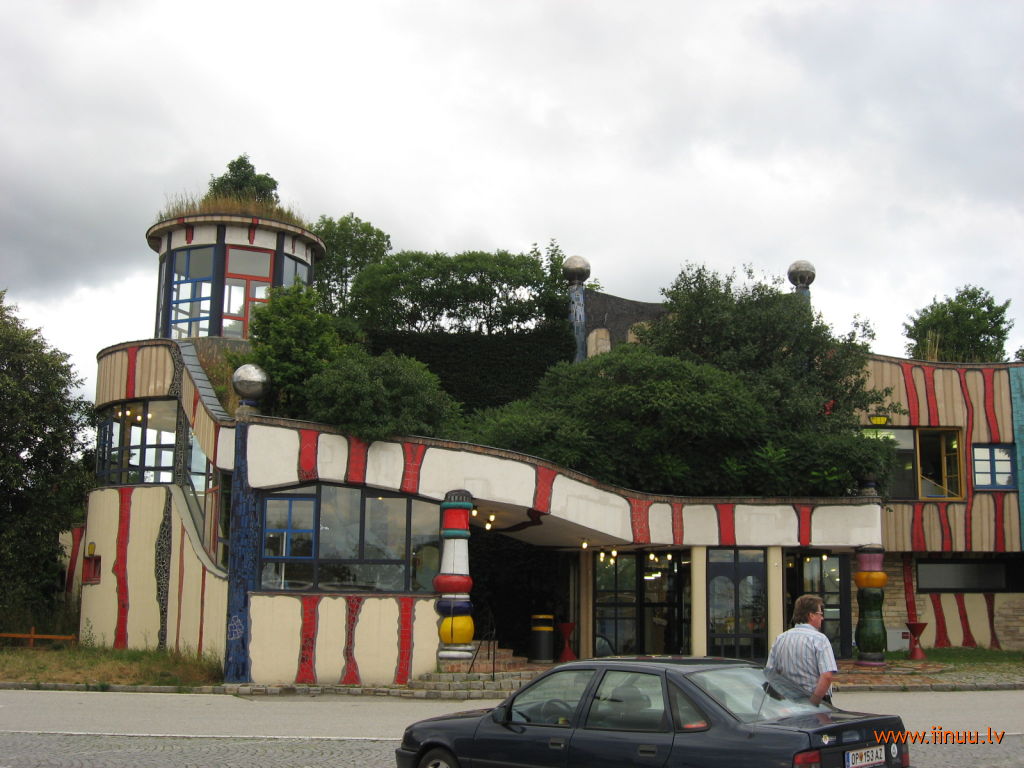
Hundertwasser's style has now become a business for many. Souvenir shops, small shops selling reproductions of the artist's paintings, and cafés are all fitted out in colourful (even too colourful for Latvian sensibilities) interiors. Palms, potted plants, and miniature trees are never absent. One is struck by the thought that a "colourful" interior suits such an environment well.
Near the Hundertwasser House stands a fountain where one can make out 12 zodiac signs and a large serpent encircling them in the water. A bench is built into the edge of the fountain. Its rim is composed of mosaic pieces, where among the stones of various colours, black shards with Gothic lettering are visible. Everything is extraordinarily beautiful and at the same time simple and practical - as the artist himself said: "Everything is infinitely simple and so infinitely beautiful."
Reading Hundertwasser's writings, where the philosophy of his work is laid out, I found appealing his observation about a person and their three layers - their skin, their clothing, and their home. All three layers are to be cared for, shaped to some degree according to one's own understanding, taste, and style. The artist placed great importance on windows in architecture, which he considered a bridge between the inner world and the outer world. Each window on a single building's facade is an "individuality" in terms of its different form, size, colour, and materials used. It is no wonder that Hundertwasser stated: "Many people say that a house consists of walls. I say it consists of windows." The distinctive windows are visible not only on the facades of buildings he designed, but also in his paintings.
Essential is the conviction that he, in my view, followed throughout his entire creative career and which could serve as a wonderful guiding principle for us in our daily work: "Paradise can only be created by our own hands, by our own creativity in harmony with the free creativity of nature."
comments