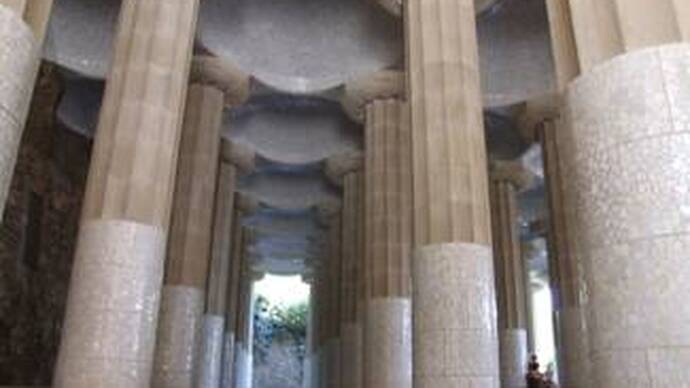
The Heart of Catalonia - Barcelona and Antonio Gaudí
Gaudí could not stand walls and ceilings, enclosed architectural forms. He considered the sky and the sea the best interior and, to avoid dividing space, invented his own support-free covering system. From the engineering standpoint of the time, it seemed simply impossible.
Barcelona is a city in the north-east of Spain on the Mediterranean coast. The second largest city in Spain, the main economic and cultural centre of Catalonia - www.barcelona.es.
Barcelona is an ancient city, rich in cultural traditions and architectural monuments, particularly distinguished by the Gothic Quarter with its ancient cathedral. It has numerous museums, including the Pablo Picasso Museum and the Catalan Art Museum. The Catalan coastline presents two entirely different landscapes. To the north of Barcelona rocky shores dominate, carved by nature into many small coves where mountain massifs lie directly beside the sea. On the other side, long sandy beaches are frequently found, especially to the south of Barcelona.
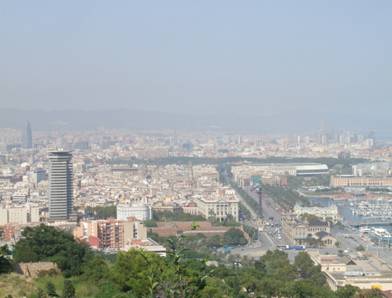
Barcelona is known for its football club - FC Barcelona. Near Barcelona lies the Circuit de Catalunya - the Formula 1 Spanish Grand Prix circuit.
In the 19th century Barcelona experienced the Industrial Revolution, and Catalonia became the most industrially developed region in Spain, while Barcelona grew rapidly.
At the beginning of the 20th century Catalan nationalism strengthened. Likewise Barcelona became the centre of Spain's workers' movement. Unlike many other countries, in Spain the workers' movement developed largely along anarcho-syndicalist lines, and Barcelona in particular was the centre of anarchism.
It is therefore no surprise that during the Spanish Civil War (1936–39) Barcelona was one of the main republican cities. In May 1937 street battles broke out in Barcelona between allies - anarchists and communists. From August 1937 to December 1938 Barcelona was the capital of republican Spain, until it was taken by Franco's forces.
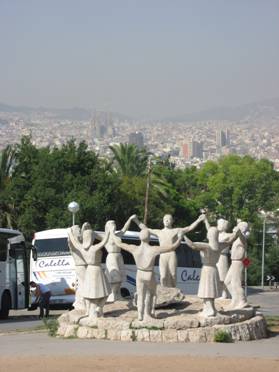 |
Sculpture - sardana dancers. This is the Catalan national dance. The sardana is somewhat similar to the Greek sirtaki - it is also danced in a circle, holding hands. During Franco's dictatorship the sardana was an important symbol of preserving national identity. |
After the end of the Franco regime Barcelona became a popular tourist centre. Although officially banned under Franco, a widespread revival of the Catalan language was observed - in recent decades it has become the everyday language of Barcelona.
In 1992 the Olympic Games were held in Barcelona.
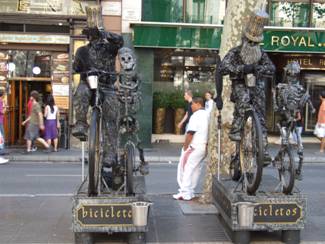
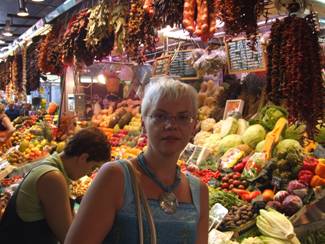
La Rambla - the most famous street in Barcelona - is always full of tourists, visitors, and locals alike. The Barcelona market, overflowing with colours and flavours, is also worth a visit.
Barcelona is famous for the works of the unique architect Antonio Gaudí.
Antonio Plácido Guillermo Gaudí i Cornet, son of the blacksmith Francisco, was born on 25 June 1852 in the small town of Reus - not far from Barcelona. Francisco was extraordinarily happy, but the midwife who delivered Antonio's mother had given the little one no more than three years to live, and the neighbours never ceased reminding them of this. Antonio suffered from rheumatoid arthritis; he walked with difficulty and could not play even the simplest games with his friends - hide and seek, chase. On Sunday masses Antonio was taken on a donkey's back. Perhaps in these childhood rides lie the origins of Antonio's later piety.
The boy had red hair and light blue eyes, as if marked out by God himself. He did not resemble a typical Spaniard at all. In fact Antonio was not Spanish but Catalan. (Even his surname is pronounced with the stress on the last syllable, as it is done in France.)
Francisco, seeing that his son, despite the gloomy prophecies, was in no hurry to depart for the next world, gradually began teaching Antonio various craft skills. The boy could sit for hours in his father's workshop, marvelling at how copper or iron yielded to human will and took on new forms.
When school time came, Gaudí was enrolled in the school of maestro Berenguer. As the weakest child he was teased by the others in various ways. Despite physical pain and difficulty moving, Antonio developed strong willpower early and a capacity for philosophical reflection. At 11 he attended a Catholic school together with peers, and by 17 he was already a celebrated traveller and excellent connoisseur of the surroundings of Reus.
Despite his illness, Gaudí cared deeply for others throughout his life. It seems health was never particularly strong in the family, as Antonio's elder brother Francesco died in 1876, and his sister also died young, leaving a small daughter. Gaudí raised his goddaughter with the greatest love and cared for his elderly father to the end of his life. This did not prevent him, however, from concealing his father's occupation from acquaintances, as he wished to rise in life and was ashamed of his origins.
Already as a teenager Antonio knew he would become an architect. Fortunately his father also believed in his son's vocation and did not try to make him a village blacksmith. He provided money and sent the boy to the Catalan capital to learn construction skills.
For ten long years nobody in Barcelona knew the name Antonio. First he expanded his knowledge of the blacksmith's trade, then trained as a carpenter and glazier; he also acquired the skills of a sculptor and stonemason. The next five years he spent at the drawing board and enrolled at the Barcelona School of Architecture.
At 26 he received his architect's diploma along with good wishes from the faculty. "You, Señor Antonio, are either a genius or a madman!" the teachers told the graduate at parting. Gaudí replied: "That means I have finally become an architect."
Antonio was so absorbed in thoughts of the victories to come that all worldly temptations passed him by. Yes, Antonio liked to dress elegantly - in fine leather gloves and a black silk top hat. Women too fell for the young man at first sight, but Gaudí remained alone his entire life. Antonio long courted the beautiful teacher Pepita Moreu, but to his awkward proposal she replied that she was already engaged to another. This was followed by a brief romance with an American girl, but then she returned to her homeland. Gaudí saw a sign from heaven: his fate was solitude.
Gaudí was a despot towards those he loved. He broke off his engagement to his adored fiancée in a single day, upon hearing that she had by chance met a former classmate on the train. Incidentally, another version of the story is also told: Gaudí was so shy that he called the beautiful Pepita Moreu his fiancée but never dared to propose, and so she went to another. In any case, no other woman ever had a place in Gaudí's life.
His niece, when she had grown into a young, beautiful woman, he would not allow to meet boys; he terrorised his pupils and for a minor act of disobedience could throw an apprentice out of the workshop permanently. Even qualified architects who worked alongside Gaudí were merely assistants: no objections were not only accepted but not even listened to. Of course Gaudí had studied not only architecture but also engineering, which made him a true master in his field, providing a theoretical foundation for his formations of unbelievable form.
Gaudí was a nationalist. He always emphasised Catalonia's independence from Spain, and all his activity was the embodiment of this conviction. Even his fascination with the Middle Ages began with the understanding that only then had Catalonia been truly free. During Gaudí's lifetime the Catalan language was not permitted to be taught in school, but he, as soon as he came of age, refused to speak any other tongue. Even the workers on his buildings were compelled to learn Catalan or hire an interpreter. Shortly before his death Gaudí refused to answer the judge in Spanish. He drank only wine fermented in Catalonia, wore clothing made in the region and, once he had acquired wealth, wore expensive shoes made in a Barcelona workshop.
Antonio Gaudí's first project was a social protest. He undertook to build a factory workshop on commission from the cooperative "Obrera Mataronense". This cooperative promoted a socialist system of labour; however, the workshop was recognised as a success, exhibited at the World Exhibition in Paris, and it was there that Gaudí met Señor Eusebio Güell. He was the largest producer of ceramic tiles in Spain, the first producer of concrete in Spain, a man of unlimited means who attracted the still impoverished architect like a magnet.
It was precisely in Güell's factories that principally new materials were created from which Gaudí's principally new buildings were made. In Güell's library Gaudí first encountered the principles of Art Nouveau; in his home he first heard the poetry of Dante Gabriel Rossetti; from him he received the first well-paid commission - the construction of a hunting lodge and five other buildings later. Güell could commission anything from Gaudí: a completely fresh idea for a house, a park, or an entire city. With Güell's help Gaudí discovered within himself the genius who builds houses without drawings, conceiving three-dimensional objects directly in space.
Incidentally, the Güell Park, where residential spaces had been planned for sale to wealthy city-dwellers, turned out to be the first financially unsuccessful project. Everyone was delighted by the urban environment the artist had created, but when imagining having to actually live there, the average citizen's head began to spin. Any other investor would have abandoned such an architect. Any other - but not Güell. He read the ironic newspaper reviews with enthusiastic laughter.
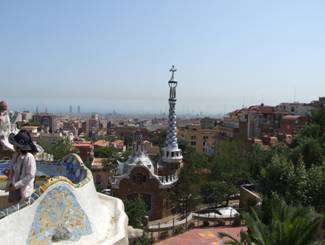
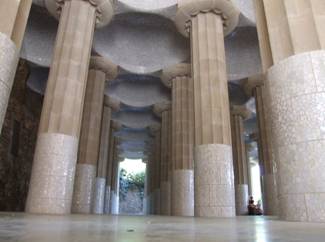
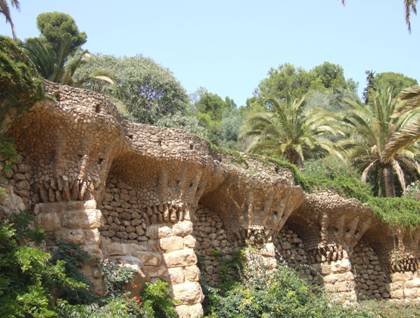
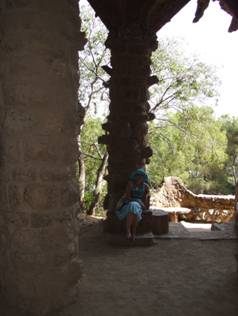
Parc Güell - a park designed by Gaudí.
After Antonio Gaudí lost his mother, sister, and father within one year, he moved to Barcelona together with his goddaughter. It was then that his most unfathomable project began - work on the Barcelona cathedral La Sagrada Família (the Holy Family).
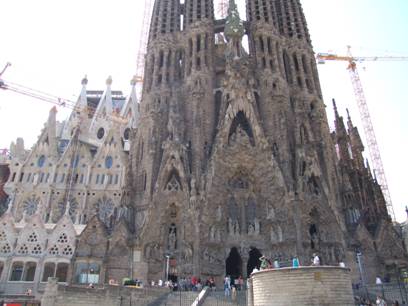
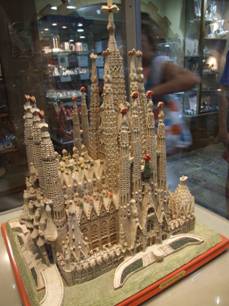
He knew he would never see it completed himself, yet he refused to accept any means of funding other than private donations. Instead of drawings he made impressionistic sketches. Instead of a traditional scale model he constructed a model from strings, hanging bags of various weights at the support points.
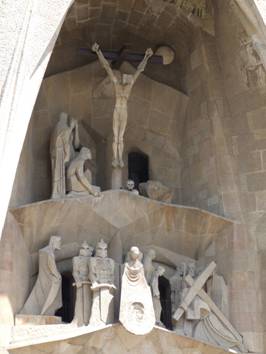
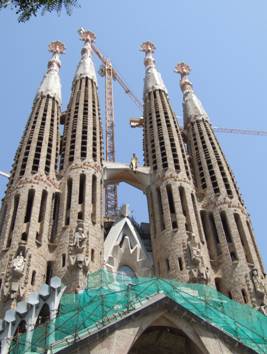
La Sagrada Família - the church built by Gaudí (unfinished)
Gaudí could not stand walls and ceilings, enclosed architectural forms. He considered the sky and the sea the best interior and, to avoid dividing space, invented his own support-free covering system. From the engineering standpoint of the time, it seemed simply impossible.
In 1914 Gaudí withdrew from all other commissions, working only on the church. He himself walked around collecting donations. When the workers' wages were delayed again, he persuaded them not to abandon what had been started. The future church, into which he had moved to live, he called only his family.
The most famous Spanish architect Antonio Gaudí died due to a tragic misunderstanding. At 74, while crossing the street, he was struck by a tram; passing taxi drivers did not recognise the celebrity in the poorly dressed man and took him to the cheapest hospital, moreover after a considerable delay. The driver later recounted that he had run over some vagrant with no documents found on him - in his pocket was a worn Gospel and a handful of nuts. Only after three days and nights in the city hospital for the destitute did someone from the staff recognise the deceased "vagrant" as the divine architect - Antonio Gaudí. Gaudí died three days after the accident; his funeral was splendid, but during the Spanish Civil War his grave was desecrated by police. The grave remained open until 1939, when several friends gathered to identify his mortal remains, and only then was the coffin sealed.
About A. Gaudí -
 http://lv.wikipedia.org/wiki/Antonio_Gaudi
http://www.tvnet.lv/men/life/article.php?id=51316
http://www.apollo.lv/portal/ipasums/2010/articles/14760/0
comments