Autumn Poets - October - Čaks
October is, of course, Čaks. A Riga man to the bone, an urbanist, a singer of drainpipes and street girls, a self-made man, the misunderstood lover with his heart on the pavement. I caught myself thinking that I enjoy reading poems not published during a poet's lifetime. Perhaps because they are the most truthful, most bare, unpolished. They have not passed through the censorship of the author himself or the publisher's editor.
In autumn one always wants to read and talk about poetry for some reason. Perhaps all the happenings in nature predispose one to it. The richness of colours before the greyness, brilliance before fading, living with full lungs before departure.
This evening the thought came to mind unbidden that the most widely read and most admired during my student years were precisely the Latvian autumn poets - Čaks, Vācietis, Ziemeļnieks. Not those who wrote about autumn, but those who emerged from autumn with its richness of colours and sometimes so unbearable ache.
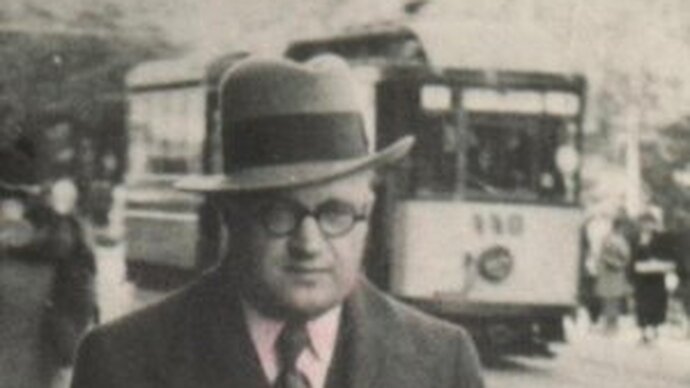
October is, of course, Čaks - or Aleksandrs Čadarainis. A Riga man to the bone, an urbanist, a singer of drainpipes and street girls, a self-made man, the misunderstood lover with his heart on the pavement. Always composed, well-dressed - in a grey classic coat, a broad-brimmed hat (after all, the son of a tailor), gallant.
Aleksandrs Čaks was born on 27 October 1901 in Riga, Russian Empire, and died on 8 February 1950 in Riga, Soviet Union.
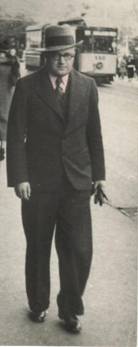
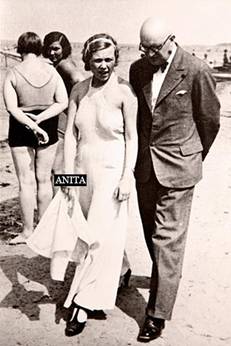
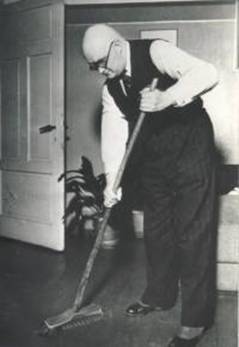
From time to time the press features articles contemplating Čaks' reserved nature and Čaks' women. Which poem was dedicated to whom, and who was the true and only one. So too this year in the October issue of the magazine "Praktiskā Astroloģija" on the influence of Čaks' star sign - Scorpio - on his creative work and relationships with women. For example, his relationship with Anita Bērziņa - Čaks' only official wife - is described there as utterly incompatible in temperament: he in a suit, she in a swimsuit (a caption on a photo from a walk on the beach). That is exactly how I always imagine him - free in spirit and imagination, yet always reined in by a fine suit, without indulgences.
In 1923, inspiration came to Čaks from the cosmos or from wherever - the Divine spark - his handwriting changed, his style of writing poetry changed, green stars began to glow above his head. Green - the cosmic colour. These changes were fateful (described also in V. Rūmnieks and A. Migla's biographical novel "Čaks" (2010)), because a transformation occurred: from an uncertain man drifting with life's current to a purposeful poet with an awareness of his mission. One must have had faith to allow oneself to publish the first poetry collections at one's own expense.
Well, he became loved, admired, idolised - but did he truly feel that way? Be that as it may, Čaks' poetry of the 1920s–30s is and will remain, if not the most decorated, then the most widely read and reread.
I caught myself thinking that I enjoy reading poems not published during a poet's lifetime. Perhaps because they are the most truthful, most bare, unpolished. They have not passed through the censorship of the author himself or the publisher's editor. Below are a few such poems to read on dark autumn evenings.
***
WITHOUT A SOUL
Days like a monotonous ache
Bend minds and souls.
Not to feel - now the only relief,
Not to think - the only joy.
I run from branch to branch,
Work rolls like a ball.
Whatever I take and do,
All as if by force,
All runs as if without a soul…
***
LOVE
Well, is it not a wonder - we,
who were two, now only one,
one single one -
as if our bodies had opened to each other
and received one another within.
Until now I thought only the contents of two vessels
can flow together and become as one,
now I know: two beings can likewise
flow together as quicksilver, as water.
And there is no power in the world then
that could split or break them apart
like a chip cut from a trunk
or a street-name sign torn from a fence.
They will be together forever, inseparable -
as the moon from the earth.
They will be together forever, inseparable
through as many years as there are suns in the world,
as many people on the earth's surface -
no hatred,
no distance as vast and heavy as an ocean, as an era
can do anything to them.
***
THE HUMAN WORD
Place your hand on a car, on a car when the engine is running.
Place your hand.
Do you feel how it trembles and pants like a man seized by passion.
So I tremble, all of me trembles, searching for a word.
A word to me is like steam from a kettle that has forced its way out from under the lid.
A word to me - ah, the petty, tiny human word. I love it and I hate it.
Give me the bellow of a buffalo, the howl of a hyena!
The human word is only a powerless old man to me - to a young, passionate girl.
Only once, just once, will I be able to express what I feel -
in the final cry before death, with a knife in the back, in a dark and damp gateway.
***
ATTACHMENT TO THINGS
Above all people I have come to love things,
Perhaps through them I shall be able to find happiness.
They have no soul as hard as people's,
Till death itself they know how to be faithful.
And all the sufferings and torments found in joy
My heart can tell them so much better.
When the trembling stars from an invisible hand
Begin to light and glimmer at the distant heavens.
From the depths of eternity there is far more within them
Than within a great person who knows how to boast,
When, gazing silently, they lie before me,
The mind finds rest in them and at the same time strength.
That peace which covers them like water,
Spread from life itself to death itself,
Is to my soul like wonderful dwelling-places
Where my joy grows deeper and every wound calms.
***
THE CYNIC'S SONG
It was a black, dark night, far darker than the longing
That tore at me like a rod through a weak wall,
When I met her and led her round the corner,
Transgressing your dogmas like a cent and a threshold.
I was a magnificent man to her in that dark night
With lips worn down and dyed hair,
Whom I had bought for two new lats
According to all the rules till morning for my urge.
Then naked I dashed like the moon on a clear night,
And, having grown wild as an upheaval or a plague,
I frolicked openly, as if having drunk acetic acid,
In time with the madmen in Strenči.
Poems from: A. Čaks, Collected Works, Volume 1 - Riga: Zinātne, 1991
Photos: from the collections of the Aleksandrs Čaks Museum
comments