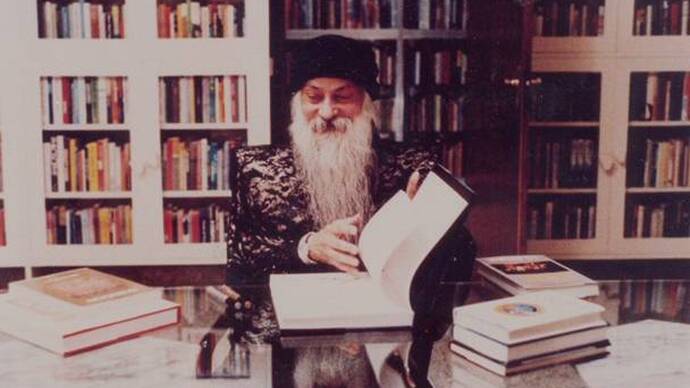
The Contradictions in OSHO's Teachings
When I began reading OSHO's book "Joy", I could not for a long time come to terms with many of the thoughts expressed there. The book simply irritated me. I think a similar feeling might overtake many readers, especially those who know little about Buddhist philosophy. Nevertheless, guided by curiosity, I studied the book carefully - through a critical lens, it must be said.
When I began reading OSHO's book "Joy", I could not for a long time come to terms with many of the thoughts expressed there. The book simply irritated me. I think a similar feeling might overtake many readers, especially those who know little about Buddhist philosophy. Nevertheless, guided by curiosity, I studied the book carefully - through a critical lens, it must be said.
The contradictions described below are not exactly contradictions. Rather, they are thoughts I did not understand, or have not yet grasped, along with questions to which I could find no answers either in the book or in several of Osho's talks I read on the website dedicated to his teachings.
[1] Trees are happy simply because they cannot be unhappy. Trees' happiness - that is not their freedom; they are compelled to be happy, they have no other alternative.
A rather authoritative observation that is fundamentally subjective. Each individual's understanding of happiness is different - although I agree there are signs by which one can sense whether a person is happy or not. But how can one devise these signs for beings and forms of existence that a human has never been? Unless one accepts a priori that everything that exists is happy, and that happiness (bliss) is the foundation of all existence.
[2] We drug every child from the very beginning with this poison of competition. By the time he comes out of university, he is completely drugged.
It should be noted that in his youth Osho opposed many systems, both denying them and actively protesting. Any school is also such a system. Strangely, however, the great teacher himself studied at various schools and obtained a professorship...
[3] The American constitution inspired all Americans with the idea that they have to strive to be happy, to "pursue" it. Not knowing him [the one who wrote into the constitution that the pursuit of happiness is a right from birth], I can say - he was an unhappy man.
It is not entirely clear what Osho is actually against - whether he opposes the idea that a person has the right to pursue happiness, or that this is written into the US Constitution, or perhaps he is opposed to the US as a system - despite the fact that Osho spent a significant portion of his life there.
The goal of Osho's own teachings is also a free and happy person. Evidently the key lies in the word "pursue". But if a person has not yet discovered bliss, what then is the basis of their motivation?
[4] Liberation from the world of symbols means liberation from society. [...] The symbolic is unreal.
A similar idea appears in relation to family. Liberate yourself from family and live your self here and now, in carefree abandon. Only the question remains - what is to be done with small children, who cannot wait indefinitely while their parents are "finding themselves".
[5] Everyone wants great tensions. If you don't have enough personal problems, you start thinking about humanity, about the fate of the world.
...and what was the esteemed teacher looking for in the USA?
[6] Buddha sought happiness by fleeing the palace. [...] He completely freed himself from desire... and in that very moment it happened. In that very instant, the blessing came.
Buddha "sought" this bliss for several years - and did so purposefully, acquiring various skills and knowledge from different teachers. And only after all these options had been explored did he conclude that one must free oneself from desire, and thereupon attained bliss. There are two "buts". The first - Buddha was very wealthy and always had a fallback option, namely, he was always awaited at the palace. The second - during his search he acquired so many skills, which he surely did not pursue aimlessly.
[7] Trees and animals are happy too, without ambitions, competition, or the pursuit of the material.
A human being is created with consciousness and ego, and moreover as a social creature. By renouncing all of that, a person would become a primitive being. And instead of pondering esoteric matters and searching for oneself, such a person would need to take care of their offspring, go hunting every day or otherwise procure food. I do not know whether such a person would feel happy.
[8] AIDS as a disease, in Osho's view, is nothing other than a person's lost will to live. On Osho's website it can be read that HIV-positive individuals are not admitted to retreat centres.
Living for 4 years in Mumbai, thanks to the hot and humid climate, Osho's health was severely undermined. He developed diabetes, asthma and various allergies, which led him and his followers to move to Pune. It should be noted that illness was also the reason for going to the USA, from where he was later expelled following the discovery of various violations.
There may well be something fundamental that I do not truly understand in this philosophy, but in my view, a human being was created (came into being) not without reason with consciousness and Ego. And it is naive to think that these qualities were created without any purpose. What is true is that the mind is an extraordinarily powerful instrument and can make a person not only happy but also bring suffering. It is true that if nothing belongs to you, there is nothing to lose; if you love no one, there will also be no parting.
In my view, a person who renounces the social, the Ego and thinking, and becomes obsessed with the search for their Self, faces a very great temptation to become an egoist. And the conscious "bliss" will be nothing but self-deception and the usurpation of someone else's care. Of course, such a person also has the right to happiness, and such a person may indeed feel a sense of bliss - but what price will society pay for it?

comments