Conspiracy Theory: Maxima
Recent events connected with the collapsed Zolitūde Maxima shopping centre, and especially the way in which representatives of state power and local government present, conceal and interpret them, involuntarily prompted reflections that go considerably deeper than an answer to the trivial question of who is to blame. If one looks at history, it is nothing unusual in Russia for some apartment block to be blown up and in the course of the "investigation" it emerges that the guilty parties were Chechens or Caucasians.
Recent events connected with the collapsed Zolitūde Maxima shopping centre, and especially the way in which representatives of state power and local government present, conceal and interpret them, involuntarily prompted reflections that go considerably deeper than an answer to the trivial question of who is to blame. If one looks at history, it is nothing unusual in Russia for some apartment block to be blown up and in the course of the "investigation" it emerges that the guilty parties were Chechens or Caucasians.
This time let us look at what happened from a slightly different point of view. What if what happened was staged by special services (for example, Russian ones) and the roof collapse was a specially prepared plan, with quite pragmatic objectives:
a) to provoke the resignation of the government or individual ministers;
b) to impose economic sanctions against Lithuania through the "boycott Maxima" scenario;
c) to discredit local construction companies with the aim of redirecting major projects to foreign companies.
The cornerstone of the conspiracy theory is the assumption that the store did not collapse due to the negligence of architects or builders, but because someone provoked it. According to one version, bolts reportedly sheared. Just as plausibly, someone could have loosened the bolts or acted on them in some other way, degrading their resistance. Perhaps even detonating them. Against the backdrop of the general repair works taking place both in the basement and on the roof, the appearance of an unfamiliar person would arouse no one's suspicion.
A change of power in Latvia has been in preparation since March 2012 [4], when one Monday evening in an office building in Riga at Dzirnavu Street 68, where the Šķēle family-owned SIA "Uzņēmumu vadība un konsultācijas" (Business Management and Consulting) is located, a meeting took place for more than two hours between the three men dubbed oligarchs - Aivars Lembergs, Andris Šķēle and Ainārs Šlesers. The trio, after exchanging views, reportedly agreed that this government would most likely hold no longer than autumn, and that in the meantime a regrouping of political forces was to be expected, in which the central role would be played by the association "Latvijas attīstībai" (Latvia's Development), founded by former Prime Minister Einars Repše and several major sponsors of Vienotība dubbed "the new oligarchs".
At this point it is also known that the former State Auditor I. Sudraba has made her entry into politics and has even managed to secure herself a sponsor - the former Man-Tess boss J. Krūmiņš (interestingly, the current State Auditor E. Krūmiņa is no relation?).
Another cornerstone of the conspiracy theory is the mysterious deaths of persons close to A. Lembergs [5]. During Lembergs's "reign", 13 persons who were more or less connected with Lembergs's business or political dealings departed this life in their prime. The numerous deaths were sudden and quite peculiar. Of course, as long as nothing is proven, one may not accuse anyone of deliberate sabotage, but the coincidences are striking...
One would like to hope that some "independent" expert into whose hands some inconvenient document or suspicious bolt from the collapsed Zolitūde Maxima has fallen will not disappear under mysterious circumstances.
Chronology of Events
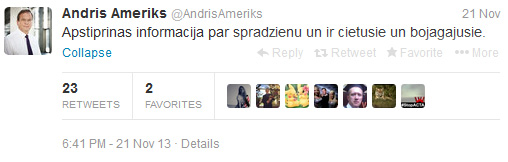
One of the first sources reporting that an explosion has occurred and there are casualties is a Twitter post by A. Ameriks at 18:41 on 21 November 2013:
Immediately afterwards rescue operations begin. Debris is cleared and evidence is effectively destroyed. As police officials later explained to the mass media, this assumption is not accurate and investigators were working on site from the very beginning. Later the same officials explain that immediately after the accident all documents were seized and interrogations begun. Forty of the best investigators are reportedly involved in the investigation. However, some inconsistencies in officials' statements later surface as well. Suspicions of an explosion are also not confirmed.
On 24 November 2013 at 20:03, A. Mirskis via the press [1] disseminates a report that documents connected with the Maxima construction are being seized and altered at the Riga City Council. This claim sounds quite plausible, because as Mirskis states, the rescue operation leader would first have needed to obtain the building's plans, identify where and what structural elements are located, determine their tonnage and only then call in equipment and form rescue teams.
Reproaches appear that assistance offered by Russia's Ministry of Emergency Situations was declined. It later becomes known that several other countries also offered assistance. On 25 November 2013 at 08:46 on Facebook, Nil Ušakovs - who on this website mostly writes in Russian - this time in both languages explains why the help from Russia was nevertheless not needed.
On 25 November it becomes known [2] that A. Latkovskis has requested US Ambassador to Latvia Mark Pekala to explore possibilities of engaging FBI experts in the investigation of the tragic Zolitūde Maxima supermarket collapse. The MP acknowledges that construction in Latvia is the most corrupt sector. Already now various invited experts have conflicts of interest, meaning their work could be called into question in the public's eyes.
Also quite suspicious is the concealment of the names of the injured and fatalities. On 22 November an unofficial and incomplete list is leaked, in which several unidentified persons also appear. Solely for this, the deputy director of the Emergency Medical Service M. Šics is suspended. The official list is published only after several days.
On 26 November a report appears in the press [3] that the wife of A. Skalbe, the supervising prosecutor of the Zolitūde tragedy, works at the Riga City Building Department. The source also points to A. Skalbe's considerable debts. Prosecutor General Ē. Kalmeiers rectifies the situation and rotates the supervising prosecutor.
An interesting detail surfaces in I. Sprinģe's LTV1 broadcast on 26 November 2013 (immediately after Panorāma), where Re&Re owners A. Pauniņš and D. Putniņš were invited for a conversation. Contrary to what police officials stated, neither of these gentlemen has been invited for interrogation.
Society raises the idea that a "public investigation commission" would be necessary. This idea is seized upon by N. Ušakovs, who would be prepared to form such a commission under the aegis of the Riga City Council. Knowing how N. Ušakovs settles scores on social networks with those followers (by blocking them) who draw attention to failures or persistently ask questions that cast a shadow on the mayor or the Riga City Council, it is not hard to imagine that N. Ušakovs could act similarly in the commission's work - those who asked too many awkward questions would be pushed aside and labelled as having obstructed the work and asked questions of the "don't bite the hand that feeds you" variety.
Social networks reflect bewilderment at the large compensations the Riga City Council is planning to pay out.
Why is it that in one foolish death case the survivors get "everything" and in another at least equally foolish one - nothing. Absolutely nothing. In our country it is more far-sighted to die under a supermarket roof than due to a drunk driver or doctors' negligence.
The construction specialists selected for the investigation claim that foreign assistance will not be needed to establish the causes of the store's collapse either. Given that only one university in Latvia - Riga Technical University - trains construction specialists, it is not hard to imagine that construction specialists might know one another quite well. There is no doubt that domestic specialists will be able to thoroughly examine the construction documentation and identify the bolt manufacturer. But will these specialists be equally objective when they discover that the person responsible for the bolting turns out to be some colleague or classmate?
Sources:
[1] http://www.db.lv/ipasums/buve/papildinats-mirskis-rigas-dome-konfisce-un-pielabo-zolitudes-maximas-buvniecibas-dokumentus-405566
[2] http://www.la.lv/latkovskis-velas-zolitudes-tragedijas-izmeklesana-piesaistit-fib-ekspertus/
[3] http://www.pietiek.com/raksti/papildinats_-_ar_kalnmeiera_svetibu_zolitudes_tragedijas_izmeklesanu_objektivi_uzraudzis_buvvaldes_darbinieces_virs_ar_milzu_paradiem/komentari
[4] http://www.pietiek.com/raksti/_vecie_oligarhi__satikusies,_lai_apspriestu_valdibas_mainas_scenarijus
[5] http://www.kasjauns.lv/lv/zinas/121181/lembergam-pietuvinatas-personas-mirst-bridi-pirms-liecibu-sniegsanas
comments