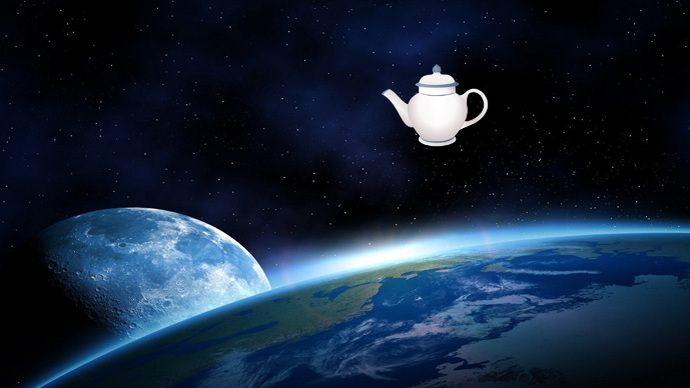
Russell's Teapot
From time to time, contentious topics appear on social media, about which clever and less clever minds, scientists and practitioners try to prove they are right. Various statements are quoted, links to studies are copied, etc. Some enthusiastically prove that it is so, others - that it is not so, and not because it is somehow otherwise, but simply is not so and cannot be.
One thing is clear - the discussion is not about the search for truth, but about the "black box", its external manifestations, assumptions, analogies and convictions. People tend to latch onto and hold on to trivial matters, which of course seem important to them, even though viewed from the perspective of science and "big things", they are often not only trivial but also of little value.
Genetically Modified Food
Some time ago, a storm in a teacup was raised by the question: is genetically modified food harmful or not? The question was comprehensively turned over, and although no summary was reached, the following can be concluded:
- one can look at it from a long-term and short-term perspective (what future illnesses will there be vs. African children need feeding now);
- what to study: the physical structure and properties of the plant; the plant's interaction with the surrounding environment (the stronger, more aggressive one wins); the impact on genetics;
- whether a person has the right to choose what to eat and whether it is worthwhile to resist scientific advances?
Ley Lines
Social media audiences have at various times been captivated by homeopathy and, quite recently - ley lines.
Some claim to feel the influence of ley lines, others - that ley line influence does not exist and cannot, since no scientist has yet had the revelation of how this influence could be measured. But even if one could, the physical influence would most likely be even more negligible than that of the moon on a full-moon night - although, for example, the phenomenon of sleepwalking has still not been explained. Stories circulate in the sceptics' camp that a well can be dug anywhere and water will be found, and that dowsers' "measurements" are a bluff. True, a "well" in such disputes means anything from which water can be extracted: a well, a spring, a deep borehole.
The properties of water are another topic not worth raising on social media if one does not wish to become an object of ridicule. To urban minds, water is either tasty or tasteless - what other properties could there be? The healing properties of water and the influence of its structure on the body are as unprovable as Russell's teapot.
What Scientists Say
The English scientist, mathematician and philosopher Bertrand Russell (1872–1970), being a sceptic and atheist, wrote in a work which, true to say, was never published, on the topic "Is There a God?":
Many orthodox people speak as though it were the business of sceptics to disprove received dogmas rather than of dogmatists to prove them. This is, of course, a mistake. If I were to suggest that between the Earth and Mars there is a china teapot revolving about the sun in an elliptical orbit, nobody would be able to disprove my assertion provided I were careful to add that the teapot is too small to be revealed even by our most powerful telescopes. But if I were to go on to say that, since my assertion cannot be disproved, it is intolerable presumption on the part of human reason to doubt it, I should rightly be thought to be talking nonsense. If, however, the existence of such a teapot were affirmed in ancient books, taught as the sacred truth every Sunday, and instilled into the minds of children at school, hesitation to believe in its existence would become a mark of eccentricity and, in former centuries, a mark worthy of the attention of the psychiatrist and, still earlier, the inquisitor.
The English scientist, chemist Peter Atkins (Peter William Atkins) points out that a scientist does not need to prove a contrary assertion, because based on the principle of "Occam's razor", from two theories that explain the same thing and are based on empirical observations, preference is given to the simpler theory.
The philosopher Paul Chamberlain considers that the logical error lies in the claim that positive truth must be substantiated with evidence, but negative truth need not be. Any truth must be proven. Including with respect to Russell's teapot. But not because negative truth needs to be proven, but because of the insignificance of this truth.
The philosopher Alvin Plantinga (Alvin Carl Plantinga) takes a considerably more practical view of Russell's teapot. In his view, the only way to place a teapot in orbit would be if some sufficiently advanced state had sent it there. If some state had done so, it would be known, but it has not. Consequently, that is sufficient evidence that the said teapot is not there.
Dr.phil. Ģirts Barinovs, in Latvijas arhitektūra #1(45)/03, writes:
In today's world, a person must encounter and evaluate phenomena about which it is impossible to obtain comprehensive and complete information. Judgements about them are made on the basis of faith, not incontrovertible evidence - or are not made at all. I think that the majority of people believe that Americans have been to the Moon, that Australia really exists, that we are made of atoms and that 2×2=4. Few of us have actually proven these things; due to lack of time we leave that to others. Likewise, few have not, at least for a moment, doubted the existence of God or the soul, flying saucers, the Yeti, the Loch Ness monster, ghosts, the Sandman, astrology, fortune-telling, etc. The problem is that science has not obtained sufficient evidence for the existence or validity of the above-mentioned things, yet cannot prove their non-existence. Therefore, it is impossible to form a judgement about the world around us without relying on faith. What we believe, and what we do not, depends on our education, philosophical convictions and cultural traditions.
comments