The Evolution of IT Company Logos
All the IT company logos reviewed here are well-known and familiar to the eye. But what were the origins of these logos? Who were their inventors, their creators? How did they develop over the years to become what we see today? For example, did you know that the first Apple logo depicted Isaac Newton himself?
All the IT company logos reviewed here are well-known and familiar to the eye. But what were the origins of these logos? Who were their inventors, their creators? How did they develop over the years to become what we see today? For example, did you know that the first Apple logo depicted Isaac Newton himself?
Adobe Systems

In 1982, two programmers, John Warnock and Charles Geschke, left Xerox and founded a new software company, Adobe. In the early days of the company, the founders tried to save money and cut costs on many things, enlisting the help of relatives and friends. And so the first logo was drawn by Warnock's wife, Marva.
Apple Inc.
In 1976, two Steves - Steve Wozniak and Steve Jobs - created the first Apple I computer. Since Wozniak was working at Hewlett Packard at the time, they decided to offer their product to that company, but it was rejected. The two go-getters then decided to sell their most valuable possessions (Steve Wozniak sold his programmable HP calculator, while Steve Jobs sold his old Volkswagen van) to fund the creation of the motherboard for their computer.
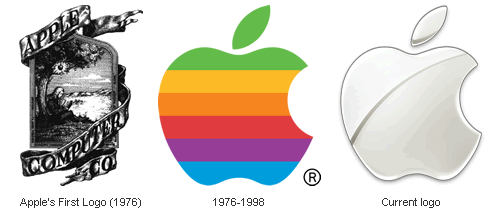
The first Apple logo depicted Isaac Newton sitting under an apple tree. The logo expressed the idea: "Newton ... a mind forever voyaging through strange seas of thought ... alone." This logo was designed by Ronald Wayne, who along with the two Steves co-founded Apple Computer. However, that same year, after working just a couple of weeks at the newly founded company, he gave up his 10% stake, believing Apple had no future. He received only $800, though he could have earned millions.
Steve Jobs felt, however, that such a logo was too complex for the company and even oddly influenced or contributed to the low sales figures. He therefore entrusted the design of a new logo to Rob Janoff of Regis McKenna Agency. Rob used the well-known rainbow motif but retained Newton's apple silhouette. Apple used this logo from 1976 until 1999. In 1998, the apple was simplified, given a clean shape, made monochrome and modernised.
In 1996, two Stanford University graduates, Larry Page and Sergey Brin, created a search engine server that would later become Google. This search system was originally called BackRub. The name came from the engine's ability to analyse "back links" to determine the importance of a given website. The two later renamed the search engine Google, which is a play on words - 1 followed by 100 zeros.
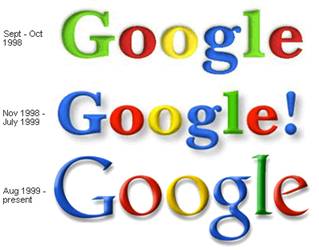
Two years later, Larry Page and Sergey Brin launched a website where searches could be performed. Having approached the then-popular web hosting providers and received a string of rejections, they initially operated from a friend's garage, but Google's popularity grew by the day.
The first logo was drawn in 1998 by Sergey Brin after he had learned the graphics program GIMP. A little later, an exclamation mark was added to the logo, borrowed from the already well-known Yahoo! In 1999, consultant and art professor Ruth Kedar at Stanford designed the new Google logo as we know it to this day.
It is often noticed that on significant dates, the Google logo is adorned with a special illustration. Their creator today is Dennis Hwang.
IBM
In 1911, two sizeable companies - International Time Recording Company and Computing Scale Company - merged, and in 1924 they became the today well-known International Business Machines Corporation, or "Big Blue". With that, the first IBM logo was created.
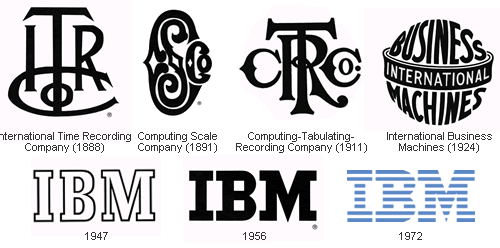
In the late 1940s, IBM transitioned from punch cards to computers. To mark this significant change in the company's activities (the company's chief executive at the time was Thomas J. Watson), a new logo was needed. So in 1947, a simplified logo was created - essentially an abbreviation of the company's name.
In 1956, Watson's son Paul Rand took over the company's leadership and decided to redesign the logo, making it more massive, stable and solid. The last changes to the logo were made in 1972, when it was decided to use horizontal lines to create an effect of speed and dynamism in the company's logo.
Microsoft
It all started in 1975, when Paul Allen, then working at Honeywell, and his friend Bill Gates, then a second-year student at Harvard University, spotted the first mini personal computer, the Altair 8800. Inspired, they wrote the first computer language BASIC in 24 hours. After licensing their collaborative effort and naming their venture Micro-Soft, they soon created the company's first logo, consisting of the two aforementioned words.
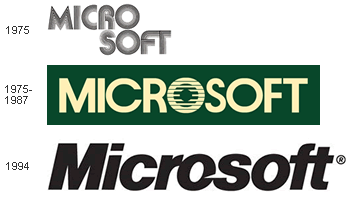
In 1982, the company announced a logo change. The two words were merged into one, with an emphasis on the letter O. In 1987, Scott Baker designed the current version of the logo, adding a slash through the letter O. In 1994, Microsoft launched the advertising slogan "Where do you want to go today?", which was part of a $100 million advertising campaign. However, this campaign, combined with the company's products, generated a wave of biting jokes - the slogan was rephrased as "what kind of error message do you want today?" In 1996, Microsoft decided to make a radical change and created several motivational slogans such as "Make it simpler!", "Start something!", "Discover your digital world!" and so on, eventually arriving at today's - "Your potential. Our passion."
Mozilla Firefox
In 2002, Dave Hyatt and Blake Ross created a browser that would later become known as Mozilla Firefox. The Firefox project went through several name changes.
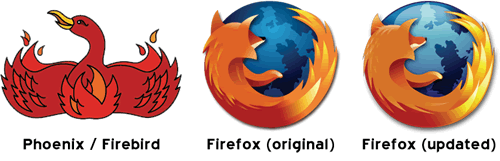
Initially named Phoenix, it was renamed due to a trademark dispute with Phoenix Technologies. The new name, Firebird, provoked a sharp reaction from the Firebird free database software project. In response, the Mozilla founders announced that the browser should always have "Mozilla" in front of it to avoid confusion with the database software. Further pressure from the Firebird project's user community forced Mozilla to change the browser's name; on 9 February 2004, Mozilla Firebird became Mozilla Firefox, often simply called Firefox.
In 2003, professional interface designer Steven Garrity wrote that the product had very poor and unremarkable branding. He was also invited to develop the new Firefox logo we know today.
Sources used in this article:
http://www.neatorama.com/2008/02/07/the-evolution-of-tech-companies-logos/
http://lv.wikipedia.org/wiki/Mozilla_Firefox
http://lv.wikipedia.org/wiki/IBM
comments