An Interview Is a Sales Act
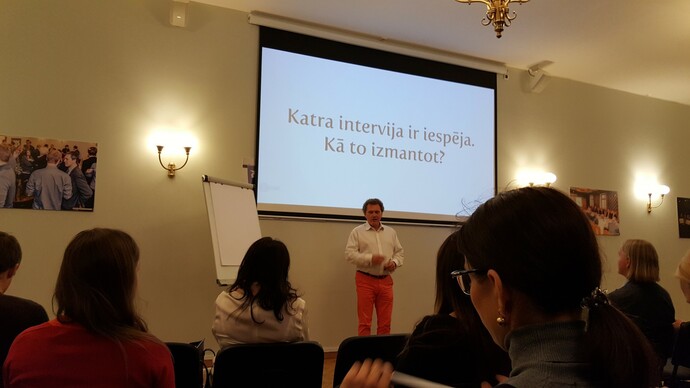
An interview is not a conversation or dialogue - it is a way for you to sell your story. An interview is a sales act - everything you say makes people either "buy" or "leave it on the shelf." This was explained to participants at the LTRK seminar "Every Interview Is an Opportunity! How to Use It?" by journalist and LNT News TOP 10 host Haralds Burkovskis.
In the two-hour seminar Haralds elaborated on the 3I principle, observance of which is important when communicating with TV journalists. So the first I - Impression, created by appearance, clothing and speech. Our first impression of a person forms within the first 30 seconds. The rational mind can process 70 units of information in that brief period, but the irrational mind - 7 million units. That is why background, image, is very important. The listener or viewer will immediately and unconsciously pick up on the information we do not say - how we actually feel.
The second I - Impact. The interviewee speaks inspiringly, passionately, with shining eyes - that is a "tasty" interview, whatever he or she may be saying. To create impact on the listener and viewer, you must know them - who are they, your audience? It is wrong to tell everyone; choose to tell those who need to hear it. One must also prepare and answer the questions: What should they do? Why should they or shouldn't they do it? A kind of stepping into your audience's shoes, putting yourself in their place.
The third I - Interview. It can be reactive - simply answering the questions asked; or proactive - telling your own story, expressing your passion, showing what makes you better, different, more notable. The second option is again that "tasty" interview, which can be very useful precisely for a business owner. However, one must be careful that the story is not only vivid but sufficiently digestible (with logical pauses) and sufficiently short (in Latvia's case, 20 seconds of airtime; in a global context - 13 seconds of airtime).
Some interesting and useful tips worth bearing in mind when preparing for and during a TV interview:
- Do not choose white, black or striped (eye-dazzling) clothing for a TV interview. Tones suited to Latvia - neutral and pastel shades (grey, sand, dark blue).
- Avoid answering even closed questions with YES or NO. Formulate your answer in a full sentence; you can even repeat or rephrase the question.
- "No comment" is not an answer. Tell what you can or are permitted to tell; what you cannot, don't!
- Before going to an interview or answering a phone or in-person interview, find out what the interview will be about and who else will be involved. You should also prepare answers for yourself for the "uncomfortable" questions. You may decline an interview, but indicate a direction, another contact person who can comment.
- Over time, each of us accumulates professional jargon and filler words. Try to simplify and tidy up your speech. Speak in plain (not crude) language with ordinary people!
- Choose 3 main arguments for your story, no more. The principle is this - if you simply want to become famous, that's your business; if you want to help me/us, that's a different matter.
- Avoid large numbers or percentages in speech. Better to use: one in ten, every other person, as tall as the spire of St. Peter's Church, as large as a stadium, etc.
- Always have at hand allegories, metaphors, widely known sayings, comparisons, proverbs, jokes. For example: "Isn't that your nose, and what is it doing in my affairs?"
- Practise speaking. Confidence in front of the camera only comes with experience. Try it in front of colleagues, friends, or a mirror! Read aloud, for example, bedtime stories to children in the evenings. This helps develop pauses in speech and changes in intonation.
- Tidy up your shoes, palms, fingers and nails, as well as watches and jewellery - these are all cameramen's favourite subjects to show in close-up.
- Wear comfortable footwear, as everything is written on your face - how comfortable you feel.
- Never look at the camera. The camera operator is an observer watching the conversation from the sideline. Don't freeze up; move and gesticulate freely. The operator's job is to catch you in frame.
- Don't let your back feel the backrest! Lean slightly forward; do not recline in the chair.
- The best facial expression - relaxed, a slight smile, lower jaw not clenched against the upper.
- When the interview begins, say hello! Correct them if they mispronounce your surname! Interrupt if needed, but with a smile! Don't understand a question? Ask again!
- Speak more slowly than in everyday life (narrative mode).
- Repeat as often as you can. Do not say "as I mentioned earlier." Say your one most important sentence that you have prepared!
- A TV journalist's "Thank you!" means "Thank you!" - but not: "The interview is over, you may get up and leave!"
- Bear in mind that nothing is private or off-camera. The interview begins when the TV journalist and camera operator cross the threshold of your company, and ends when they leave the premises. You can never be certain that your off-camera comments are not being recorded.
comments