The "Return" on Speed Fines in Latvia and Other Countries
Not going unnoticed is the increasingly frequent news about plans to raise fines for various traffic violations, including speeding. A fine must be fair, proportionate and, most importantly, equal for everyone. But... fines vary from country to country, just as average wages do.
Not going unnoticed is the increasingly frequent news about plans to raise fines for various traffic code (CSN) violations, including speeding. The amendments to the Administrative Violations Code (APK) have been submitted for review by the Saeima Legal Committee [2], which means they are close to being adopted very soon. It goes without saying that the amendments also have a stated objective: "to improve road safety."
It should be noted that the idea of "improving road safety" through fines is not new. In 2011, during L. Mūrniece's (V) time as minister, the Ministry of the Interior introduced speed cameras which, although they did not improve road safety overall, did allow the state coffers to be replenished. The idea of a cash pump was so appealing to the powers that be that the "revenue" from the cameras was even included in the following year's budget. But the pump did not operate for long, and following the Krājbanka collapse, the contract with the camera operators - among whom figures a friend of Riga Mayor N. Ušakovs (SC), Teilāns - was terminated in autumn 2012 for work not completed on time. Following the epic failure of the speed camera saga, a cosy position was found for the ardent speed camera champion and defender, the Head of the Preventive Department of the State Police, E. Zivtiņš... at Rīgas Satiksme.
Drivers too were not satisfied with the newly introduced speed cameras, since the familiar fine category "speed up to 20 km/h over the limit" was interpreted by the camera operators (not without the Ministry of the Interior's endorsement) such that a fine of LVL 10 (EUR 15) could be issued even for exceeding the limit by 3 km/h. The cash pump was meant to operate at maximum yield, and so the cameras were placed not in the most dangerous locations, but in well-visible spots where, from the driver's perspective, conditions were safe enough for drivers to dare to press the accelerator a little harder. But even that might have been tolerable - however, so that the fine would not produce any corrective change in drivers' behaviour, fine notices began being delivered two or three months - or even longer - after the offence. What remorse could there be for a violation if the driver (in some cases - the vehicle owner!) could not even remember the moment and circumstances of the offence?
Attentive ears among drivers found a champion in P. Timrots (Zebra), who proposed introducing a rule that speed cameras would only register offences from 15 km/h over the limit. During the campaign, 10,000 signatures were collected. But to no avail. Meanwhile, little-known "safety experts" methodically pushed through a bill for harsher penalties.
Since 2003, a penalty points system has operated alongside monetary fines.
The New and Old Fine Schedule
|
|
In a populated area |
Outside a populated area |
||
|
|
Previously |
Proposed |
Previously |
Proposed |
|
< 10 |
|
10 |
|
10 |
|
11 – 20 |
Warning or EUR 15 |
30 |
Warning or EUR 7 |
20 |
|
21 – 30 |
40 |
55 |
30 |
40 |
|
31 – 40 |
85 |
100 |
55 |
70 |
|
41 – 50 |
120 – 140 |
120 – 140 |
85 |
85 |
|
51 – 60 |
140 – 210 |
250 – 300, licence suspended 3–6 months |
120 – 140 |
200 – 250, licence suspended 3–6 months |
|
> 60 |
350 – 570, licence suspended 3–6 months |
650 – 850, licence suspended 12–18 months |
210 – 430, licence suspended 3–6 months |
350 – 650, licence suspended 6–12 months |
In Other Countries?
Any fine has two purposes - a) to punish for the offence committed and b) a preventive one. But in terms of its educational effect, a fine must be - a) inevitable and b) imposed as quickly as possible after the violation, so that the offender can reflect on and regret the offence.
The unresolved question concerns the amount of the fine. For example, for a pensioner EUR 10 will be a significant blow to the wallet, while for a "fat cat" even EUR 100 will prove negligible. But a fine must be fair, proportionate and, most importantly, equal for everyone. But...
Fines vary from country to country, just as average wages do. As a result, the "loss" upon paying a fine can prove different in different countries. Figure 1 below compares the fine for speeding by up to 20 km/h in a populated area against the average annual net salary. Assuming that the average driver commits one speeding offence per year, or is caught once per year. :)
Average wages were taken from International Labour Organisation (ILO) [4] calculations. Although the figures obtained may differ from those calculated by the Central Statistical Bureau (CSB), the methodology used by the ILO is (hopefully) the same for all countries, so that while the absolute value may be imprecise, the ratio (fine/salary) between different countries is comparable.
For example, in Latvia the average wage according to the ILO is EUR 790 (CSB 2013: LVL 504), the fine for speeding by up to 20 km/h is EUR 15, and the fine under the proposed APK amendments - EUR 30. As a proportion of the annual wage, this fine currently accounts for 0.16%, and with the higher fine - 0.32%, which would place Latvia roughly in the middle among other EU countries. It should be noted that the fine for the aforementioned speeding offence is EUR 115 in Estonia and EUR 100 in Lithuania! [3]
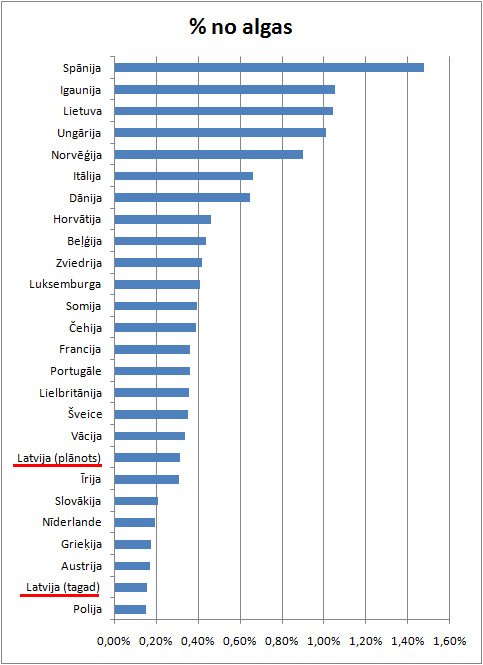
Figure 1. Fine (up to 20 km/h over) vs. average salary
References:
[1] Latvian Administrative Violations Code - http://likumi.lv/doc.php?id=89648
[2] Proposed amendments to the Latvian Administrative Violations Code - http://www.csdd.lv/lat/noderiga_informacija/normativie_dokumenti/dokumentu_projekti_un_diskusiju_dokumenti/?doc=2246
[3] Permitted driving speeds and fines in European countries - http://www.apollo.lv/zinas/atlautais-brauksanas-atrums-un-soda-naudas-eiropas-valstis/285801
[4] List of countries by average wage - http://en.wikipedia.org/wiki/List_of_countries_by_average_wage
comments