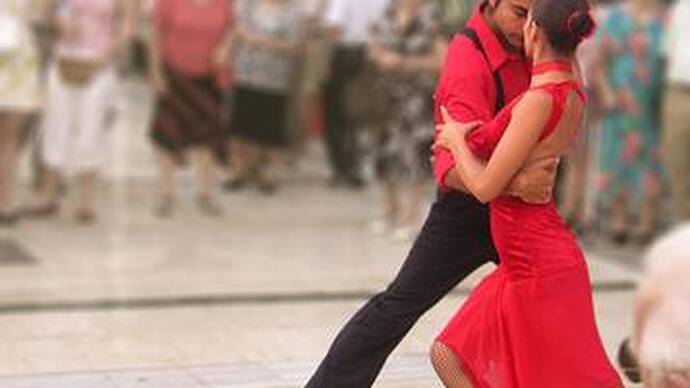
Mauricio Wainrot's Ballet "Tango Plus. Journeys."
Tango, to me, is associated with quite an intimate interplay of bodies. Of bodies specifically, not of souls. A dance danced in the street, on cobblestones, beside a café, beside a drainage gutter, in the presence of curious eyes, in defiance of oneself, one's partner, or someone watching.
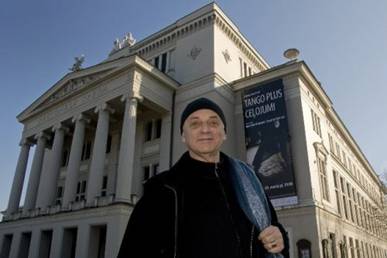
On the evening of 29 April, we had the opportunity to visit the Latvian National Opera and watch the productions of Argentine choreographer Mauricio Wainrot. These are two one-act ballets, which, in my view, differ from each other quite starkly in atmosphere.
You can read more about the production itself at various websites, for example: http://www.music.lv/opera/Ballets/tangoplus/, but what follows are my purely subjective reflections.
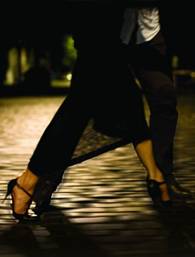
The first act, Tango Plus, created a certain atmosphere of an urbanised environment - city noise, bustle, asphalt or grey cobblestones, artificially lit streets in the late afternoon, haste, feverishness. Initially a unisex impression, then as if from the collective mass a couple separated, who danced out their relationship in this urban environment. I would not say, however, that these were lasting relationships filled with fine feelings - rather fleeting, hurried like the city itself, but undoubtedly passionate. The music unmistakably tango, but the dance elements from tango nevertheless very loosely applied. In my view, quite a lot of polished, pure classical ballet movements.
The second act, Journeys, was much more colourful and musically varied. This was naturally determined by the central idea - a journey through several countries, their cultures, and rhythms. In imagination one could visit Mongolia, France, Israel, Java, Turkey, Kurdistan, Bulgaria, Brazil, Belarus, Argentina, and India. The movements much more primitive, natural, and free. At times evoking associations with ritual dances, orgies, or battles. The dance revealed more the natural beauty of the female and male body in simple movements. The dance unmistakably of nature, not within city walls. In the interplay of light with the plasticity of the dancers' bodies one could feel the hot southern sun, sultry nights, arid ground, the expanse of the steppe, the flow of water, the glow of sunset. More colourful, longer-enjoyable, in terms of atmosphere not as draining as the first act.
About tango
Tango, to me, is associated with quite an intimate interplay of bodies. Of bodies specifically, not of souls. A dance danced in the street, on cobblestones, beside a café, beside a drainage gutter, in the presence of curious eyes, in defiance of oneself, one's partner, or someone watching. When we were trying to learn tango several years ago, I was very fond of the feature whereby in this dance the woman takes the first step, while the man initially retreats - unlike in the waltz or foxtrot. The bodies seem to lean onto each other, push against each other. Sharp movements alternate with held pauses. But that's how it is - nostalgia - so now a little about the history of tango.
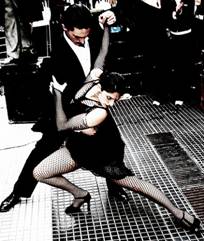
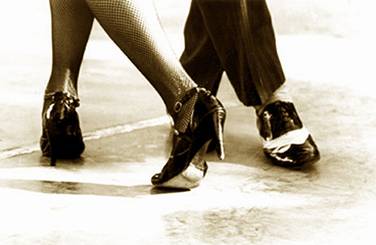
The origins of tango are to be found in Buenos Aires and Montevideo at the end of the 19th century, when many immigrants from Europe, primarily young, unmarried men, arrived in these cities in search of fortune and earnings. Initially tango was one of the ways for these young men to express their creative spirit and at the same time their superiority over rivals and to try to impress the numerically scarce women - often it was precisely the best dancers who managed to marry and start families. At the beginning of the 20th century, tango became popular in Europe as well, when it was brought to Paris by sons of Argentina's best society families who had gone to the Old World to study. From France, the tango craze spread further through Europe and around the world, making its way also into the music market.
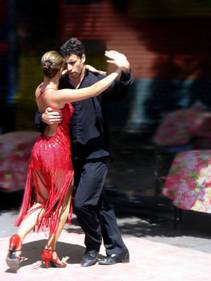
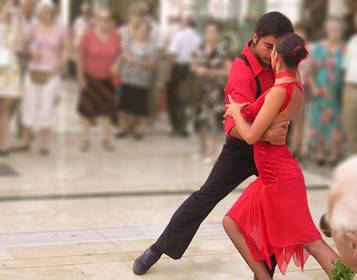
Through various historical vicissitudes, tango in its homeland has been both worshipped and completely rejected - to the extent that tango dancers were forced underground - until at the beginning of the 1990s a new wave of tango enthusiasm swept the world. Moreover, it is specifically authentic Argentine tango, rather than its European variant, that has become especially popular. Tango encompasses the widest spectrum of emotions: loneliness, sadness, longing, love, jealousy, desire, trust - a great wealth of human relationship, and every dance is a story that arises right on the dance floor.
Tango music is unimaginable without Astor Piazzolla (1921–1992), his compositions, and the art of bandoneon playing. Piazzolla's music also sounds in the "Tango Plus" production.
Argentine tango dance studio in Riga: http://www.tangostudio.lv/
comments