
Is Access to VMware Being Blocked on Behalf of the Latvian Government?
It has come to light that the Lotteries and Gambling Supervisory Inspection, subordinate to the Ministry of Finance, has - either by mistake or deliberately - blocked access to the VMware knowledge base using administrative resources at its disposal.
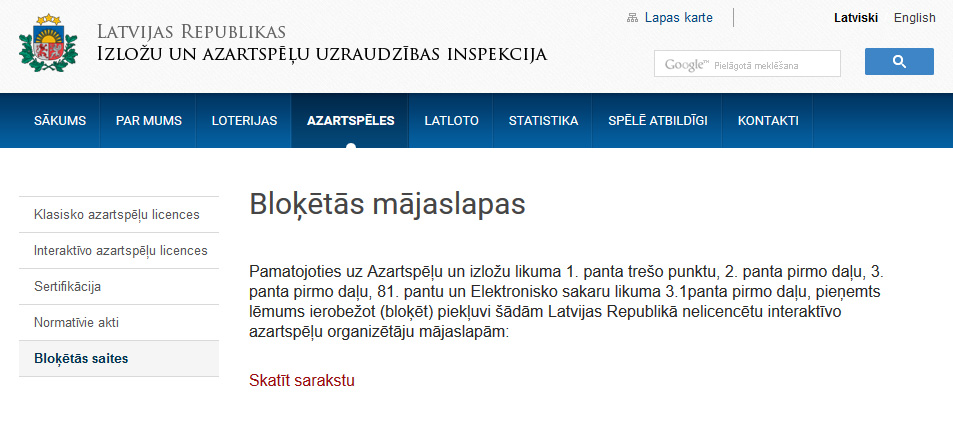
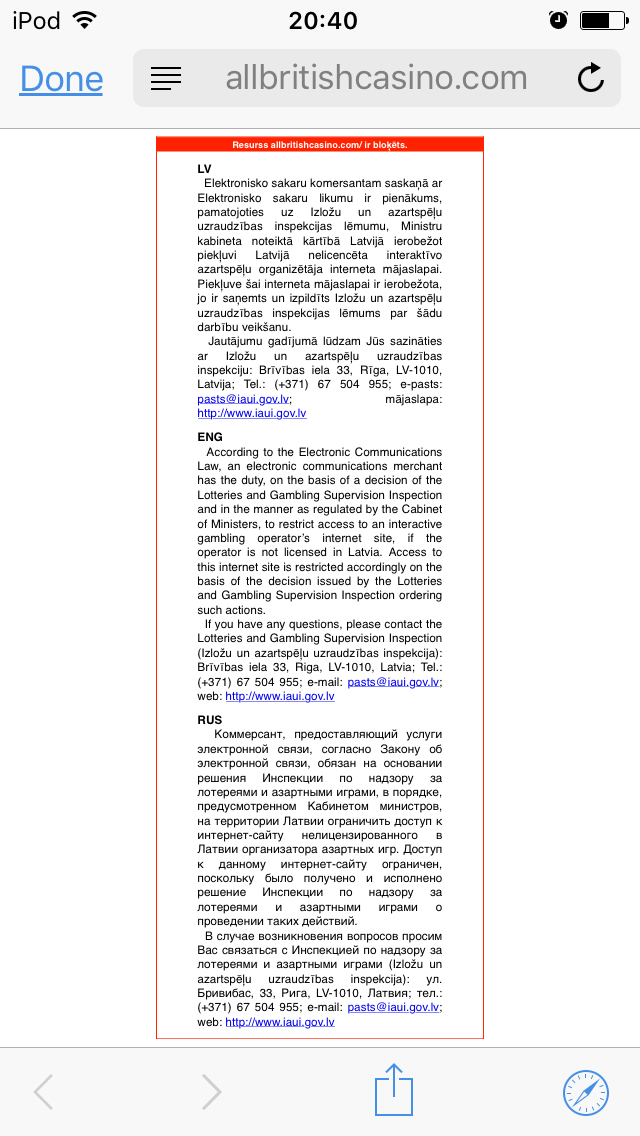
The website of the Lotteries and Gambling Supervisory Inspection does not contain a list of blocked IP addresses - only information about blocked domains. Since blocking domains is quite complicated (users don't always use their ISP's DNS servers), IP addresses are blocked. ISPs approach the requirement to block sites quite creatively. For example, BasNet has blocked both kb.vmware.com and the prohibited domains. Bite appears to be similar. With LMT internet, kb.vmware.com can be opened but the prohibited domains cannot. LTK is similar, though the message differs (see image 1 in the gallery). Livas can open everything. :)
Legal Aspect
Section 81 of the Gambling and Lotteries Law stipulates that supervision and oversight of how gambling and lottery organisers comply with this law, other regulatory acts and gambling or lottery rules is carried out by the Lotteries and Gambling Supervisory Inspection. The Inspection, based on Section 19, paragraph 22 of the Electronic Communications Law, issues a decision in accordance with Cabinet Regulation No. 291 "Procedures by which the Lotteries and Gambling Supervisory Inspection prepares and sends a decision on restricting access to websites of unlicensed interactive gambling operators in Latvia", which obliges electronic communications operators to block access to the specified pages within 5 days.
Cabinet Regulation No. 291 provides that the Inspection sends to each electronic communications operator (i.e. only registered ones) no less than once per quarter a copy of the decision specifying: the domain name, IP addresses (there may be several) and the Inspection's decision number. The Inspection is not obliged to make this information public, but neither can this information be secret.
Neither the law nor the Cabinet regulations establish the procedure by which the Inspection cancels a request if the included (blocked) IP address has changed or is no longer linked to the specific domain name. Only the involved party is entitled to request unblocking of an IP address - i.e. the gambling site if it has, for example, legalised its operations, or the electronic communications operator if an IP address belonging to it has been blocked - but not the internet user or ISP. Nor does the law establish the procedure (which is therefore determined internally by the institution) for how domain monitoring is conducted (I assume on the basis of complaints) and decisions about IP addresses to be blocked are made. It is not difficult to conclude that the Inspection can "make mistakes" and request the blocking of any IP address.
Theoretically, Microsoft (or anyone else) could try to "arrange" with the Inspection to have an undesirable IP address blocked.
Of course, such an arrangement would not be lawful and evidence would be required to invoke it. However, it is virtually impossible to prove that the said (blocked) IP address had not been associated with the domain at some point. True, the Inspection is allowed to "make mistakes". :)
Technical Aspect
When registering a domain, DNS servers are specified which, alongside this domain, also hold information about many other domains. With regard to a specific domain, the DNS server stores the IP address (one or more) of the server where the web page itself is located. Domain registration is not tied to any specific IP address. This IP address can be changed without any restrictions. Moreover, one host's IP address can serve multiple pages for different domains. As a result, it is inevitable that situations can arise where blocking an IP address effectively blocks access to several mutually unrelated pages. And here it depends on how technically knowledgeable the Inspection is and whether it can track changes, acknowledge and cancel erroneously blocked IP addresses. The chaos and illogic of the Inspection's decisions will most likely lead to electronic communications operators ignoring them or implementing them selectively, as seen in observations with different ISPs.
comments