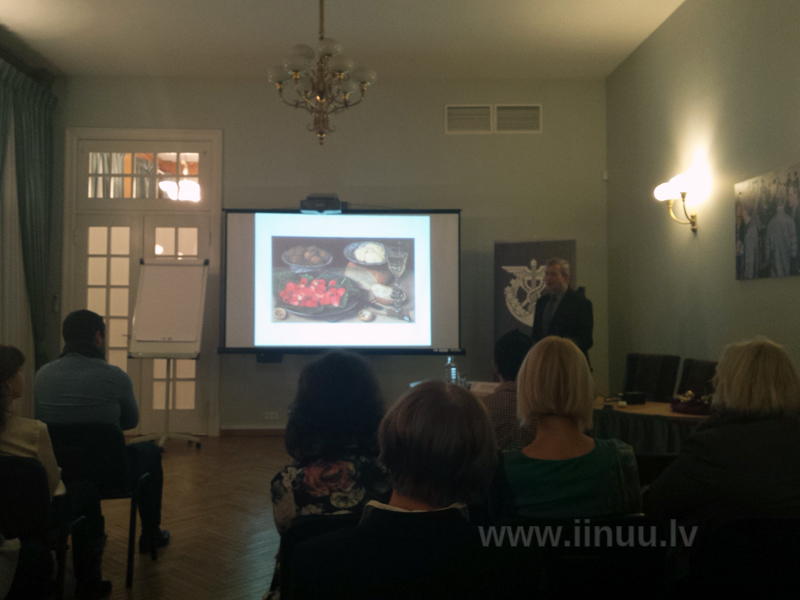
Ojārs Spārītis's Lecture on Art Perception Through Five Plus One Senses
One must agree with the lecturer's observation: if you look at a painting for one minute, you can notice only a pleasing composition or colours; if you look for five minutes, you already see the subject; but if for ten minutes - you can discern the conflict depicted in the painting.
This evening I came home from a LTRK appreciation event for partners full of inspiration. To be honest, I had not expected that a talk on such topics as Emperor Rudolf II and the most beautiful house of worship in Kurzeme - Zlēkas - as well as Dutch 17th-century still lifes, their motifs, and their symbolic meaning, could be so captivating.
Of course I will not be able to report all the many facts or convey the emotional enthusiasm that the President of the Latvian Academy of Sciences and art scholar Mr. O. Spārītis had invested in his talk, but I am happy to share the insights and interesting discoveries I took away.
The speaker noted right at the outset that business and art are not mutually distinct concepts, because in all ages wealthy and commercially successful people are those who have supported art and culture. He also pointed to the fact that during the Renaissance, in the 16th century and the early 17th century, Latvia was by no means on the cultural periphery of Europe. For example, the volume of silver crafts was even greater than in countries that mined silver themselves.
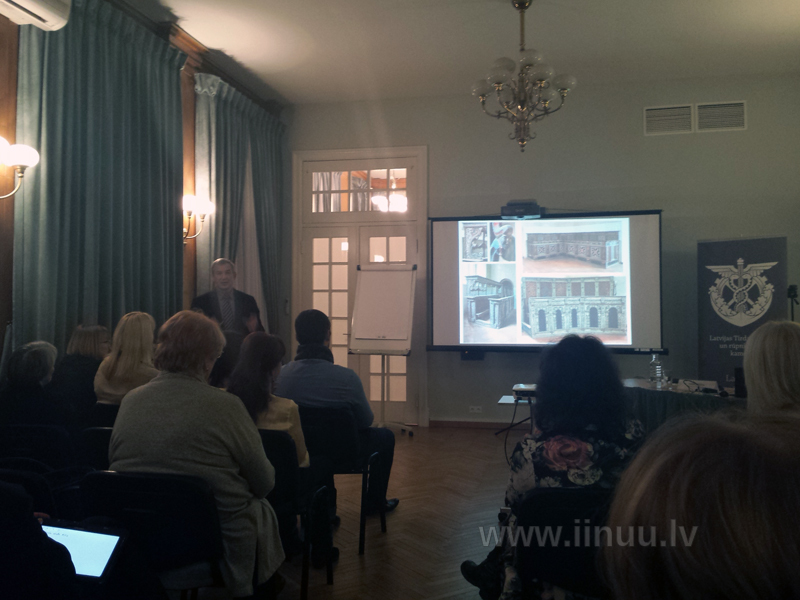
The talk centred mainly on Ulrich von Behr and the von Behr family, who held large land estates in Kurzeme and owned several manors, including Ēdole and Zlēkas. In the latter, a church was built that is notable for its magnificent wood carvings. The confessional bench alone is worthy of a separate story - it depicts scenes of the creation of the world, the five human senses through which one perceives God's created world, and three cardinal virtues symbolised by a cross, an anchor, and a heart. There is also a curious painting - a woman carrying a beam of wood. This refers not to physical but spiritual strength, generated by faith.
If for some (the peasants or serfs, as they were called) such little scenes served as instruction or illustration for the pastor's sermons, then for others (educated noblemen) they were food for intellectual reflection.
The second part of the lecture was devoted to the five human senses - hearing, taste, touch, smell, and sight - plus one further sense or perception: the perception of art. Here Mr. Spārītis showed various Renaissance paintings and analysed the symbols depicted in them: the apple, the sliced lemon (contrast), cherries (temptation), the pomegranate (resurrection, human procreation), lilies (the purity of a maiden), iris, and so on.
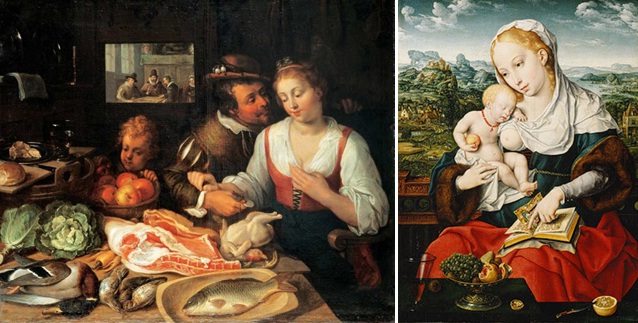
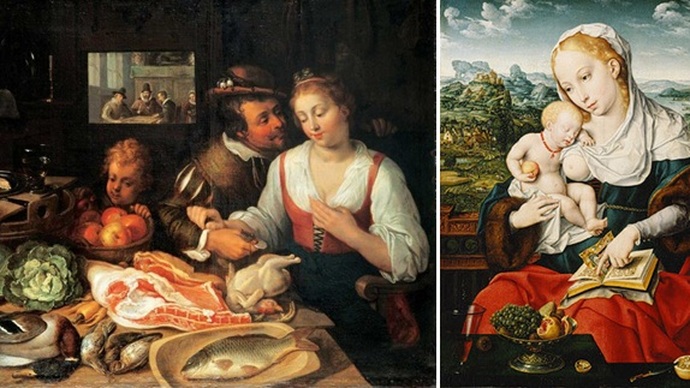
With this immersion in paintings - primarily Dutch still lifes - came insights about human pleasures, which Renaissance artworks so willingly spoke of. Enjoyment alongside a warning about excess that leads to slipping into idleness and apathy. But also about a person endowed with the capacity to appreciate their own prosperity. Because usually, when something begins to be lacking, only then is a person capable of recognising that they were happy.
Paintings with abundantly laid tables - such as Pieter Bruegel's "Peasant Wedding" - are the dream of a person always hungry. Eating fish comparable to the Communion bread that Christians receive as a unity with Christ. Rubens's full, prosperous, pleasure-enjoying bodies. The transience of life in the symbols of a soap bubble and the flame of an almost burned-out candle.
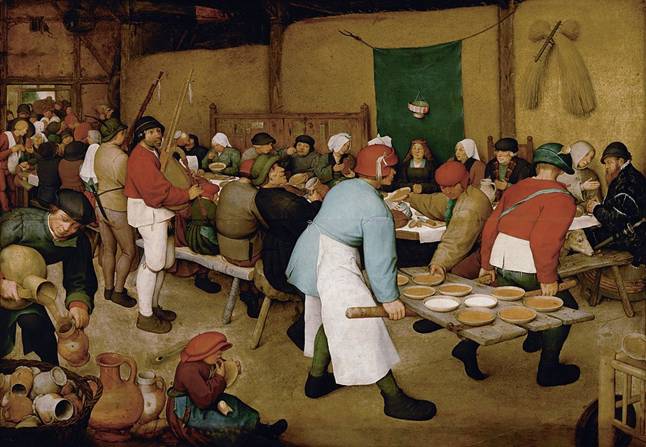
Pieter Bruegel "Peasant Wedding" (1566–69)
The parrot - the third being in Paradise, besides Eve and Adam, who could speak - or more precisely, repeat words. From this, the theory about the reversed form of the word "Eva": "Ave" - "Ave Maria" (Hail Mary).
An interesting thought was raised about crucifixes, which are found primarily at crossroads. I would never have thought that they might serve as memorial markers for unknown wandering beggars, who were buried right there by the roadside, at crossroads.
In closing, one must agree with the lecturer's observation: if you look at a painting for one minute, you can notice only a pleasing composition or colours; if you look for five minutes, you already see the subject; but if for ten minutes - you can discern the conflict depicted in the painting.
comments