Dance for Three
On Thursday evening we went to the "Rīga" cinema to watch the premiere of the new Latvian film "Dancis pa trim" (Dance for Three) together with the film's creators. The evening included: soldiers' songs, the appearance of the film crew, a moment of silence in memory of those who have passed, a glimpse into the making of the film, and the film itself. I was glad that the events depicted and the characters were not idealised.
On Thursday evening, 3 March this year, we went to the "Rīga" cinema to watch the premiere of the new Latvian film "Dancis pa trim" (Dance for Three) (2011) together with its creators. The foyer and later the auditorium were full of familiar and less familiar faces. Several people had cameras and smartphones in hand, flashbulbs going off constantly. One wanted to immortalise the evening's chief culprit, director Arvīds Krievs; another the writer Jānis Peters; another the government representatives led by Sarmīte Ēlerte; another the remaining artists, actors and musicians.
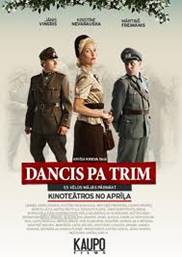
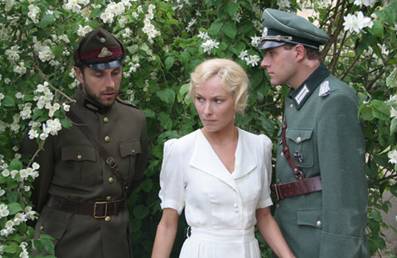
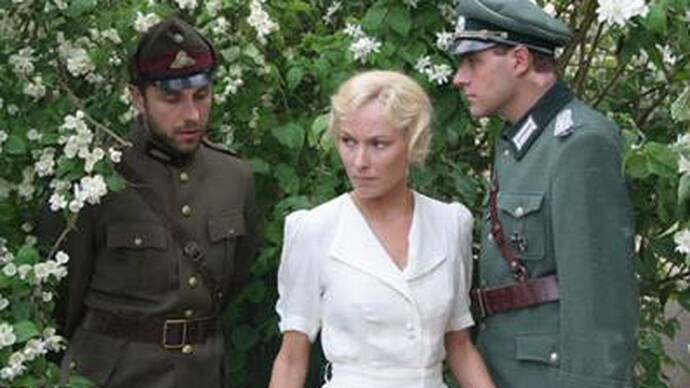
Film poster & the lead roles - the "love triangle": the great Latvian soldier (Jānis Vingris), Sandra (Kristīne Nevarauska), German officer (Mārtiņš Freimanis)
The evening began with old soldiers' songs accompanied by accordion and drums, performed by the men's ensemble "Vilki," which set the mood for the historical backdrop depicted in the film. This was followed by the director and the entire film crew appearing on stage, a moment of silence in memory of four members of the team who, during the long period of the film's creation (5 years), had left this world - cameraman Dāvis Sīmanis, actors Leonīds Locenieks, Kristīne Bēdele, and one of the performers of the lead roles, Mārtiņš Freimanis. Footage from the making of the film. Then the film's music composer Mārtiņš Brauns took his seat at the piano.
"Vilki" song "Bunkurs 13"
After watching the film I could not for a long time formulate the feelings and thoughts that had arisen. There was no real ache or emotional stirring at the rather tragic fates of the characters depicted. But there was certainly satisfaction that the filmmakers have brought to light and told the Latvian public about a very significant historical fact that must not be forgotten. The action takes place in 1944–1945 in Kurzeme, where the destruction of Latvian General Jānis Kurelis's group is depicted. The Kureļi - who in those turbulent times did not wish to side with either the Russians or the Germans, but were determined to stand firm to the end for a free Latvia.
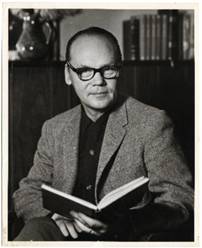
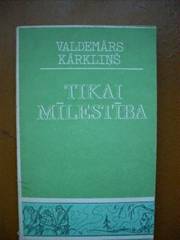
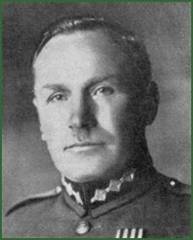
Writer Valdemārs Kārkliņš (1906–1964) & novel "Tikai mīlestība" (1992 edition) & Jānis Kurelis (1882–1954) - General of the Latvian Army, holder of the Lāčplēsis War Order, commander of the Kurelis Group (1944)
The film's plot is based on the novel "Tikai mīlestība" (Only Love) published in 1959 by émigré writer Valdemārs Kārkliņš, which depicts a true event about ten (reduced to four in the film) deserting legionaries sentenced to death by the Germans. I was glad that the events in the film and the characters were not idealised. I agree with the thought expressed by director A. Krievs in an interview: "What attracted me was that Kārkliņš, unlike some other émigré writers, is not an ura-patriot, and therefore there is more truth in his works. Kārkliņš does not idealise his characters - they are living people with their own weaknesses and at the same time deeply human. A person in extreme circumstances at a decisive moment in Latvia's future."
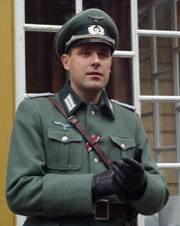
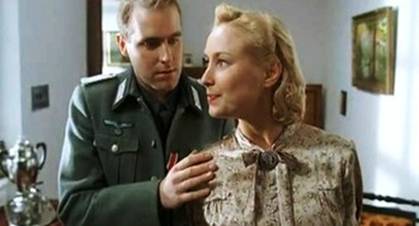
Mārtiņš Freimanis (Ginters) & Kristīne Nevarauska (Sandra)
In any case, the German lieutenant Ginters Hartvigs portrayed by Mārtiņš Freimanis seemed far more likeable, with the capacity for self-sacrifice in the name of love for the Latvian girl Sandra (Kristīne Nevarauska). That is, to think in higher terms - not "you will be mine because I love you," but "I will do everything so that the one I love may be happy, even if that means renouncing being together with her." The great soldier Alfrēds Smilga, portrayed by Jānis Vingris, was nonetheless much more simple-minded and gentle in his feelings. As for Sandra - there is also the question of whether she truly loved either of the two men at all. She needed both and wanted to please both. Could Sandra's character be Latvia itself in the fire of war?
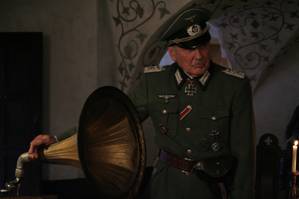
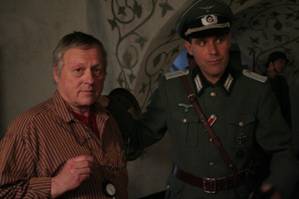
Actor J. Bartkevičs (German Colonel Šulcs) & director A. Krievs and M. Freimanis (German Lieutenant Ginters)
Of course, one can nitpick at details that seemed a little illogical in the film. For example: an attack begins, shells explode all around, but a white swan in the Jaunpils pond peacefully goes on swimming. At times one wanted more wear, more authenticity in the 1940s scenes at the forest warden's house and the manor. Looking with an untrained eye, however, it was easy to notice the distinction between the professional actors' performances and the engagement of non-actors. Juris Bartkevičs was excellent in the role of German Colonel Štāls. The auditorium completely held its breath during the scene where he spoke in his manor office with a well-fed tomcat in his arms. His gestures and facial expressions were natural and suited to the role. Subjectively, or perhaps too stereotypically, Lauris Reiniks did not seem to me to fit his portrayal. For Mārtiņš Freimanis, acting ability seems a gift of nature rather than a skill acquired in advanced courses. His diction bothered me slightly in the internal monologues of Atis, but in the German officer role he was convincing. The attempt to play with symbols - red, juicy crab apples and jasmine - in my view never quite came off. But perhaps that was not the intention either, though elaboration would have added emotionality, ache and a focus on inner experience.
In summary, the film must be seen - both for the historical fact and for the aftertaste that comes later, but does come and does remain.
Film homepage - www.dancispatrim.lv
comments