The Film "Experimenter" (2015)
Yet another film as a sweet course for the little worm of thought that gnaws at the mind. Not very engaging emotionally or visually, but another timely, essential invitation to think - how evil or how spineless or uncritically thinking can a person actually be in the face of authority and the crushing opinion of society.
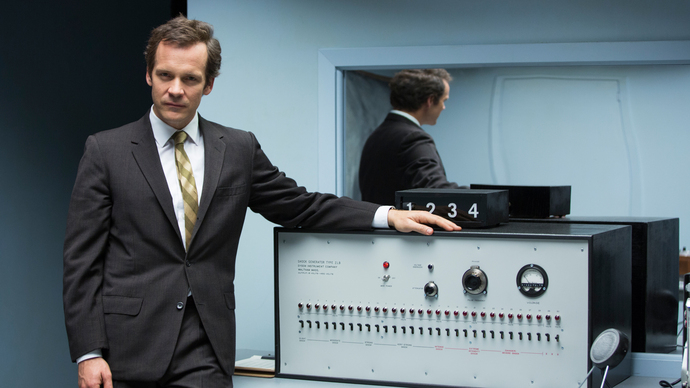
The film "Experimenter" (2015) is indeed the story (a screen adaptation on the boundary between feature and documentary film) of the American social psychologist of Jewish origin Stanley Milgram, who in 1961 conducted an experiment on human obedience to authority that caused outrage in the scientific community and broader society.
The impetus for such an experiment he found in the Nazi war trials, most of which took place in those post-war years, and in which the accused justified themselves by saying they had simply been following the orders of their superiors. Milgram wanted to find out whether an ordinary person in peacetime is capable of evil even when it goes completely against that person's nature, but is demanded by authority.
Stanley Milgram's Obedience Experiment
The experiment involved people - volunteers who had responded to an advertisement in newspapers for participants in a study on memory. In the experiment two participants were present simultaneously: one was the "learner" and the other the "teacher." The "learner" alone was one of Milgram's associates who knew the nature of the experiment. The "learner" was placed in a separate room, while the person playing the role of "teacher" was in another room together with the experiment's conductor - the "authority."
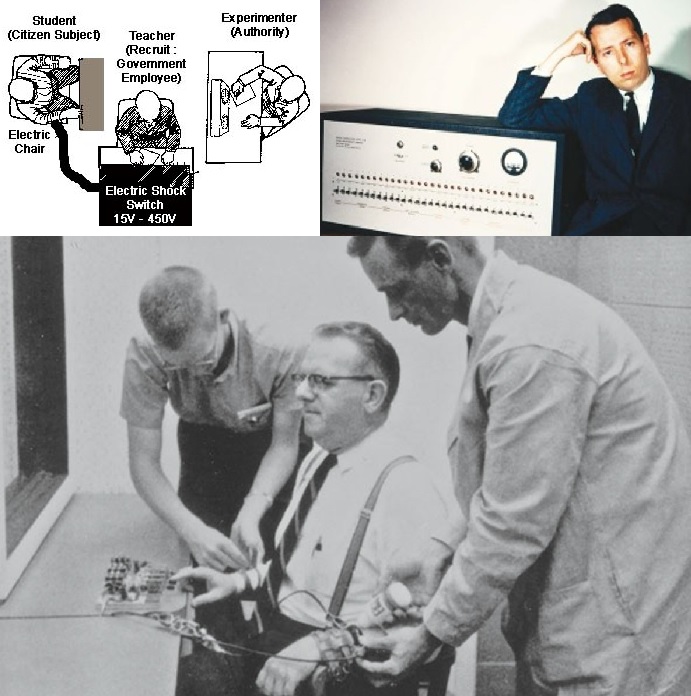
The "teacher's" task was to ask questions of the "learner." If the "learner" answered incorrectly, the "teacher" had to punish them with an electric shock. With each incorrectly answered question, the voltage increased from 15V to 450V (the last level marked XXX - lethal).
Beforehand the "teacher" had the opportunity to feel the lowest voltage level on their own wrist. They were also shown how the wires were attached to the "learner's" hands. Notwithstanding the fact that during the experiment the "teacher" heard screams from behind the wall with pleas to end the experiment, the experiment continued. It was also considered an incorrect answer if the "learner" at the end gave no answer at all. The experiment continued.
If the "teacher" showed doubt or hesitated, the experiment's conductor - the "authority" - encouraged them with phrases:
- Please continue!
- The experiment requires that you continue.
- It is absolutely necessary that you continue.
- You have no other choice, you must go on.
If the "teacher" began to inquire whether the "learner" was being harmed, the "authority" had to explain that even if the "learner" feels pain, it will leave no visible injury on their skin. Or alternatively - you must certainly continue until the learner has learned the correct answers to all the questions (thus invoking the teacher's sacred mission - to teach, no matter what).
In the feature film a further phrase was quoted: that the experiment's conductor takes full responsibility for what is happening, so the "teacher" need not worry. And alas, how much people love to hear such phrases - that someone else takes responsibility for what he does or fails to do (a manager, a leader, for example)!
The results were shocking: 65% of the experiment's "teachers" (the real participants) went all the way to the lethal voltage level, notwithstanding the fact that during the experiment they were nervous, doubtful or showed extreme distress (clutched their head, furrowed their brow, clenched their hands into fists until their nails dug into their palms, pounded the table, etc.).

After the experiment the participants were questioned. Many acknowledged that it had made them think about their own nature. Some told their household members, almost all of whom maintained that had they been in the "teacher's" place, they would have stopped the experiment. Others expressed outrage that they had been misled, lied to (choosing, in other words, the tactic - attack is the best defence).
Even greater resistance awaited Milgram's experimental results in scientific circles. Previously, 39 surveyed psychiatrists had predicted that at best 20% of the participants would go as far as the mid-range voltage level. It turned out that human beings are fundamentally far more evil and capable of submitting to authority without particular resistance.
Milgram even had to leave Yale University, where he had been teaching. But he did not cease researching this feature of human nature. In 1963 he published the book "Behavioral Study of Obedience," and in 1974 "Obedience to Authority: An Experimental View."
Milgram's findings gained popularity only in the 1980s, when totalitarianism, authoritarian regimes and techniques for influencing public opinion were widely discussed. George Orwell's works "Animal Farm" and "1984" were snapped up from bookshop shelves. American television began to think about reality shows, which to a degree are based on experimenting with human behaviour and public opinion.
Some Conclusions
- Milgram's experiment showed that in peacetime, in an ordinary society, without special threats or physical coercion, at least two-thirds of citizens are prepared to kill a fellow human being if authority simply "asks them to do it" or announces that it takes responsibility for it (even though in reality this is merely an empty slogan).
- The experiment was repeated in other locations and with representatives of both sexes. The results were not influenced by whether the "teacher" was male or female. This shattered yet another myth - that women are much more empathetic and less inclined toward aggression.
- The experiment's participants were in no way different from you and me, as Stanley Milgram himself said - "they are also us."
- In the repeated experiments people did not comply with the call to continue the experiment when it was made by another equivalent participant - a person of equal rank - whereas the requests of a higher-ranking person were carried out by the majority, even if they contradicted their own inner convictions.
- Stanley Milgram also has a very interesting theory of six handshakes - the summary of the results of the "Small World" experiment. The central finding is that any person can be deliberately reached within six handshakes. This theory was later developed in connection with social networks, so popular today.
Images in the article sourced from blog.eternalvigilance.me, www.psmag.com, www.imdb.com, en.wikipedia.org/wiki/Milgram_experiment
comments