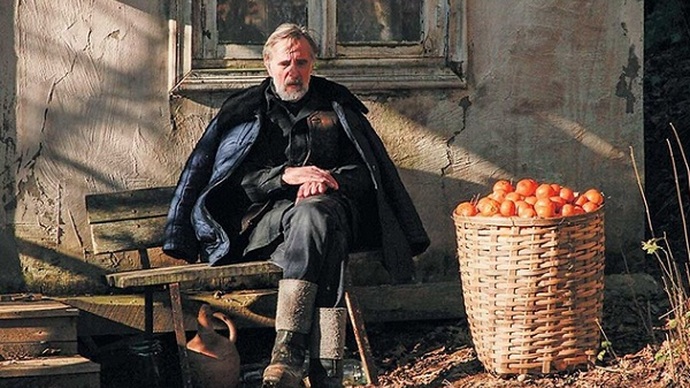
The Film "Tangerines" (2013)
The main character at the end of the film poses a fundamental question - does it matter? In war it is not an Estonian, a Chechen, a Georgian or a Russian who is killed - in war ordinary people are killed, each of whom has their own life, loved ones, parents or children. War takes everything; death has no nationality. A grave has no nationality.
I wanted to write the film's title in Estonian - Mandariinid - with the language's characteristic double vowels. Even though the film's director is Zaza Urushadze and it is an Estonian-Georgian co-production.
The action takes place in the recent past - in 1992 during the Abkhazian War, in a mountainous region where two Estonians, Ivo and Margus, are busy making wooden crates and gathering a rich tangerine harvest. The reasons why they have not left with the other Estonians back to their homeland are each their own. Margus's reasons are fairly prosaic and rooted in practical concerns - he is not about to let such a harvest go to waste and miss the opportunity to earn money by selling the gathered tangerines later. Ivo's reasons are much deeper, more painful and more torturous to the soul. But the viewer only learns of these in the film's final frames.
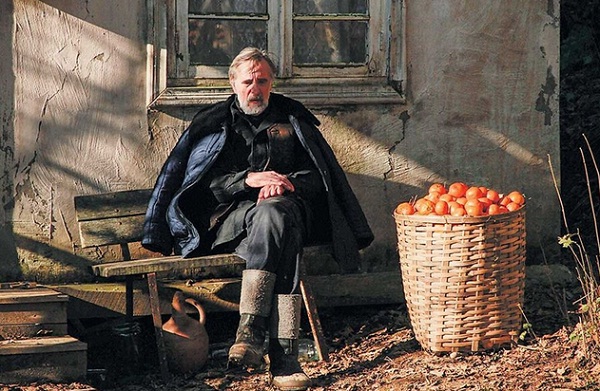
Image from estonianworld.com
At first both characters seem to feign ignorance of the fighting going on around them (at least from the viewer's position, that is how it appears). A calm governs their daily work, but the war makes itself known. Margus's house is blown up, and Ivo, like a caring father, takes it upon himself to nurse two soldiers fighting on opposite sides - the Chechen Ahmed and the Georgian Juhan.
It is interesting to observe how a relationship develops between war enemies, both of whom are by nature men of their word and who have a deep respect and gratitude for Ivo, their saviour. The first reaction - demanded by duty to their fighting side and to fallen comrades - is revenge and killing the other. But later, with Ivo's help, they see in each other simply a human being who shares the same values: family, home, a beloved trade, parents, and so on. In different circumstances, enemies could even be friends.
In one simple scene the filmmakers also sketch such a thing as a culture of war - or, for some nations, its complete absence. Russian soldiers drive up to the house and, unwilling to listen to explanations from the Chechen who is at that moment fighting on their side, shoot him. The Georgian rushes to defend his "enemy" from "his own side." Here again, in the portrayals of the Russian soldiers, is confirmation that narrow-mindedness and non-thinking are the greatest evil.
The main character at the end of the film poses a fundamental question - does it matter? In war it is not an Estonian, a Chechen, a Georgian or a Russian who is killed - in war ordinary people are killed, each of whom has their own life, loved ones, parents or children. War takes everything; death has no nationality. A grave has no nationality.
Also in connection with Ukraine and the Russian military occupation of Crimea, in connection with a possible war, today one wishes to pose the question - does it matter?
comments