Rashism, Vatniks and Other Creatures
Rashism - a quasi-ideology that emerged in the early 21st century in the territory of the Russian Federation. It encompasses an eclectic and contradictory mixture of imperialism, Great Russian chauvinism, Soviet nostalgia and traditional religiosity. A symbiosis of fascist and Stalinist ideologies.
Rashism (Рашизм) - a quasi-ideology that emerged in the early 21st century in the territory of the Russian Federation. It encompasses an eclectic and contradictory mixture of imperialism, Great Russian chauvinism, Soviet nostalgia and traditional religiosity. A symbiosis of fascist and Stalinist ideologies. Its foundation is the Russian Orthodox Church's theory of Russians as a chosen people (богоизбранности русских).
The antithesis of Rashism is Western liberal-democratic values and institutions - free elections, individual freedom and civil rights. In foreign policy, Rashism is used as justification for an aggressive (захватнической) stance, known as "the gathering of Russian lands" (собирание земель русских). Academically, Rashism is not yet formalised. It exists as an instrument for achieving the tactical goals of the Russian Federation's government in the early 21st century. It manifests through daily mass propaganda directed at Russian-speaking populations.
In older sources (no longer publicly available), mention is made of Ivanov Sukharevsky, who reportedly created a self-invented ideology he called Rashism (in English - "russism"), placing in the foreground the supremacy of one nation. The aim of Rashism is to create a link between the pre-revolutionary Orthodox monarchy and Nazism, identifying it in two (film?) heroes - Nicholas II and Adolf Hitler. By his own reckoning, the Russi (in English - russy) are based on 8 branches - Great Russians, Belarusians, Ukrainians, Carpathian Ruthenians, New Russians (on Ukrainian territory), Siberians, Cossacks and Pomors.
Variations in Definition:
Alexander Skobov (Александр Скобов, Russian politician): Rashism is a peculiar variant of totalitarianism and fascist ideology - a symbiosis of fascism and Stalinism.
Andrei Piontkovsky (Андрей Пионтковский, political scientist): In its principles, Rashism resembles fascist Nazism, and in terms of V. Putin's policies and speeches - the ideas of A. Hitler.
Yuri Nesterenko (Юрий Нестеренко, emigrated to the USA in 2010 seeking political asylum): Rashism is an eclectic and contradictory mixture of imperialism, Great Russian chauvinism, Soviet nostalgia and religious traditionalism.
Alexander Kostenko (Александр Костенко, Ukrainian-born academic, professor): The ideology of Rashism is based on an illusion grounded in misconceptions about the interests of Russian society. Rashism violates the principles of international law by imposing on the world its own version of historical truth, derived from Russian interests.
Oleg Leusenko (Олег Леусенко, Ukrainian politician): Rashism has become the governance ideology and practice of Russia, based on the idea of the supremacy of Russian co-citizens and Soviet-imperialist neo-colonialism. Russian Orthodoxy is used as a moral doctrine. Emphasis is placed on geo-economic instruments - primarily energy.
Vatnik
Vatnik (Ватник) - a rank-and-file apologist of Rashism. Characteristic psychological feature: inability to think independently and critically; susceptibility to influence. Often poorly educated. Circulates decontextualised, slogan-form slogans with a Rashist tendency (e.g. Крым наш! - "Crimea is ours!"). The Vatnik's information consumption model is closely tied to television: in the active functioning phase, 2–3 hours of televised propaganda per day are required.
Khuilo
Khuilo (Russian - Хуило, English - khuilo) - a person who has provoked dislike, disgust or a negative attitude during heated arguments in some inebriated or smoke-filled company. Possibly something said as a joke with the aim of embellishing the story or making a greater impression on listeners. With Russia's aggression against Ukraine in 2014, this expression was also applied to Putin. [3]
St. George Ribbon
The St. George Ribbon (in critically inclined literature also known as the "Colorado ribbon") - the distinguishing mark of aggressive Rashism supporters. Used during acts of vandalism and violence. Rashists identified themselves with it at rallies, marches, attacks on those expressing alternative views, and in occupied territories. The idea of using the St. George Ribbon as a symbol arose before Rashism consolidated its status as the dominant ideology. Initially it served as a commemorative accessory at 9 May celebrations - dedicated to the Allied victory over fascist Germany in the Second World War (in the Russian version).
The St. George Ribbon is now rarely used in its original meaning.
Wikipedia
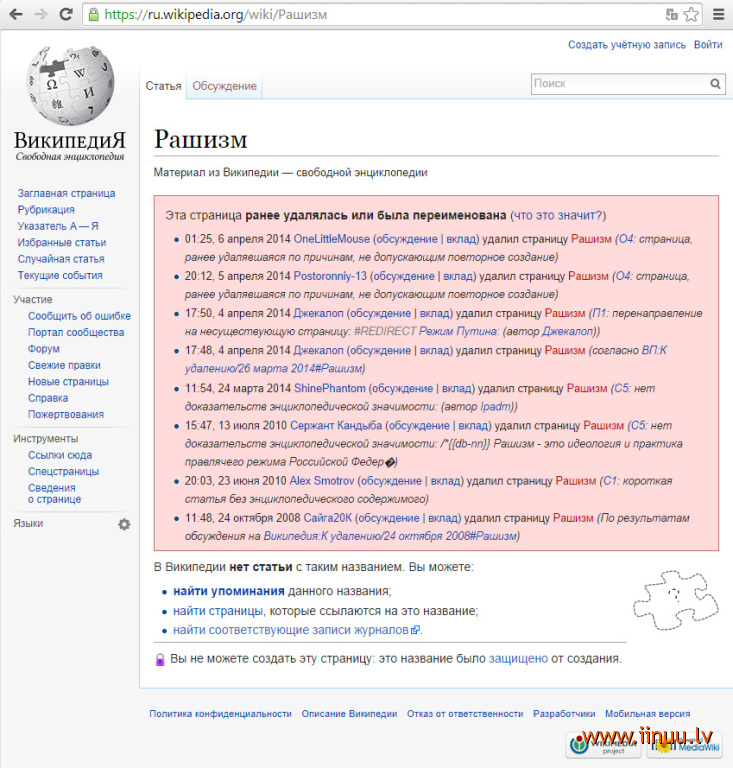
Efforts to include a definition of Rashism in the "open" encyclopaedia Wikipedia date to 2008, when Russia launched its aggression in Georgia. For some time, the definition of Rashism was available in English and Russian. With the start of Russia's aggression in Crimea and then in Ukraine in March 2014, the entries were deleted on the grounds that "the definition is not encyclopaedic."
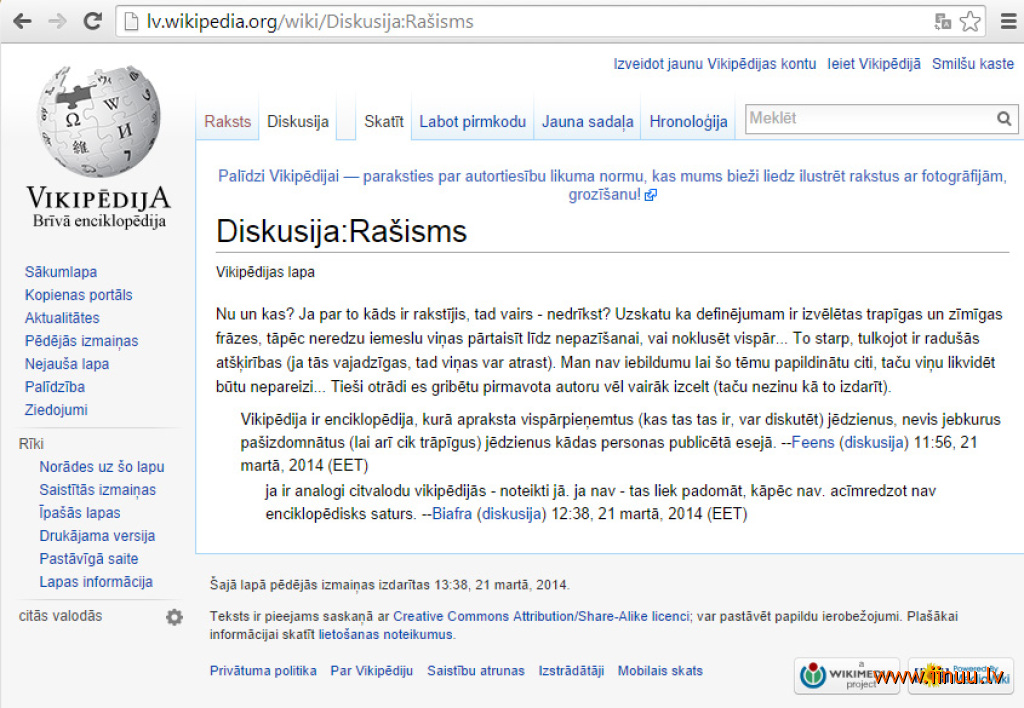
In the Latvian version, the content guardians surpassed themselves in their expertise and the article was deleted in a flash, on the grounds that the content had been translated (from a blog post), despite the fact that the article contained no images or other copyright objects. Currently the only language in Wikipedia in which a definition of Rashism can be read is Ukrainian. [2]
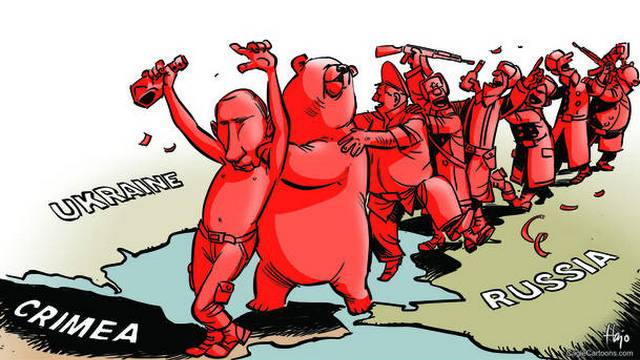
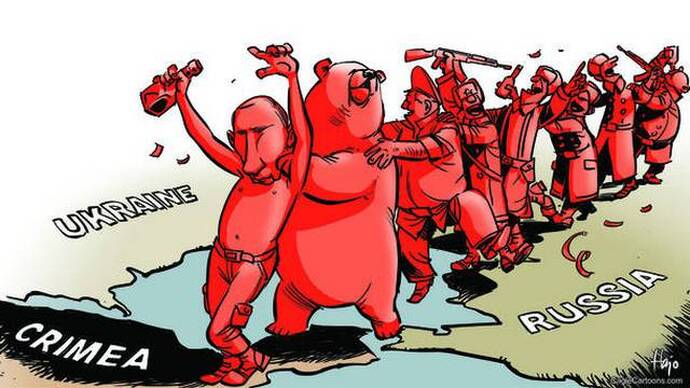
Illustration: Hajo de Reijger @ politicalcartoons.com
Sources:
[1] http://styazshkin.livejournal.com/919731.html?thread=6335155#t6335155
[2] http://uk.wikipedia.org/wiki/%D0%A0%D0%B0%D1%88%D0%B8%D0%B7%D0%BC
comments