
Saint Valentine's Day and Valentine's Day Traditions
Valentine's Day is celebrated on 14 February. But who exactly was Saint Valentine, now called the patron of all lovers? The history of Valentine's Day's origins, as well as information about Saint Valentine himself, is rather obscure and imprecise, yet it is known that this day combines the traditions of both Ancient Rome and the Christian world.
Valentine's Day is celebrated on 14 February. But who exactly was Saint Valentine, now called the patron of all lovers?
The history of Valentine's Day's origins, as well as information about Saint Valentine himself, is rather obscure and imprecise, yet it is known that this day combines the traditions of both Ancient Rome and the Christian world.
One legend tells that Valentine was a priest of Ancient Rome. When Emperor Claudius II (3rd century AD) concluded that unmarried men made better soldiers than those with wives and families, he banned young, unmarried men from marrying. That was a vast number of potential soldiers! Priest Valentine, who understood the injustice of this decision, refused to submit to the emperor's order and continued secretly marrying couples in love. When Valentine's disobedience was discovered, Claudius sentenced him to death.

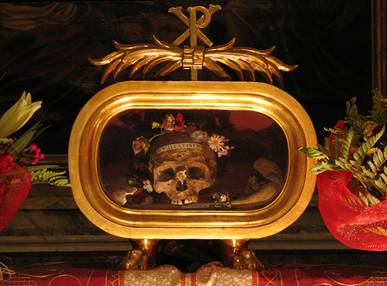
St. Valentine in a church window stained glass Relics of St. Valentine in the Church of Santa Maria in Rome
Other legends tell that Valentine was punished for attempting to arrange the escape of Christians from Roman prisons. As is known, Christians were once mercilessly persecuted and tortured in Rome.
Yet another legend tells that Valentine sent the first greeting to himself. The imprisoned priest was said to have been allowed to meet a young girl, possibly the daughter of the prison warden, with whom Valentine fell in love. Before his death, Valentine left her a letter signed with the words: "Your Valentine" - a phrase used as a signature on Valentine's Day greetings to this day.
Although legends tend to be considered unreliable, they portray the priest Valentine as a sympathetic, heroic and - most importantly - romantic figure. It will come as no surprise that in the Middle Ages, especially in England and France, Valentine became one of the most popular saints.
Opinions also differ on why Valentine's Day must be celebrated specifically in February - some historians claim this is connected with the death of priest Valentine around the year 270 AD, while others claim that the Christian church once decided to declare these celebrations specifically in February, thereby attempting to give a Christian spirit to the pagan Lupercalia festival.
In Ancient Rome, February was the official beginning of spring, and it was considered a time of purification. Special rituals were performed in homes - dust was cleaned away, and salt and wheat were scattered throughout the rooms.
The Lupercalia festival began on the Ides of February, the 15th. These were fertility and harvest celebrations held in honour of Faunus, the Ancient Roman god of agriculture, and Romulus and Remus, the founders of Rome.
At the start of the festival, members of the Roman priestly order of the Luperci gathered in the sacred cave where, according to belief, a she-wolf known as Lupa had nursed the founders of Rome, Romulus and Remus. The priests first sacrificed a goat, which was to ensure fertility, and a dog, symbolising purification. Then boys cut the hide of the sacrificed goat into strips, dipped them in blood and then gently struck both women and fields of grain with the bloody strips. Roman women were said not to fear this touch, as it ensured a greater likelihood of becoming a mother in the following year. According to legend, later during the celebrations all the maidens of Rome placed slips with their names in a large urn. Each unmarried man of the city then drew a slip with a woman's name, forming a couple for the coming year. These randomly chosen pairs quite often also married.
In 498 AD, Pope Gelasius declared 14 February as Saint Valentine's Day. The Roman "couples' lottery" was declared unchristian and banned by law. Later, in the Middle Ages, 14 February was considered the "Day of the Mating of Birds", adding further romance to the idea of Valentine's Day.
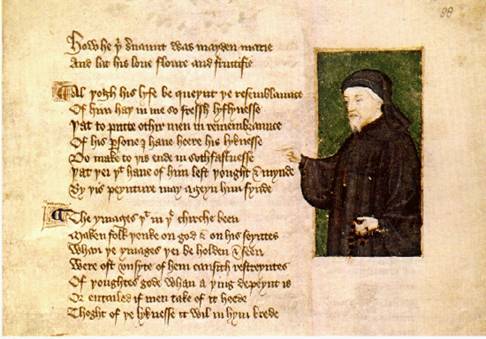
One of the earliest sources (1412, England) in which Valentine's Day is mentioned
The oldest known Valentine's Day greeting still exists today - it is a romantic poem written by Charles, Duke of Orléans, who was captured at the Battle of Agincourt and imprisoned in the Tower of London, to his wife. Written in 1415, the greeting can currently be viewed in London at the British Museum.
In England Valentine's Day has been celebrated since the 17th century. In the mid-18th century, the tradition of sending small gifts or handwritten notes quickly spread among lovers and friends of all social classes. In medieval England on Valentine's Day, young people also chose their "Valentine". Several young people would gather and write girls' names on slips of paper, toss the slips into a hat, and each draw their "Valentine". The drawn girl became the drawer's "Valentine" for a whole year. This meant one had to dedicate sonnets to the chosen girl, accompany her everywhere - in short, behave as a true gentleman. There was also a tradition of dressing children in adult clothing, and children would go from house to house singing songs about Saint Valentine.
By the end of the century, handwritten notes were replaced by printed cards - these became widely available thanks to improvements in printing technology. Moreover, in an era when direct expression of feelings was considered improper, a printed card allowed feelings to be expressed without violating etiquette.
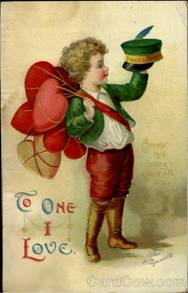


Valentine's Day postcards - 1910–1913
In America the sending of handwritten "Valentines" began at the start of the 18th century. The first commercially produced Valentine's Day cards in America were sold by Esther Howland in the mid-1840s.
According to data from the United States Greeting Card Association, every year on Valentine's Day romantically inclined people send 1 billion greeting cards, making this the second largest "card-sending" holiday of the year (approximately 2.6 billion cards are sent at Christmas). Approximately 85% of the cards are bought by women.
Italians consider it their duty to give their loved ones sweets on this day. That is why this day in Italy is called the Day of Sweets.
The French, for their part, have introduced love messages - quatrains.
Finns give each other heart-shaped gifts on 14 February, and also give gifts to their mothers.

In Japan a competition is held for the loudest declaration of love. Young people climb onto a bridge and take turns shouting, with all their might, everything they wish to say to their significant other. The winner receives a prize. In Japan this day is also called Men's Day, as the majority of gifts are received by men.
In some countries there is a belief that the first man a girl encounters on the road on 14 February is obliged to become her "Valentine", regardless of his own wishes.
Anonymous messages also occupy a certain place on Valentine's Day - for example, greeting cards sent unsigned and without a return address, or written with the left hand. This is so mysterious that it quite often confuses the recipient for a long time, as they cannot find the "guilty" sender. But according to tradition the sender must be found, if one believes in fate.

One of the symbols of Valentine's Day is red roses, which according to an ancient legend appeared thanks to Aphrodite, the Greek goddess of love and beauty. Aphrodite, hurrying to her beloved Adonis, stepped onto a white rose bush and her divine blood transformed the white roses into red.
Sources used:
http://www.varaviksne.lv/materiali/valentine/valentine.htm
http://virtuve.calis.lv/lielie-noslepumi/par-stilu/valentina-diena/
Read more about this holiday's traditions -
comments