What is the Fern Flower?
The shortest night of summer is approaching once again, and with it the summer solstice celebrations - Līgo and Jāņi. One of the indispensable and mystical symbols of the festival is the fern flower. Today I even received by work email from a business partner a traditional Latvian folk song with a greeting - wishing me luck in the search for the fern flower! I shall try to find an answer - what exactly is the fern flower?
The shortest night of summer is approaching once again, and with it the summer solstice celebrations - Līgo and Jāņi. This year it can be celebrated in style, with a whole five days off in a row - one just needs to lay in larger stocks of cheese, shashlik and beer. One of the indispensable and mystical symbols of the festival is the fern flower. Today I even received by work email from a business partner a traditional Latvian folk song with a greeting - wishing me luck in the search for the fern flower! I shall try to find an answer - what exactly is the fern flower?
1. A myth and folk beliefs passed down from generation to generation, telling of the search for the fern flower on Midsummer Night. Usually there are several obstacles to this process - shape-shifters, demons, witches and similar. But whoever obtains this fern flower is assured of happiness, wealth, wisdom, health and prosperity. In other beliefs, the finder begins to understand the language of birds and beasts. If the fern flower is placed in one's shoe, one can go wherever one wishes - no one sees or hears them.

All flowers bloomed and faded,
Only the fern did not bloom;
It bloomed on Midsummer Night
With little silver blossoms.
The fern blooms on Midsummer Night
With nine branches;
On the ninth branch
A golden button at the tip.
2. A symbol. The energy felt by a person attuned to the rhythms of nature and the cycles created by celestial bodies gave rise to a desire both to name it and to depict it somehow. That is, to gather this energy in one place so that it might serve as protection, spiritual strength and support for a person throughout the whole year. And so, why not hang such a fern flower on a necklace and wear it as an amulet?!

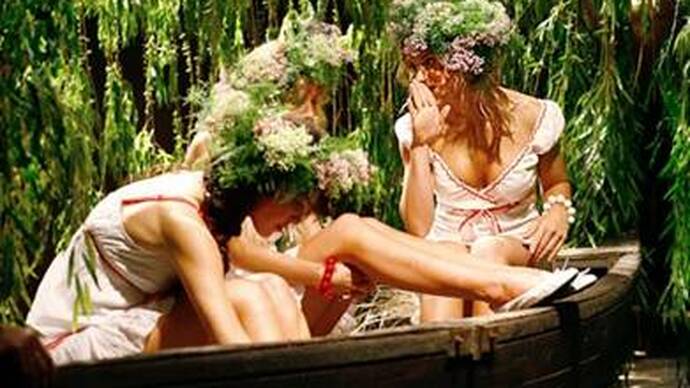
3. An opportunity to almost officially "stray from the path". On Midsummer Night one can permit oneself more than a few liberties. On Midsummer Day, wives, like young maidens, wear flower wreaths on their heads. Since ancient times this night has also otherwise made no distinction between wives and maidens - all together they sang, danced and played games. In the sexual sphere as well, Midsummer was a time when deviations from everyday norms were possible - erotic licence. This has a magical significance, for it was believed that such actions could favourably influence the creative vegetative force, promoting a general heightening of nature's energy. A certain echo of the ancient fertility rituals dedicated to pagan fertility deities.
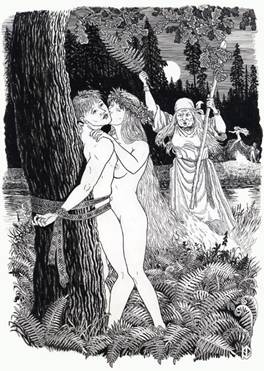
On Midsummer Night I could not tell
Which was a wife, which a maiden:
Both wives and maidens
Wore green flower wreaths.
Young lads, young maidens,
Do not sleep on Midsummer Night:
Whoever sleeps on Midsummer Night
Will never find a wife.
4. A white lie. In botany, reading the description of the fern plant, one finds that it does not flower and reproduces only by spores (unlike other plants, which reproduce by seeds).

Sources used:
http://en.wikipedia.org/wiki/Fern
http://www.magic.regiones.ru/slav.html (цветок папоротника)
http://www.liis.lv/folklora/gadsk/tdz/jani.htm
comments