Grayson Perry and His Tapestries
Grayson Perry explored the lives of various social classes in Britain to understand what these people buy, what they choose, what they prefer, and most importantly, what they want to say about themselves to the surrounding world. The result was that the artist created tapestries based on sketches with the most characteristic elements of each social class - colours, patterns, objects, and types.
I came across this artist and his works entirely by chance, while switching on the television channel "24_Doc". It was showing the documentary series "All in the Best Possible Taste with Grayson Perry" (2012), in which Grayson Perry explored the lives of various social classes in Britain to understand what these people buy, what they choose, what they prefer, and most importantly, what they want to say about themselves to the surrounding world. The result was that the artist created tapestries based on sketches with the most characteristic elements of each social class - colours, patterns, objects, and types - and exhibited them in a gallery, inviting the people he had visited to assess how accurately he had captured the taste, lifestyle, or prevailing concerns of their particular class.
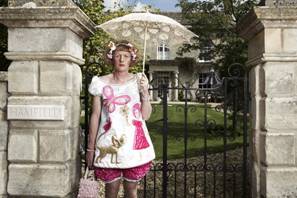
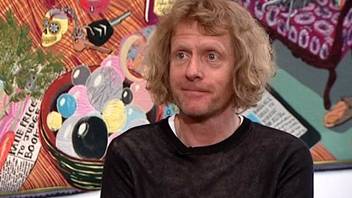
Photo from www.bbc.co.uk
Grayson Perry is a British artist (born 24 March 1960) known to the wider public as a professional ceramicist and as Claire - the girl persona he deliberately created, in which he dresses in brightly coloured frocks and attends public events or participates in TV programmes. Otherwise he is, as he himself puts it, "a simple, normal Essex man" - a family man (he has a wife and daughter). In 2003 he received the prestigious Turner Prize, awarded in Britain for achievement and innovation in contemporary art.
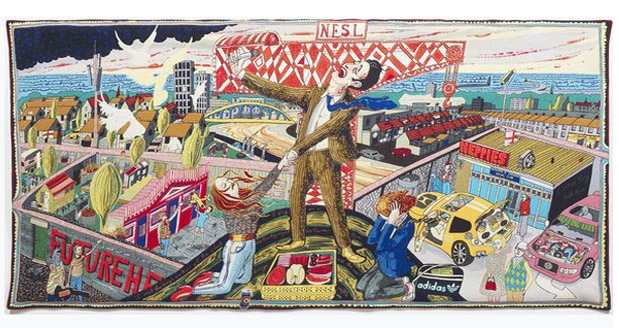
Grayson Perry, The Agony in the Car Park, 2012
Returning to the tapestries - interesting precisely for their concept - I should describe the process of their creation and the three social classes that Grayson dissected under his artistic lens. He dedicated the tapestries to the taste of the working class, the taste of the middle class, and the taste of the aristocracy. Moreover, he concentrated the details of each tapestry in a narrative taken from European classical painting or from the Bible.
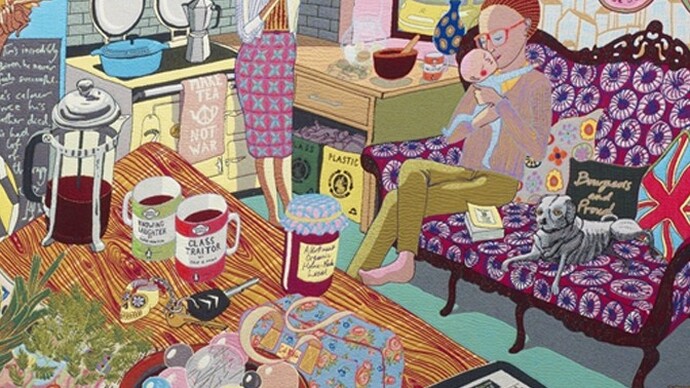
For example, in creating the tapestry dedicated to the middle class - depicting an average British town and a weekend afternoon in the living room - Grayson chose the narrative of the expulsion of Adam and Eve from the Garden of Eden. Symbolically showing what seems like a breaking out of the working class into the middle, from adolescence into the adult world, from the mass into the individual.
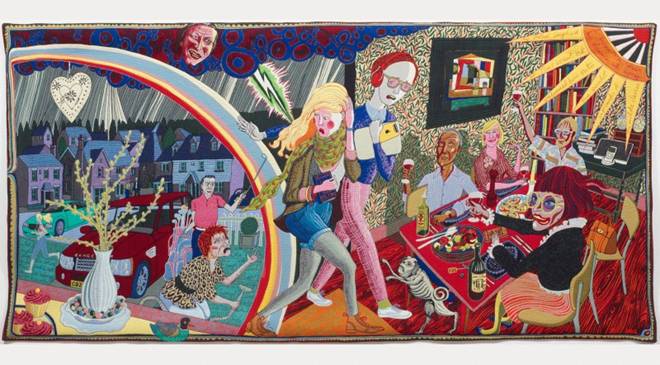
Grayson Perry, Expulsion from Number 8 Eden Close, 2012
Every detail here has meaning; every detail is taken from a real flat where Grayson visited, from real everyday life. A vase on the window ledge, home-baked cupcakes, a carefully chosen wine for celebrations, floral wallpaper, organic food on the table, an iPhone, a music player, a reproduction painting, and so on.
The artist found that middle-class representatives, through the things they buy or choose, primarily want to emphasise their individuality and the right to choose. Things are mostly not inherited but sought out at flea markets, sales, and organic shops. Each object has its own story - whether brought back from a trip, received and kept as a beloved gift, or purchased on a whim driven by momentary emotions. All the objects are combined in a fairly eclectic manner. Much colour and pattern. Much uniqueness, but also very many trendy things - the latest brand smartphones, televisions, tablets, and so on. The middle class works very hard at forming and cultivating its taste.
The opposite is true of the aristocracy, for whom, in Grayson's view, the concept of taste simply does not exist. They are owners of castles, manors, and lands, bearing a family name and the burden that places on them. Very much is inherited from generation to generation over several centuries, and each generation only needs to take care of dusting the original paintings, carved solid-wood furniture, tapestries, hunting trophies, and so on.
Representatives of the aristocracy can be recognised by their restrained, most often monochromatic clothing in pastel tones, understated accessories chosen according to template rather than personal taste, and rather old-fashioned objects. Here there is no individuality, colour, or originality - rather tradition. Members of this class do not aspire to buy the latest brands, the most powerful technology, or the fastest cars.
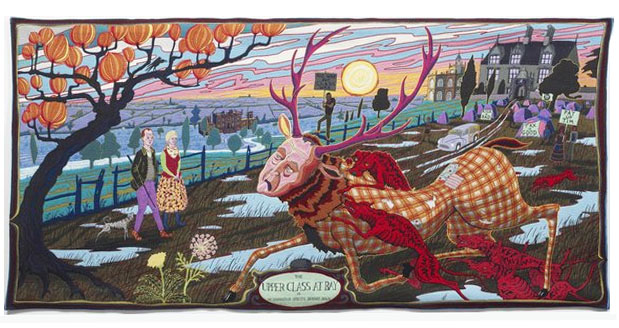
Grayson Perry, The Upper Class at Bay, 2012
It would be interesting to create a collage reflecting the everyday realities of Latvian society. I suspect that in terms of objects and their combinations, even greater eclecticism would dominate here, given that several political systems have come and gone, much has been lost, much has been adopted from elsewhere, much has been attempted to be preserved but the original context has been forgotten - from Soviet-era standard chipboard shelving units found in every typical flat to great-grandfather's hand-crafted wooden chest of drawers that are now being brought back into the light, and so on.
What would the taste of the Latvian middle class look like in a tapestry?
comments