Kamasutra for the Orator
A year ago, when I purchased this book by Radislav Gandapas, it never even occurred to me that this year I would have the good fortune to attend a training session led by him in Moscow. Back then it was the book's subtitle that spoke to me - "Ten chapters on how to gain and provide maximum pleasure and delight when speaking in public"; now I was fascinated by the author's ability to hold an entire audience at the peak of interest for a whole day.
A year ago, when I purchased this book by Radislav Gandapas, it never even occurred to me that this year I would have the good fortune to attend a training session led by him in Moscow, organised by the company HeadHunter. Back then it was the book's subtitle that spoke to me - "Ten chapters on how to gain and provide maximum pleasure and delight when speaking in public"; now I was fascinated by the author's ability to hold an entire audience at the peak of interest for a whole day - with useful advice, with anecdotes from his public speaking practice, with a brief glimpse into the history of oratory, and with practical exercises in which all those present were involved.
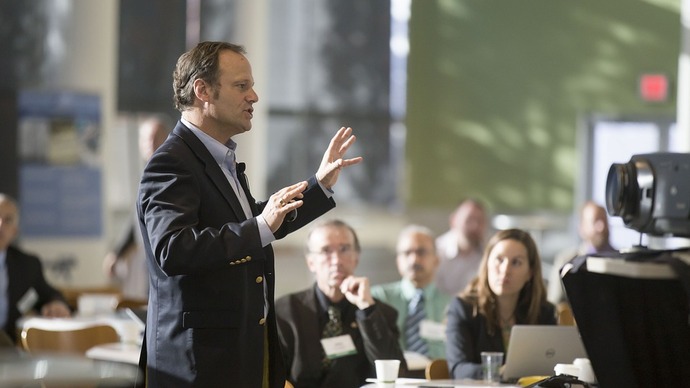
 This "Власть убеждения" (Power of Persuasion) training session drew heavily from the book "Kamasutra for the Orator" - on types of delivery and choosing the appropriate speaking style, on preparing a presentation, on planning, on holding the audience's attention, on handling awkward questions and so on. But how all of this was presented and conveyed is impossible simply to describe. This is also why one of Radislav's principles is to never distribute handout materials to the audience during a presentation, as they - like many other things: a microphone, a podium, another person on stage, etc. - distract attention from the speaker himself.
Both in the book and in the session, Radislav placed particular emphasis on Level 1 contact, which yields incomparably greater benefit than the levels that follow. If you have come to a lecture, do not try to sit as far back as possible - if there is the opportunity, choose the front row so as to be in closer contact with the speaker. This is about the exchange of both information and energy. In this life, everything is gathered not by the person who raises their hand from their seat, but by the one who takes a step forward and comes to the front.
The lecturer, in turn, must understand that what matters during a presentation is not how much information you have conveyed to the audience, but how much information the listener has "absorbed". It is a long-known truth that an audience perceives 60% visually - how the lecturer looks - 30% in terms of how he speaks, the manner in which things are said, the voice, and only 10% the actual content.
When preparing a presentation, one must very carefully devise a good opening and a good conclusion; in between, one can allow oneself to improvise. Something similar was once said to me by my music teacher, who during orchestra rehearsals always maintained that the most important thing in a performance is for everyone to begin simultaneously and, at the end, to finish with perfectly precise simultaneity - to hold the final chord; everything in between is a matter of God and each player's professionalism. In this connection there was an interesting exercise in Radislav's training session in which everyone had to divide into groups of three and speak continuously for 3 minutes without stopping, telling something - in free improvisation continuing with the theme where the previous speaker had left off, and so on without pause until a signal was sounded to end the exercise.
We also practised standing in the correct orator's posture, relaxing the vocal cords before a performance, and dealing with nerves before going before the audience. Standing before an audience is like leaping into an ice-cold plunge pool - but once it is done, such a good, pleasant feeling remains: no cold, no fear, a complete sense of pleasure.
"It is said that in our lives only two things happen: those things we passionately desire, and those things we are terribly afraid of."
".. an orator enters into a kind of intimate relationship with the audience, in which the orator plays the masculine role (regardless of their actual gender) and the audience plays the feminine role."
Both the information gained from the book and the experience of Radislav Gandapas's training session are excellently suited to developing one's presentation skills and working with an audience. However, these skills must be honed day after day before one can become a good speaker; otherwise nothing will come of any of it. For those for whom the topic of public speaking is close or necessary in daily work, I recommend reading Radislav's works and getting to know this orator's experience more closely.
The author's website - http://www.radislavgandapas.com/
comments