Manuscript Found in Accra. Paulo Coelho
I like that the author speaks of universal human values, universal human fears and doubts, sorrows and joys, and also that his view of faith extends beyond the framework and canons of any particular religion. Love is not only towards a representative of the opposite sex, a fellow human being, a loved one - love is in everything you do, everything you decide, and also everything you give up.
I bought Paulo Coelho's book "Manuscript Found in Accra" knowing the author's writing style and knowing that it would be saturated with references to historical details, with the dry and hot air of southern lands blowing through it and an ocean or desert stretching to the horizon, and that the text would be full of insights impossible to pass by without underlining or otherwise marking. I also like the convenient format of the book chosen by the Jānis Roze publishing house, which allows it to be taken along on journeys, longer trips, and read during leisure time.
I had been saving this book for my holiday, but realised I could not wait and read it in three sittings. Even though the book is not so thick, the font is sufficiently large and the divider pages sufficiently "bare" (this is no Soviet-era book), and it could practically be read in one longer evening. I have not been disappointed - the book lived up to my expectations.
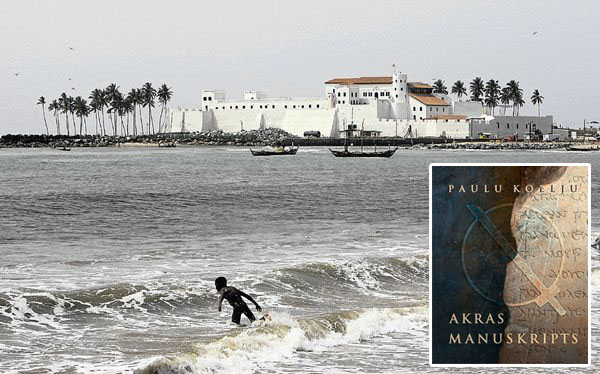
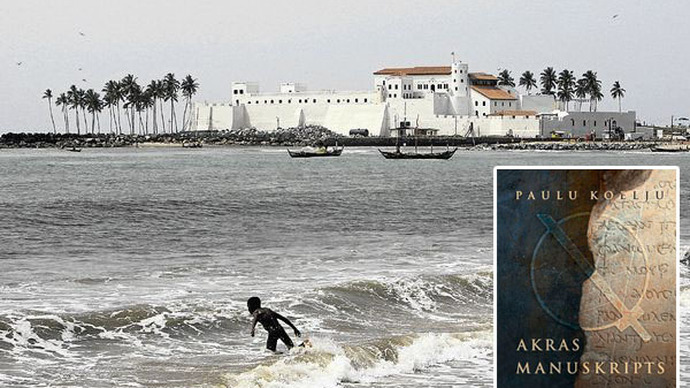
Pictured: photo from timeslive.co.za - a view of the Danish fort Christiansborg (1661) in Accra & the Latvian edition of P. Coelho's book
I have caught myself thinking that every time changes are ripening in my life or I lack the faith to bring those changes about, I return again and again to Coelho's books. They give the freedom to realise one's dreams. Like a good psychotherapist, they repeat over and over: there is no need to fear failure, loneliness, defeat - for each holds its own blessing.
"It is a great wisdom of life - to understand that we can be in control of what wants to enslave us." (Quote from the book, p. 138)
I like that the author speaks of universal human values, universal human fears and doubts, sorrows and joys, and also that his view of faith extends beyond the framework and canons of any particular religion. This book too has a Coptic priest speaking to the people, a rabbi, the imam of Al-Aqsa Mosque, and a Christian pastor.
Here too appear paradoxes or insights that to some extent confront the values I acquired through upbringing. For example:
"Be wary of those who keep your company only in moments of sadness and offer you comforting words. For such people in their hearts are thinking: "I am far stronger! I am far wiser! I would never have let this happen!" And stay with those who are with you in moments of joy. For such people know neither jealousy nor envy and rejoice that you are happy." (p. 99)
"Let us forget that giving is noble and receiving is humiliating. Unfortunately, for most people nobility is associated only with giving. Yet in receiving there is also the spirit of love. Allow another to make you happy - and they too will be happy." (p. 92)
I like that Coelho's concept of love extends beyond the usual rather shallow understanding. Love is not only towards a representative of the opposite sex, a fellow human being, a loved one - love is in everything you do, everything you decide, and also everything you give up. He writes:
"Never miss an opportunity to show your love." (p. 142)
The author also speaks of friendship and loyalty. Here too the formulation differs from the one we are accustomed to:
"People in the world are divided into the weak and the strong, not into enemies and friends." (p. 164) "[Loyalty] is a choice that only the strong in spirit dare to make." (p. 157) "...saying NO does not always make a person bad, and saying YES does not always make them good." (p. 39)
Usually one wishes to take these insights as a travelling companion when facing doubt or a moment of decision. Coelho sees a great role for human intuition, but when it is silent, discipline must take over. Here is a true and concise piece of wisdom -
"Go with the wind, but do not forget the horse." (p. 144)
For your information
Accra is a city in Africa on the coast of the Atlantic Ocean. It is the capital of Ghana. The official language is English. Religions: Muslim, Christian, and indigenous tribal faiths. The city and its surroundings are home to around 4 million inhabitants - more than 99% of Black African descent. Historically it was a Dutch, Danish, and British colony.
comments