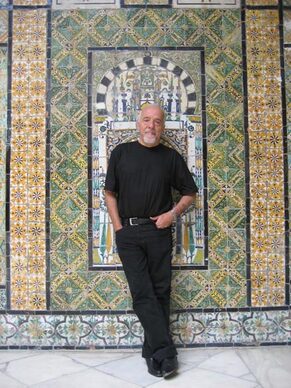
Paulo Coelho "The Witch of Portobello"
What Paulo Coelho writes makes you step outside, if only for a moment, the daily rush, routine and enforced pragmatism of real life. It encourages you to look at values that lie beyond career, material well-being and social recognition. That is valuable - so you don't lose the ability to find joy each day in the work you do, the duties you must fulfil, the people you meet, the difficulties you overcome.
Dedicate your free time to reading a book by the Brazilian writer Paulo Coelho!
I arrived at this conclusion after reading the book "The Witch of Portobello" (2008), published in Latvian by Jāņa Roze publishing house. I should admit that this is not the first book by this author I have encountered, as others have been read and lined up on the bookshelf at home - "The Alchemist", "Manual of the Warrior of Light", "Maktub", "Veronika Decides to Die", "By the River Piedra I Sat Down and Wept", "The Zahir". Yet all these books have carried only ideas of light, love of humanity, spirituality, passion, forgiveness and self-discovery.
In my view, what Paulo Coelho writes makes you step outside, if only for a moment, the daily rush, routine and enforced pragmatism of real life. It encourages you to look at values that lie beyond career, material well-being and social recognition. That is valuable - so you don't lose the ability to find joy each day in the work you do, the duties you must fulfil, the people you meet, the difficulties you overcome.
"The Witch of Portobello" contains an interesting thought about the work you do every day with passion, about relationships with employees, colleagues and clients. A quote from the words of the book's character - bank CEO Peter Sherny - "Clients and employees live in one world - in reality, there is nothing other than electrical impulses in our brains. What we think we "see" is merely the pulsation of energy in a completely dark part of the brain. But by learning to synchronise our electronic impulses with those of other people, we can influence this reality. In a way I cannot fully understand, joy is contagious, just as enthusiasm or love - even more so sadness, depression or hatred - and these are emotions that are "intuitively" perceived by both employees and clients. To improve this process, one must create a mechanism that keeps these positive stimuli active".
The book also touches on the nowadays popular and widely discussed idea of God as a feminine principle. This notion, as we know, is at odds with the dogmas of the classical church. It resonates with Dan Brown's ideas about the cult of the Goddess.
Of course, everything is permeated by the idea of humanism, searching for answers to questions of faith, forgiveness and love. But the perspective is much broader - the true nature of feelings is shown: "love does not give happiness and never has. On the contrary, love is a constant anxiety, a battlefield, sleepless nights in which you endlessly ask yourself whether you have acted rightly. True love consists of heightened rapture and agony".
Quite naturally, for such insights to come from a creator, one must be an interesting and rich personality with significant life experience. My thoughts were confirmed when, searching online, I found the websites and blogs created by the author himself (see below), where his activities are described in text, photos and video.
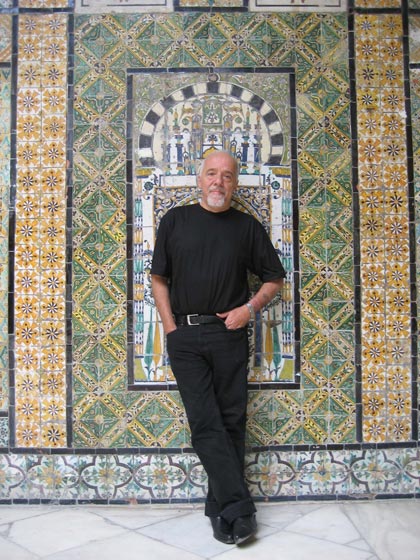
Brief note on the author -
Paulo Coelho, born 1947, 61 years old, lives in Rio de Janeiro, Brazil, native language - Portuguese. Writer, journalist, author of lyrics for several songs. Member of various organisations and institutes. Messenger of Peace. Widely travelled, including on pilgrimages. Author of books that are known and translated worldwide.
Official Site Paulo Coelho - http://www.paulocoelho.com/engl/index-site.html
Paulo Coelho books in electronic format (free) - http://piratecoelho.wordpress.com/
Paulo Coelho's Blog - http://paulocoelhoblog.com/
Paulo Coelho profiles - http://www.myspace.com/paulocoelho
comments