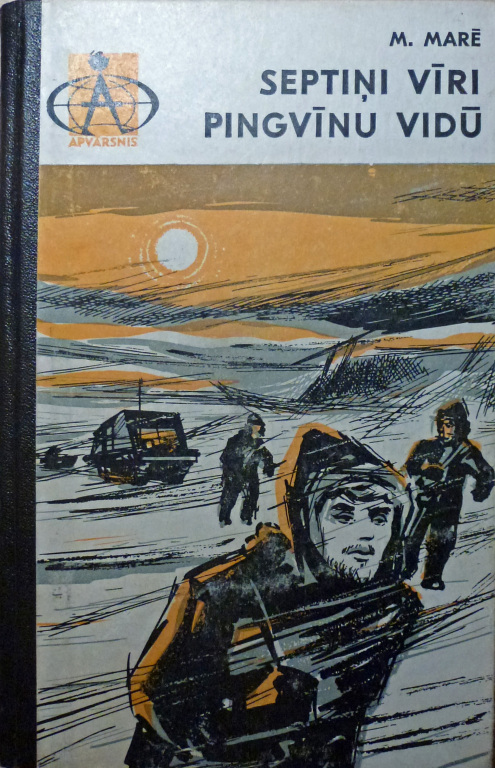
Seven Men Among Penguins. M. Marret
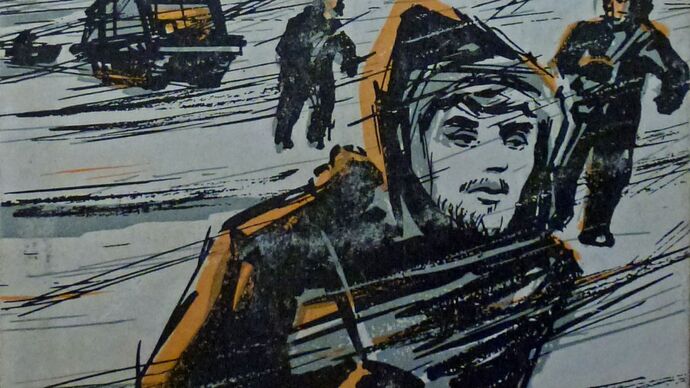
When in the autumn of 1951 Mario Marret and three of his companions left France and set out for Antarctica, they lived in Adélie Land through three summers and two winters. This was France's third expedition to Antarctica. The story is about the polar explorers' everyday life and the living conditions that prevailed in Antarctica. About setting out on excursions in blizzards, conducting observations and research. And, of course - penguins.
When in the autumn of 1951 Mario Marret and three of his companions left France and set out for Antarctica, they lived in Adélie Land through three summers and two winters. This was France's third expedition to Antarctica.
The story is about the polar explorers' everyday life and the living conditions that prevailed in Antarctica. About setting out on excursions in blizzards, conducting observations and research. And, of course - penguins.
Some of the most notable quotes:
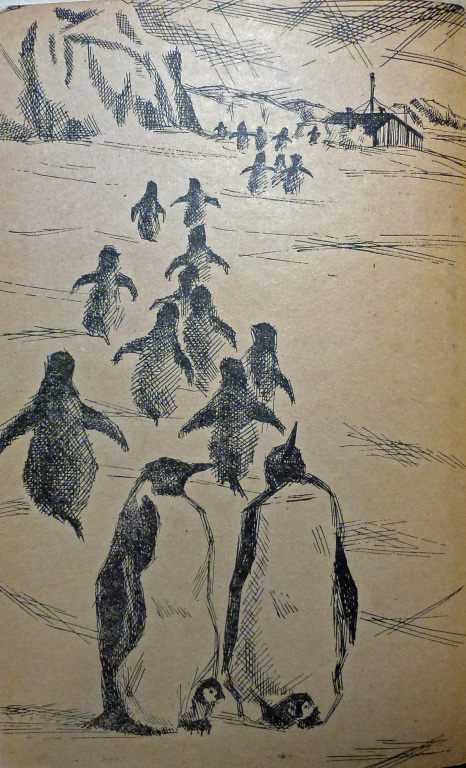
In a Charlie Chaplin gait, whole hundreds of the peculiar Adélie penguins waddle past - little clergymen in white collars. (p. 25)
In the evenings we often find the victims of our biologists' experiments on the table; they appear on the menu under the enticing name "Emperor penguin à la Waterloo". However, the unpleasant fishy aftertaste, which even a too-strongly sizzled wine sauce cannot dispel, prevents us from properly appreciating this ... imperial meal! (p. 54)
From the water the birds shoot up onto a block of ice in much the same way as an olive stone slips out when you squeeze the olive between your fingers. (p. 71)
Scientists designate this bird by the unusual name Aptenodytes forsteri, in honour of the researcher Forster, who was the first to sketch a picture of this penguin. The emperor penguin is 110 to 115 centimetres long, measured from beak to feet. It reaches such a length when fully stretched out or when dead. In reality, a live, standing penguin is slightly hunched, its length not exceeding 80 centimetres. The bird's weight is between 25 and 40 kilograms, though seasonal fluctuations in weight are very considerable.
The emperor penguin's plumage is exceptionally magnificent both in the richness of its colours and in the outstanding harmony of the different hues. The back is entirely blue, a deep blue with silvery reflections. The crown of the head is all black, and this onyx cap slides down over the cheeks, chin and under the throat. All the rest of the body - the belly and the front of the wings - is dazzlingly white. But the finest adornment is the yellow patch on either side of the neck and head, graduating from a golden tone to orange. A more splendid and refined festive costume could not be imagined. (p. 72)
A few steps to one side, a few to the other, a few flaps of the wings, a tilt of the head to the right, then to the left, and then two hours of complete immobility, then three more steps, and so on... (p. 97)
Prévost brought two penguin chicks to the hut. The more dexterous one we named Arthur, and the other Untimely. They let themselves be fed like docile children and show no shyness at all. The moment we move, the chicks follow at our heels, squealing shrilly, not giving way by a nail's breadth, and show a tendency to go wherever it is warmest. (p. 165)
Like us, they are curious; like us, they want to see everything, and the moment they spot something unusual - for instance, a human being - they rush to inspect it. But as soon as we approach too close and try to touch them, they take to their heels. Splash! They topple flat on their faces, their chest jutting out like the tip of a ski, and in a sliding glide - tobogganing - they flee, paddling as hard as they can with their wings. (p. 168)
The reader may wonder why one should tell a story in which nothing happens, why speak of days that seem tediously alike, why describe a kind of work that is one continuous test of patience and endurance, of unhurriedness and caution. And yet it was necessary - if only to portray life in Antarctica truthfully. It was necessary so that the reader who thirsts for truth might be convinced that this very monotony, unhurriedness and tedium, this enforced idleness, these sorties a few kilometres from one bare, gloomy, snowbound spot to another just like it, this setting out into a snowstorm when day turns as dark as night - this is our real life. (p. 183)
With beaks held high, these shameless little creatures with insatiable curiosity in their eyes - round as buttons on ladies' boots - bore themselves with the self-assurance of true masters and returned once more to these places that had belonged to them since time immemorial. These little beings never fail to amuse me. Their self-assured stance as outright owners of the land involuntarily brought to mind noble lords who spend the winter in Bermuda and the summer in their ancestral castles in Scotland or elsewhere. (p. 184)
The penguins' black plumage - I would venture to call it a "black cassock" - and their white chest make them strikingly similar both to the little clergymen portrayed in operettas and to café waiters. (p. 185)
During nest-building time the Adélie penguins are seized by a veritable frenzy. One can watch birds carrying pebbles in their beaks and laying them in the nest, but the moment they turn their backs on it, their neighbours rush up and snatch the pebbles. Thus the birds steal from one another. This continuous movement, with pebbles travelling from one nest to the next and on to another, this endless coming and going, resembles a sort of collective game in which the whole penguin colony takes part. (p. 186)
Main base is pleased to inform you that the first Adélie penguin chick has been born. Arthur has developed into a young emperor penguin and already sings like an adult. (p. 213)
In the emperor penguin colony, the birds threw themselves into the water with abandon, just like the pendulum weights of a wall clock; they swim the crawl, leap across floating ice floes and shake their feathers misted with silvery droplets. The Adélie penguins also indulge in the pleasures of swimming, but perhaps too close an acquaintance with sea leopards has made them more cautious: as soon as a small group of birds makes its way to the edge of a floating ice floe, it stops before diving. The leader hesitates, and the companions appear to urge it to jump. Finally it plunges into the water, and all the others watch to see whether anything unusual happens. If this "guinea pig" gets through safely, all the rest leap in! The Adélie penguins plunge into the sea with tremendous vigour. To get back out of the water, they make for a floating ice floe and, a couple of metres from the shore, shoot up - literally "blasted" out - land on their chests and end their flight with a sliding movement. (p. 216)
comments