The Great Stench Sources in Sarkandaugava
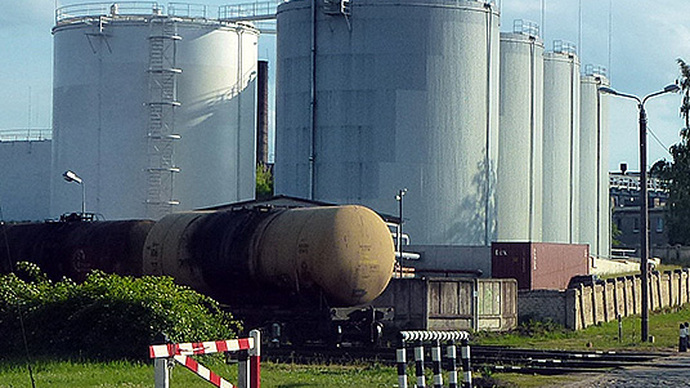
When talking about oil, one often hears - oil is black gold. Evidently, not only oil extraction but also its transshipment by companies in the Riga Free Port has for decades allowed them, to put it mildly, to "thumb their noses" at environmental requirements and local residents.
When talking about oil, one often hears - oil is black gold. Evidently, not only oil extraction but also its transshipment by companies in the Riga Free Port has for decades allowed them, to put it mildly, to "thumb their noses" at environmental requirements and local residents.
The problem did not mushroom only this year. Written evidence can be found around 2006, when activists spoke out against the unbearable oil smell in the area. At that time the boss of Man-Tess was a millionaire - Jānis Krūmiņš - and as locals gossip, he resolved the conflict with residents "in his own way", namely that men in black very actively began visiting the activists. What these men talked about we will probably never know, but the activists became very, very quiet. [1]
Notably, Krūmiņš himself admitted in an interview that he was leaving the business and the country (after selling Man-Tess, he relocated to Australia, ed. note), as there were well-founded concerns about a change in political power, and if ZZS were to come to power, then business activities could be threatened by what Krūmiņš described as "one overturned oil tanker car". This in turn suggests that problems with environmental pollution do exist.
Man-Tess is the largest in terms of territory, and its site - within which, it is true, several companies operate - stretches from the Kundziņsala Bridge to house 52 or 54 on Tvaika Street. But Man-Tess is not the only one transshipping oil products in Sarkandaugava. The press mentions that there are 7, although in the author's opinion the most active are 4 (Man-Tess, OVI, Woodison Terminal, and BLB). There is also Eko-Osta, whose sphere of activity involves the transshipment of chemical substances, and the Ship Repair Factory in Vecmīlgrāvis.
The suggestion that the Ship Repair Factory might also be to blame in the Sarkandaugava stench case was mentioned on social media by Andris Ameriks (Riga City Council deputy mayor, formerly LPP, now GKR). It should be noted that of all the RCC officials addressed on social media, only A. Ameriks saw fit to express an opinion. Possibly also the only one who was aware of the stench incident in Sarkandaugava on 26 May 2012.
There are also 4 air monitoring stations, of which, as far as is known, only one belongs to Riga City Council (at 44 Tvaika Street).
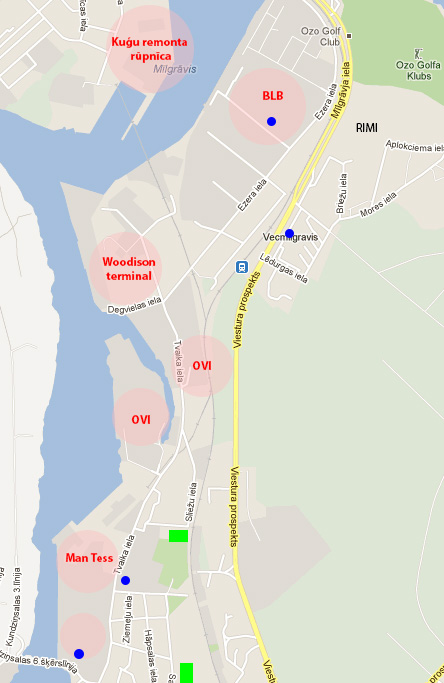
In the image: pink circle - known oil transshipment companies; blue circle - air pollution monitoring stations; green - schools.
Around Sarkandaugava and its environs
Walking around the Sarkandaugava area, the most intense unpleasant odour can be noticed in the following locations (at virtually any time of day or night):
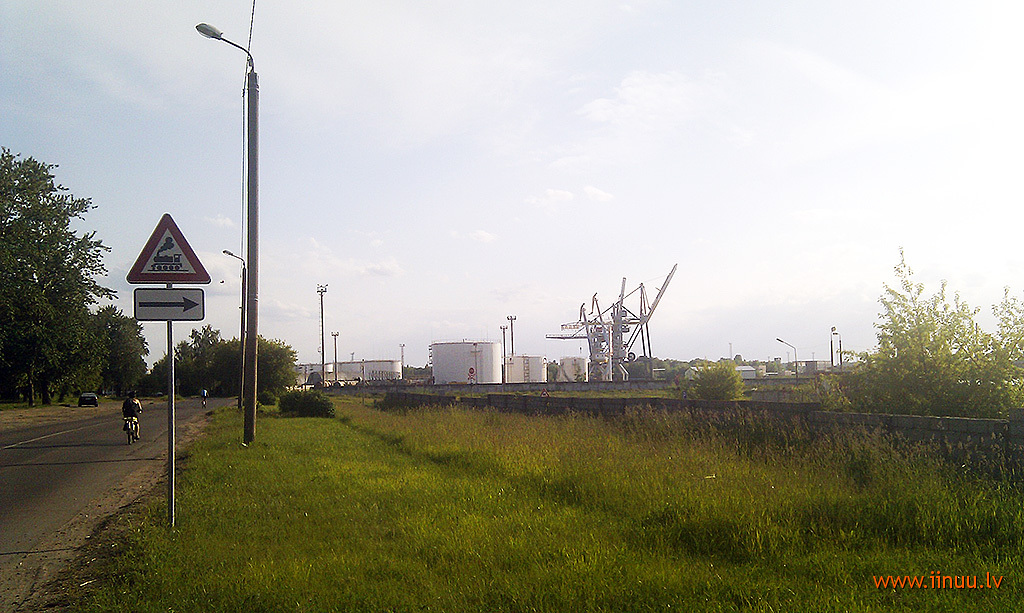
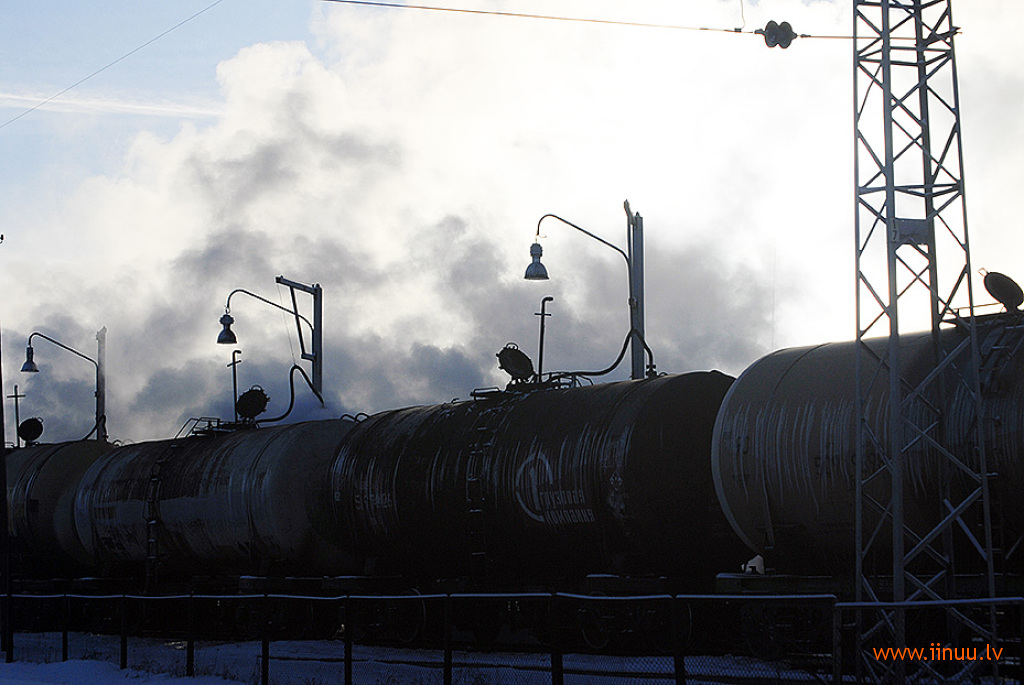
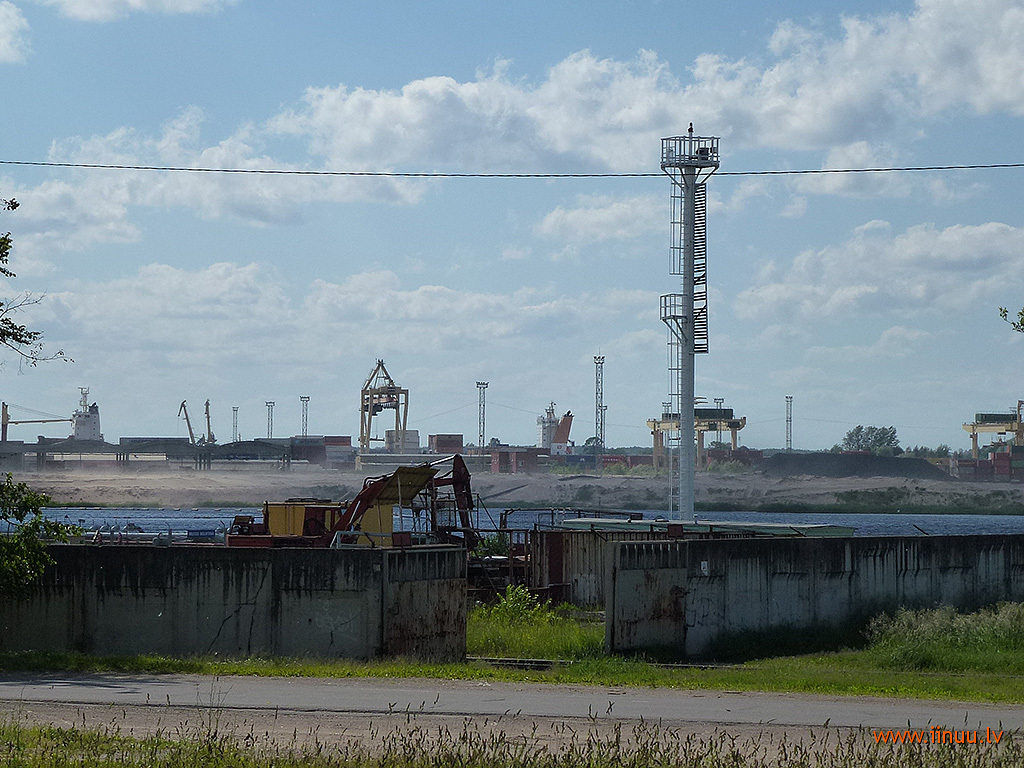
- Kundziņsala Bridge. The Man-Tess oil transshipment structures for railway tankers are visually visible on the territory. Depending on wind direction, it can be detected in the apartment buildings across Tvaika Street.
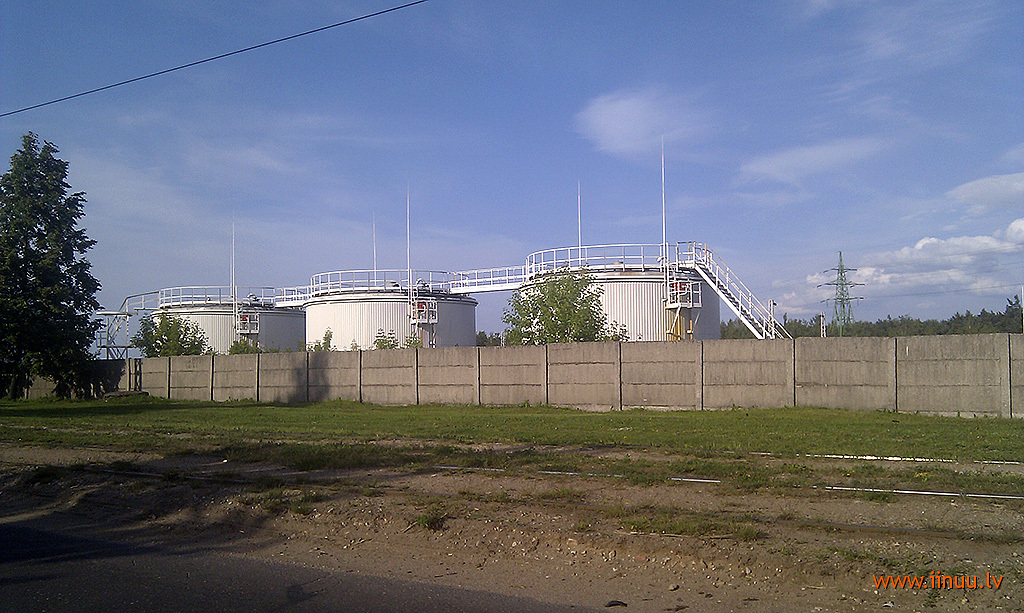
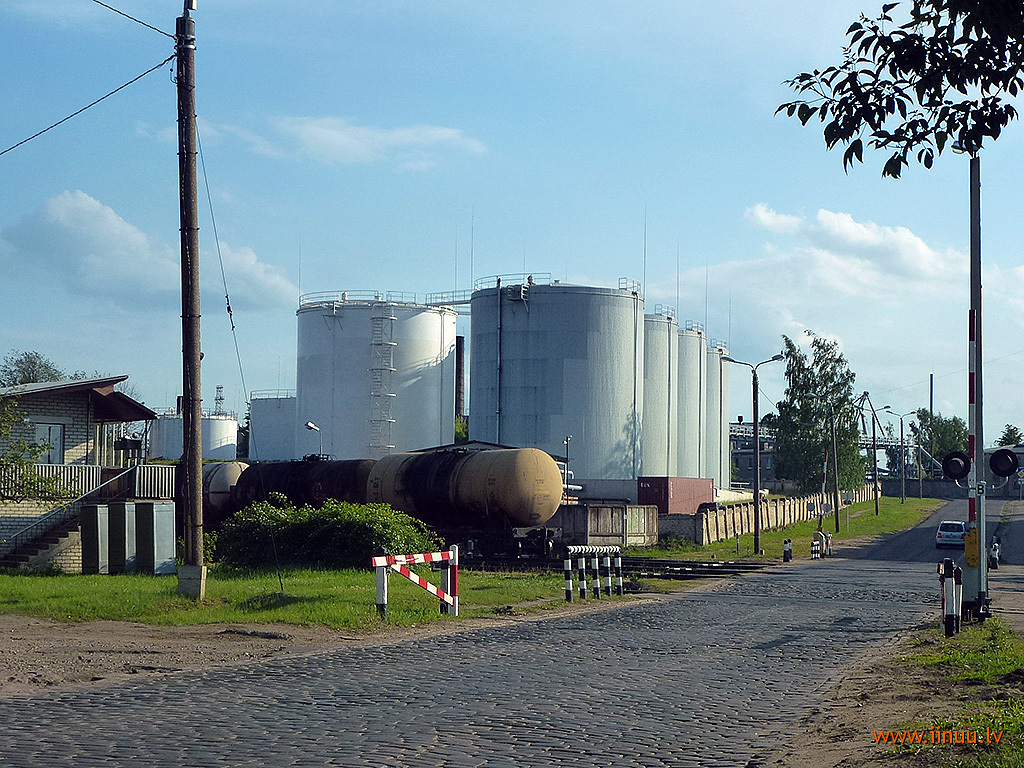
- OVI between Tvaika Street and Viestura Prospekt. Fortunately, there are no apartment buildings nearby, except for one two-storey house. Along that stretch, a path leads along both sides of the railway to Mangaļi, and the oil smell is always present. Opinions are divided as to whether it is only OVI there, as BLB also heavily burdens the Ezera Street overpass.
- Woodison Terminal. Most frequently a very unpleasant smell can be detected in the early morning hours (possibly also at night). At the junction of Degvielas, Tvaika, and Ezera Streets is the terminus of tram No. 5, and quite often the tram travels with open doors all the way to the Aldaris stop just to air out the carriage, which has become stench-filled in the few minutes spent at the terminus.
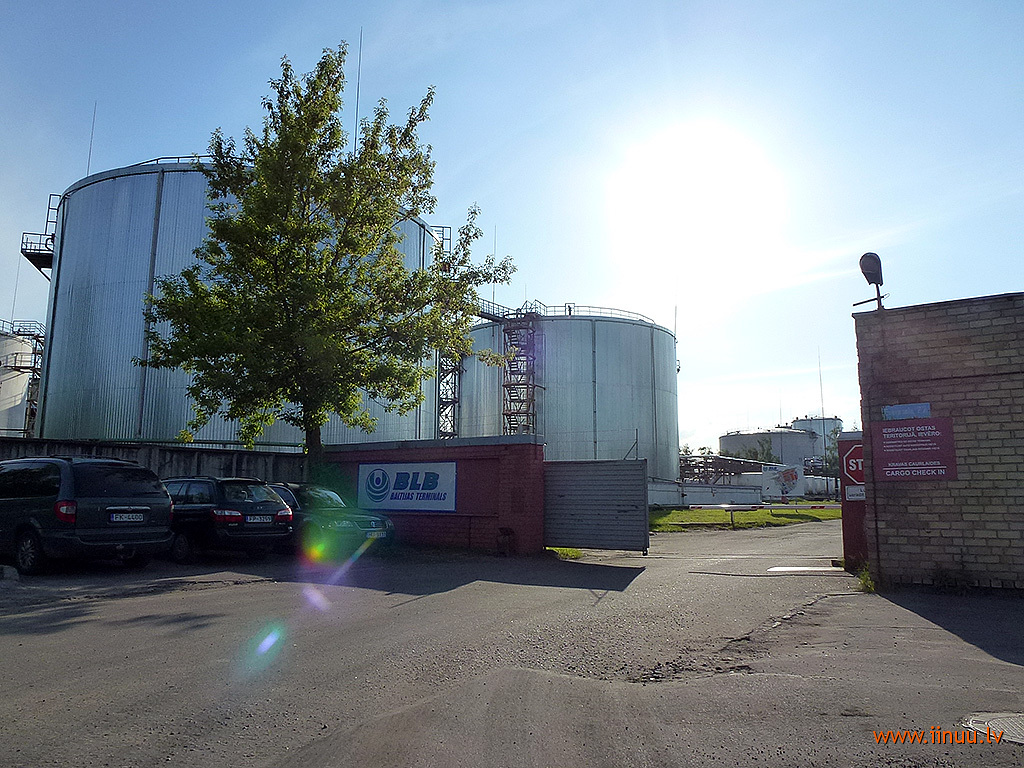
- BLB always smells. Both when driving along Ezera Street and the smell is noticeable when driving along Mīlgrāvis Street (past RIMI towards Vecmīlgrāvis).
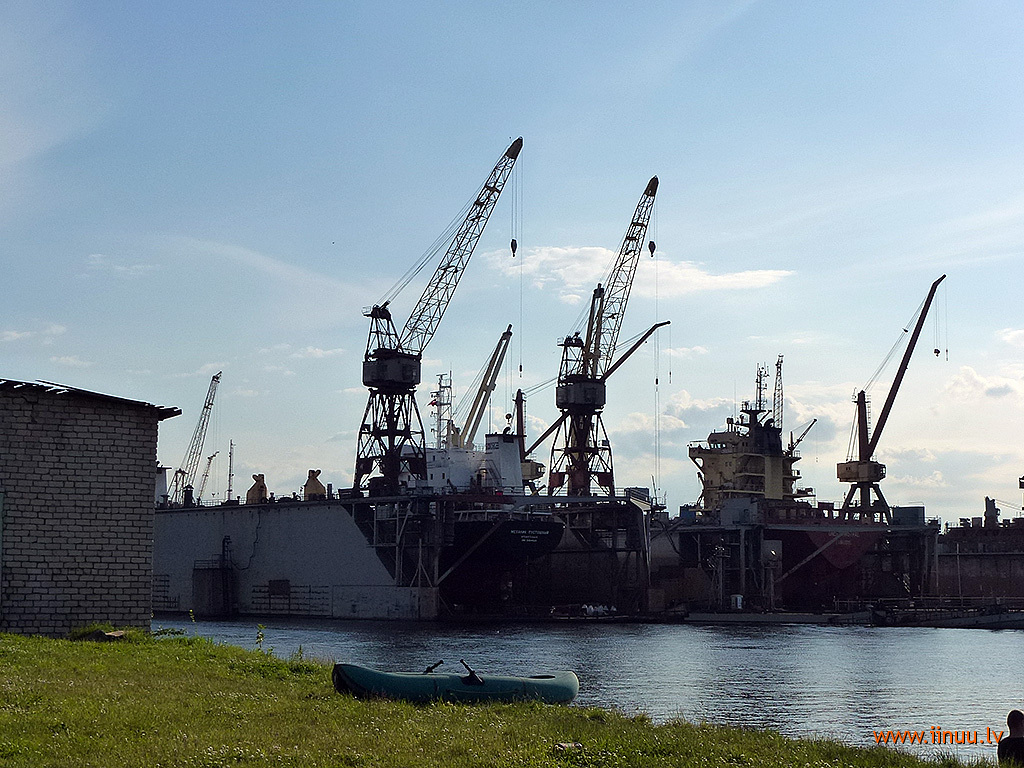
- Vecmīlgrāvis Bridge. The intensity of the smell depends on the wind direction. As can be seen on the map, the source of the smell can just as easily be BLB as the Ship Repair Factory.
The intensity of oil product odour depends on wind direction and strength. Understandably, in strong wind the smell is quickly dispersed. Residents of Tvaika Street along its entire length can enjoy the stench when a northerly or north-easterly wind blows. There is only one wind direction when the smell is not felt - westerly.
This year, for the first time, Woodison Terminal and BLB are mentioned in the press, but not a word about OVI.
BLB has not previously shown itself publicly in any way. Its owner, naturally - a millionaire, Andrejs Bobrovs. In the public KNAB donors database it can be seen that BLB donated to both LPP and PCTVL in 2002/2003 [4]. Has planned to expand transshipment volumes. The main culprit for the burden on the Ezera Street railway overpass (as a result of which drivers have to wait an hour or more for the railway crossing to open).
Woodison Terminal for a long time belonged to the Estonian joint venture SIA "Trest Oil Co.", which purchased it from millionaires Vladimir Komogortsev and Yuri Shabashov. Currently, as far as is known, the sole owner is SIA Tropico and its owners Andrejs Maksimovs and Oļegs Čerņikovs. Notably, on the company's website the email addresses still lead to "Trest" (a petrol station chain in Latvia, ed. note). An interesting fact: the planned reconstruction (in 2008) also envisaged the installation of an air (benzene and toluene) monitoring station. The reconstruction took place, but the monitoring was never installed - though that, it seems, was not an obstacle for the State Environmental Service to renew the Category B licence in January 2012.
With this "curious" discovery we approached both the Housing and Environment Department of Riga City Council and the Greater Riga Environmental Administration of the State Environmental Service. In response we received a quite exhaustive explanation from the RCC, which in great detail pointed to the contradictory conditions of the SES. The response received from the SES, in turn, indicated that administrative proceedings had been initiated regarding the aforementioned fact. One hopes that the gentlemen of both institutions know what they are doing :)
OVI for a time supplied Rīgas Satiksme with fuel in a rather dubious manner, until its owner, millionaire Vladimir Oderov, was caught in connection with fuel smuggling, working hand-in-glove with the then executive director of Daugavpils City Council, the late Andris Upīts (TP).
In conclusion
The troubles surrounding environmental pollution will hopefully breathe new life into civic organisations and encourage residents of this area to actively participate in them: the Public Organisation "Kundziņsala", the Sarkandaugava Development Association, and the Mežaparks Development Association.
In the very near future, residents of these neighbourhoods may have to fight not only against the stench of oil products but also against other odours and dust. The planned Kundziņsala development project and the construction of a mineral fertiliser transshipment terminal have not been cancelled by anyone, although the project promoter A. Šlesers has stepped aside [5]. Nevertheless, the development of Kundziņsala continues in full swing…
[1] http://www.kasjauns.lv/lv/zinas/62170/krumins-pardevis-biznesu-jo-baidijies-no-lemberga-naksanas-pie-varas
[2] http://www.db.lv/citas-zinas/degvielu-rigas-satiksme-gada-saubiga-veida-148028
[3] http://www.delfi.lv/news/national/riga/smirdigs-un-vel-smirdigaks-sarkandaugavas-iedzivotaju-ikdiena.d?id=42405586
[4] http://knab.gov.lv/lv/finances/db/donations/
[5] http://www.lolitacigane.lv/2011/10/vel-viens-slesera-projektins.html
comments