Feng Shui in the Workplace
Our workplace is not merely a desk with a chair or an impersonal office, but an environment where we spend practically the greater part of our conscious lives. At an office workstation we keep important documents, daily notes, and also some personal items, which can both tell something interesting about the employee and attract a certain energy.
Our workplace is not merely a desk with a chair or an impersonal office, but an environment where we spend practically the greater part of our conscious lives. At an office workstation we keep important documents, daily notes, and also some personal items, which can both tell something interesting about the employee and attract a certain energy. The work desk is also the place where important strategic and financial decisions are made.


Feng Shui
It is the science of arranging living space correctly; it is the art of living in harmony with the surrounding world and using the energy of heaven and earth to gain luck, health and prosperity. An office in which everything is in its place will work in our favour, helping to set the mood for success and attracting achievement.
The career sector in feng shui theory is associated with the North, the water element, the colours blue, black and slate blue, a wave-like form, and the number "1". Career energy is activated by water and metal.
Let us first cast an eye over the office
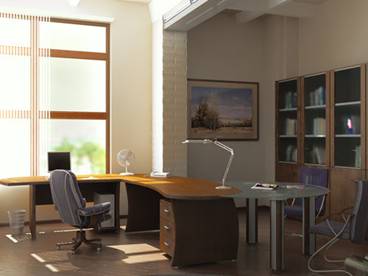
The compositionally significant central object of the office is the work desk. Its placement and shape have an indirect influence on business and the development of one's personal career. If the work does not require constant direct contact with clients and constant visibility, then the best position for the workstation is in the quietest sector of the office - diagonally, in the farthest corner from the entrance door. Such a position can ensure stability, security and steady financial income.
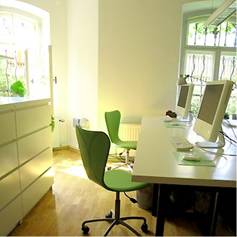
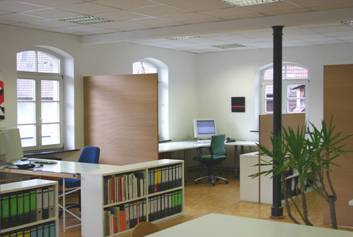
One should never sit with one's back to the door or a window. In feng shui theory such a position is considered a "draught" and a certain fundamental weakness.
The work desk should not be positioned under ceiling beams, lest an oppressive energy descend upon the employee. Also, the sharp corners of the desk must not point towards walls, so that constant conflicts between colleagues do not arise.
The work desk should be positioned so that one sits with one's back to the wall, which will provide energetic support and invisible protection. It is advisable to hang a painting or photograph depicting a high mountain on this wall. This attracts the energy of solidity and a stable, lasting position in the given office and company.
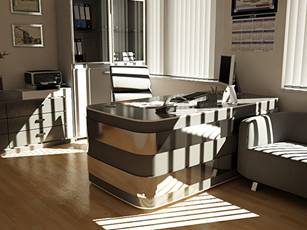
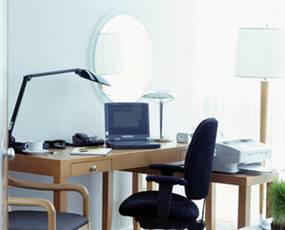
Sufficient space must be left around the work desk so that one can stand up and leave freely without obstacles and without manoeuvring between furniture. Physical confinement will also create emotional confinement. Working in a space crammed with furniture, document shelves, folders, boxes and similar items, any growth or career development becomes impossible. The discomfort of confinement is usually accompanied by dissatisfaction, manifesting as misunderstandings with colleagues and financial problems.

The space in front of the work desk must also be sufficient so that the seated person can see the office door and those entering through it without obstruction. It is important that the first thing an incoming person notices is you. This eases the initiation of communication and attracts the energy of importance - i.e., you will never be forgotten when the boss thinks about promoting, rewarding or praising an employee.
But do not sit constantly facing your boss, even if their desk is two floors above. Engage your spatial imagination and picture how you would need to sit so that, ignoring all walls and structures, your gaze would be directed at the boss's back. In this way you will avoid conflict situations with management and gain their support.
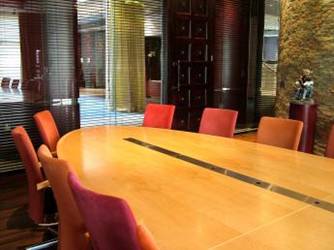
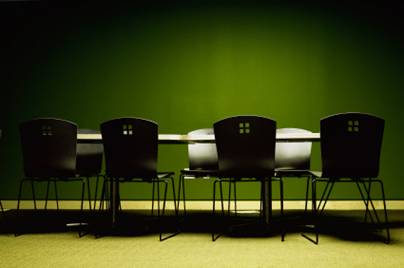
If meetings are regularly held in the office in which you work, an additional table (preferably round or oval) with chairs is needed. Never arrange a conference table in a T shape, i.e., perpendicular to your own work desk. Such a position is unfavourable both for yourself and for the meeting participants, as it creates coldness between management and employees. Ideas expressed will not be mutually accepted and supported.
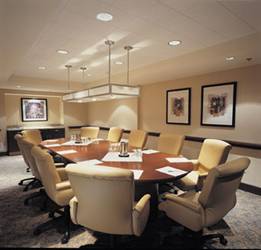
If while sitting at your work desk you have to solve problems and make important decisions, then the desk should be large and substantial. The solidity of the desk will, as it were, underscore and lend weight to your words.
More free space!
One of the principles of feng shui must be kept in mind - before something new can arrive, something old must depart. This applies to worn-out or broken office supplies, used-up notepads and similar items - everything that is not necessary must go without mercy!
An important point is the proper organisation of the desk surface. The desk itself should be at least medium-sized: 1.5 metres long and 1 metre wide. It should have as much free space as possible. The centre of the desk must be empty. It is better to keep all necessary papers in desk drawers, sorted into colourful folders. To your right you can place a small green plant with rounded leaves, which will renew and absorb negative energy.
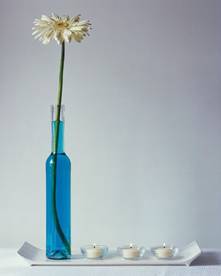
Similarly, metal objects (in the far left corner) will look very organic on the work desk - metal attracts money and fame. Next to the metal object place a small crystal or glass figurine, which will absorb the negative energy emitted by the computer and rest tired eyes.
In the far corner of the desk it is better to place a card with the company logo or some photograph significant in one's professional field. This zone is responsible for the fulfilment of wishes and the realisation of hopes.
No matter what symbolic items you place on your desk, it must not be cluttered with things and certainly not with untidily scattered sheets of paper.
Let us organise our work papers and documents! To your left should be those papers still to be reviewed, and to your right - those already reviewed. The near right corner zone of the desk is responsible for help and patronage, so the telephone should be located there. In the far right corner is the relationships zone - it is better to place a family photo or a photo of a loved one there.
Colour scheme and lighting of the workspace
Light tones and beige colours are most suitable. Coffee with milk, warm red and soft green provoke brain activity and create a sense of confidence and joy. Of course, it is unlikely anyone will allow you to repaint the office walls at will, but no one will forbid you from hanging on the opposite wall an abstract work painted in the corresponding colour palette. This will create the right working mood and help to rest tired eyes.
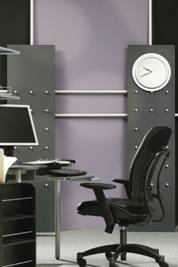
Workplace lighting is very important. In addition to ceiling lighting, it would be beneficial to acquire a desk lamp and place it on the side of the non-dominant hand (usually the left). It is preferable for the lamp to have a white frosted bulb and a blue shade.
A home office
One should definitely avoid combining a workspace and a sleeping area in one room. These are two different energies that can come into conflict and negatively affect one or even both of these spheres.
Career sector energy activation talismans
A sailing ship - an excellent business talisman. It symbolises ever-growing success in business. A model or painting of a sailing ship can be used, placed in the north side near the window.
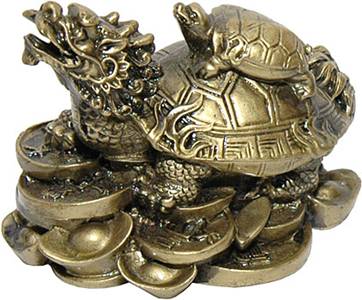
A turtle - symbolises protection, wisdom and longevity. You have probably noticed in eastern-style trinket shops turtles of various sizes with a pronounced shell pattern, which in feng shui depicts cosmic order. Golden coins are often added as well, since a turtle figurine can activate the energy of wealth.

A glass goldfish - symbolises luck in financial dealings.
A fountain - attracts a flow of money. A miniature or substantial fountain or small waterfall is often an indispensable component of eastern-style offices or large shops.
These talismans also seem to make good business gifts. Especially if the recipient is an adherent or at least a knower of the feng shui teaching.
Sources used -
http://www.ameno.ru/sweethome/feng-shui/14060.html
http://www.rusmaster.org/fengshui/fsintof.html
http://www.ogrenet.lv/izklaide/kas_jauns/6035/
http://www.fengshu.ru/karjer.html
comments