Myths and Truths About Vote Counting in Elections
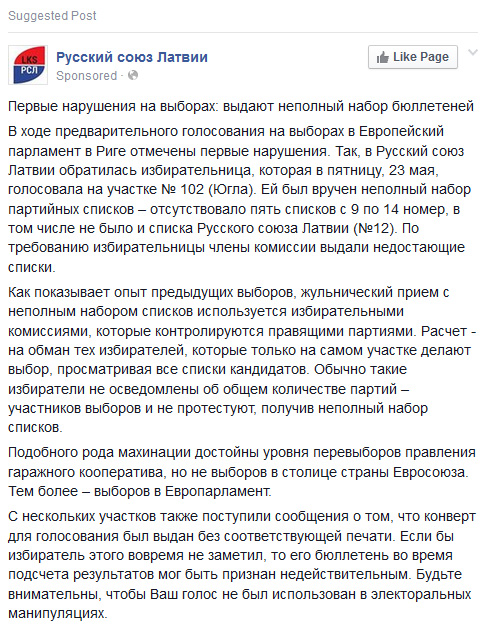
What could be more entertaining on election day than reading about the agony of a party that has lost popularity, as it spreads information - now about the deliberate removal of ballot lists, now about vote fraud and bribery of the commission, now about how commission members will add unused ballots to the results and therefore they must on no account be left at the polling station.
What could be more entertaining on election day than reading about the agony of a party that has lost popularity, as it spreads information - now about the deliberate removal of ballot lists, now about vote fraud and bribery of the commission, now about how commission members will add unused ballots to the results and therefore they must on no account be left at the polling station.
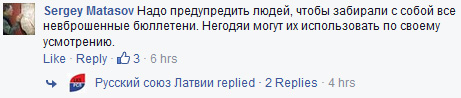
ALL OF THESE ARE MYTHS!
How Does a Polling Station Operate?
Setting Up the Polling Station
The polling station election commission consists of a chairman, a secretary and several commission members. Since polling stations are mostly located in schools or community centres - i.e. state or municipal institution premises - the commission is most likely made up of people who work there. The list of candidates is approved by the Central Election Commission (CVK) well in advance of the establishment of the polling station. Polling stations rarely change, and new ones are added equally rarely; therefore, if the CVK had no objections to the commission's work at the previous election, the same commission will most likely be able to continue at the next one.
Depending on the type of election, the commission begins work several days before election day, when voters can review the election materials and apply to vote at home if someone at home cannot come to the polling station due to illness or other reasons.
The CVK organises seminars for the polling station commission chairman and secretary, explaining the process, demonstrating and training them on what and who should do what, etc.
A few days before the election, the ballot papers are delivered - in ordinary cardboard boxes, each containing the ballots of one electoral list. The ballots have not yet been counted and the number in each box is only approximately known. A count takes place. Usually one commission member counts while another recounts. If there is any discrepancy, everything is tipped back into the box and counted again. The results are recorded in a protocol (and possibly reported to the CVK).
Ballot packages are then assembled. There is no special procedure for how this is done. Typically, the ballots for each list are placed in separate piles on a long or round table. Commission members walk around the table and take one ballot from each pile. Once all the ballots for a complete package have been collected, they are fastened with a clip (or otherwise secured) and placed in a separate box. The work takes several hours, with all commission members involved.
During this process, it is possible that when assembling packages, ballots may stick together and several may be picked up at once, or something gets mixed up and one list is skipped.
Envelopes are counted in a similar manner. The polling station secretary, under the supervision of the chairman, stamps the envelopes. The stamp is always held by the polling station commission chairman. The number of counted and stamped envelopes is recorded in a protocol (and possibly reported to the CVK).
From the moment the ballots are counted and envelopes stamped, the State Police maintains a round-the-clock presence at the polling station.
Election Day
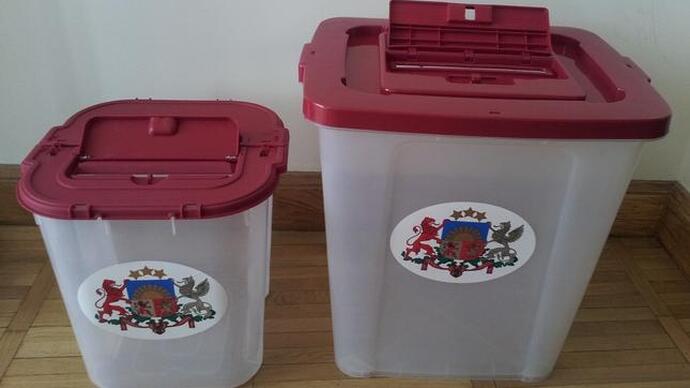
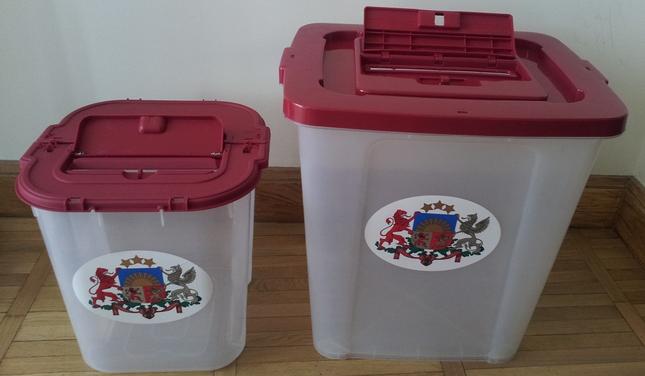
Assuming nothing unexpected has occurred up to this point, on election day at the appointed time the polling station commission chairman reports to the CVK by telephone about the opening of the polling station. Upon receiving the first voter, the full commission, in the presence of the duty police officer and observers, opens and displays an empty ballot box (also called an urn), seals and stamps it, and places it in a visible location. In recent years this process has become even more transparent, as transparent plastic ballot boxes are used.
One commission member works with one signature sheet (if no list). When the sheet is full, the number of signatures is counted, the commission member signs it and hands it to the polling station commission secretary. Even if the commission member needs to use the toilet, the unfinished sheet is not handed to another commission member. In an emergency the sheet is closed unfinished.
If any suspicions arise, the person responsible for that particular signature sheet is known.
The polling station commission secretary issues commission members working with signature sheets a set number of ballot packages. For example, if a signature sheet has space for 20 signatures, 100 ballot packages are issued. A commission member requesting additional packages hands back 5 signature sheets in exchange.
A commission member cannot receive and use more packages than there are entries on the signature sheets.
At set times, the polling station commission secretary reports to the CVK by telephone on the number of people who have voted (this data may also be submitted electronically).
If a voter has left unused ballots, the polling station commission (contrary to the myth) can do nothing with them, because the number of stamped envelopes and ballot packages is recorded and reported to the CVK before (!) the polling station began operating.
If voter turnout is high, a special protocol comes into force, which requires: one commission member at the ballot box, one at the door - additionally checking passport validity and regulating the number of voters present in the polling station at any one time. The voting booths are inspected periodically; any left-behind ballot papers are removed; it is checked that no pens or voting instructions have gone missing or been damaged.
How Does Vote Counting Work?
After the polling station closes, with the full commission, observers and the duty State Police officer present, the ballot box is unsealed and all the ballot envelopes are emptied into a single pile.
The envelopes are then counted - twice. If the second commission member's recount does not match, all (!) envelopes are tipped back into a pile and counted again from the beginning. During the count, no commission member may leave the counting area. The count is recorded in a protocol and reported to the CVK. The number of unused but stamped envelopes and unused ballot packages is also reported. Unused materials are placed in a bag, tied and sealed. In principle, the signature sheets show exactly how many envelopes should be in the ballot box. There may be fewer (if a voter left without voting), but not more!
Contrary to the myth, it is impossible for the polling station commission to add pre-prepared envelopes at this point.
The envelopes are then opened and the ballots removed. Invalid ballots (damaged, marked) are identified and shown to all those present. The valid and invalid ballots are counted.
Finally, the lists are counted, along with the ticks for and crosses against each list's candidates. All counting is done twice. If the second counter finds a discrepancy, all ballots are placed in a single pile and the stage is started over.
Home voting operates similarly. It has its own signature sheets, its own ballot box, a predetermined number of issued stamped envelopes and ballot packages. Moreover, home voting takes place according to a pre-registered list.
Once the polling station's election results have been tallied, this is recorded in a protocol, announced to those present (including observers) and reported to the CVK, which publishes the information on its website.
I allow for the possibility that the CVK has its own additional "technical" verification mechanisms. As a result, the official election result is announced not immediately after the votes have been counted, but a few days later. The election materials are stored at the CVK.
It is equally unrealistic for the CVK to falsify anything, because the polling station results are known to the polling station commission, to the observers, and are published.
If, having read this, you have ideas about how something could be falsified within the polling station framework, I would be happy to hear them! :)
comments