
The Art of Thinking Clearly. Rolf Dobelli
I likely chose this book in the bookshop precisely because of the provocative chapter subtitles that promised to explain - why you should never let anyone buy you a drink; why you need not respect authority; why you should leave your model girlfriend at home; why it is better to use a wrong map than no map at all; why rational people do not appeal to reason. Intriguing, isn't it?
I bought the book at the Zvaigzne bookshop (on Krišjāņa Barona Street), where I had gone because I was looking for substantive reading to take with me on a trip to Lithuania. Any journey is an excellent opportunity to get away from the computer screen and turn to printed works. Usually what I read on journeys brings new discoveries and the satisfaction of having given time to it.
The book was not easy to read at first, as it is full of references to people the author considers known to everyone in the business or finance world. Secondly, already the first chapter - on survivorship bias, or The Survivorship Bias - explained why it is worth visiting cemeteries to understand that behind every popular writer, rock star, or entrepreneur there are hundreds who were equally talented, with the same capacity for work and the same determination, yet who are unknown to anyone and gained neither popularity nor success. Conclusion: people systematically overestimate their chances of success.
Do you understand what I mean when I say - not easy to read? From the very beginning the author "seats" the reader firmly, does not inspire action, does not encourage belief in oneself and in success, but does precisely the opposite - prompts one to forget all illusions and remove the rose-tinted glasses through which we so love to view the world. However, despite a certain inner emotional disappointment that this book would help me gain new strength, conviction and understanding, I nonetheless forced myself to read it from cover to cover in three afternoons. And I have no regrets.
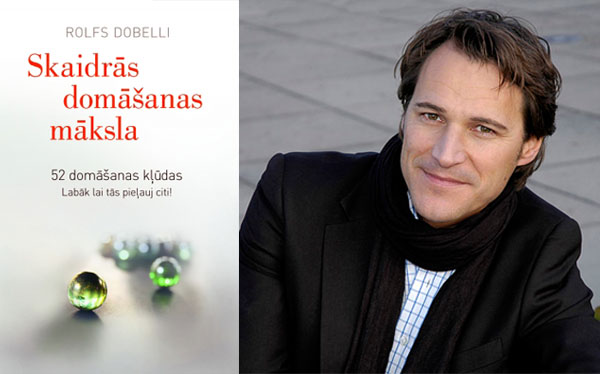
The author, in 52 chapters with practical examples, explains how people live in illusions, cling to them as if for dear life, and rarely does anyone part with them by listening to their own common sense. Here is a quote that well explains the futility of human clinging:
"There are many good reasons to continue investing in something to complete it. But there is one bad reason: the sunk cost. Making a rational decision means ignoring past costs. No matter how much has already been invested - only the present and future projections matter." (The Sunk Cost Fallacy, or The Trap of Sunk Costs - Why You Should Ignore the Past - p. 31)
I likely chose this book in the bookshop precisely because of the provocative chapter subtitles that promised to explain - why you should never let anyone buy you a drink; why you need not respect authority; why you should leave your model girlfriend at home; why it is better to use a wrong map than no map at all; why rational people do not appeal to reason. Intriguing, isn't it?
In virtually every sales seminar or masterclass, speakers tirelessly assert - the client buys based on emotions, not reason. One cannot disagree. Rolf Dobelli in his book explains precisely these emotional thinking traps into which we fall very often, because for the average person choices are based on like or dislike, not on what benefit this purchase will bring in the future.
The author explains the absurdity of today's popular weight-loss programmes or diets, or of taking up a sport or buying a gadget simply because it is currently trendy. One of the standard sales and marketing techniques is also analysed - that of finding similarity or mirroring (mirroring). A good salesperson tries to copy the client's gestures, mood and manner of speaking; all of this makes the salesperson (and thereby the product or service) seem more likeable to the buyer. We linger with what seems likeable and makes us feel good. We buy what makes us feel good. But is it what we truly need? More often than not, weighing it up with a cool head - no.
Every day we must make dozens of choices. Those with a tendency to analyse themselves and their actions additionally overload their minds with analysis of whether a choice was right or wrong. But here is what Rolf Dobelli writes:
"Never judge a decision solely by its outcome. A poor result does not automatically mean that a wrong decision was made - and vice versa. So instead of fretting about a wrong decision or patting yourself on the back for one that may have led to success purely by chance, try once more to recall why you made that decision. Did you have sound and understandable reasons? Then act the same way next time. Even if it didn't work out this time." (The Outcome Bias - p. 91)
"The fear of losing something motivates people more than the prospect of gaining something of equal value." (Loss Aversion - p. 142)
Here too the idea of the contribution of the individual versus the group (and the team) in any process or work is analysed. It is in human nature to belong to a group, and very often the opportunity is taken to hide behind others' backs - which does a certain harm not only to the overall result of the work but also to oneself.
"People in groups behave differently than when they are alone (otherwise there would be no groups). The negative aspect of groups diminishes when individual performance is made as visible as possible. Long live meritocracy, long live a performance-oriented society!" (Social Loafing - Why Teams Are Lazy - p. 147)
In unclear situations we are seized by the feeling that something must be done urgently, despite having no clear vision or understanding at that moment of what exactly should be done. We rush or do something that under normal circumstances we would never choose to do. Moreover, we are satisfied that we acted, that we did something for the sake of the matter - even if it achieved nothing good. The author advises: if a situation is not clear, do nothing until you are able to assess it objectively with a cool head.
Overall, this book is useful reading that now and then allows one to look at oneself from the outside. If you wish to learn more about your own emotional thinking patterns, I recommend it. It may help you avoid a mistake in your choices.
comments