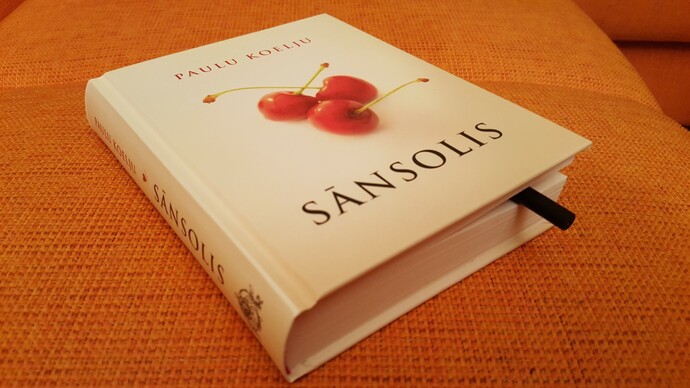
Paulo Coelho. Adultery
Paulo Coelho wrote this book as a female narrator - from a woman's point of view. The story of a successful thirty-year-old journalist who lives in Geneva and has an ideal family - a husband, two children, a beautiful house in a good neighbourhood, a calm, ordered and predictable life. A happy life. But a moment arrives when she begins to be tormented by the question: "Is this all?" She is overcome by an inexplicable fear.
Which would you prefer - a happy life or a passionate life, which always means danger and uncertainty about what awaits you? To the main character of the book it seems that the day she married, time stopped and an ordered, monotonous life began. Now she begins to seek confirmation that she is still alive and capable of feeling. Life deals her an old school crush, now a successful politician, and they become lovers. For a while - and then she recovers once more in the arms of her infinitely understanding husband.
Rather insipid, far removed from the reality of life (does the author really think that a deceived husband is so spineless as to be incapable of even a single passionate jealousy scene?), and somewhat unbelievable that a thirty-year-old woman can already begin to suffer from such life apathy. Do people in Switzerland really feel so financially and career-wise secure at thirty that they are exposed to no external risks?!
Of the fifteen Paulo Coelho books I have read, this seemed to me the weakest. As if the theme is topical and entirely understandable - there is nothing imaginary about it: after more than a decade of living together, a certain cooling of passion can indeed set in, and one may begin to seek challenge elsewhere - at work, in public life, in other relationships, etc. However, the plot itself, with its intermittently inserted spicy love-making scenes, somewhat resembles a pulp novel rather than the search for the meaning, mission or passion of human life that is characteristic of the author. Also absent was Coelho's typical mysticism and play with fateful coincidences.
The only thing that has been preserved is the easily readable language. Three hundred and more pages were devoured across two evenings almost in one breath. There are also a few quotes that one once again wished to underline beautifully with a pencil, so that when leafing through later there is somewhere for the eye to rest.
That is just how I am. The volcano has erupted, and I must gather the lava back into myself, plant new trees and mow the meadow, and bring the sheep here to graze. (p. 32)
Well, beautifully put. Which of us has not felt that way?!
There is nothing more boring in the world than interviewing a politician. I would feel far better if they sent me to cover some crime. Murderers are always genuine. (p. 35)
[..] aching souls possess this incredible ability to recognise one another and find each other. And to multiply suffering. (p. 48)
I have always wondered why people in Latvia do not talk about being lonely, about lacking love, why they are afraid to admit that they are weak and defenceless. They would sooner choose to play the hero (the hero-mother) or the victim, and cultivate a sense of guilt in those close to them.
Aching souls recognise one another and are drawn together - to the great alarm of the strong. (p. 69)
We do not choose life, but we do decide what to do with the joys and sorrows it gives us. (p. 109)
For two lovers it is important to come to know not only each other's soul but also each other's body. (p. 159)
It is impossible to convey one's loneliness to another - especially when surrounded by people. Loneliness stands tall and consumes the best of what dwells in our souls. Consumes it because we spend all our energy on appearing happy [..]. (p. 203)
Who has not wished to leave everything behind in order to realise a dream? But realising a dream always involves risk, there is a price to pay [..]. In any case, a dream always comes at a price. (p. 205)
[..] let us first seek Love, and life itself will provide all the rest. (p. 331)
comments