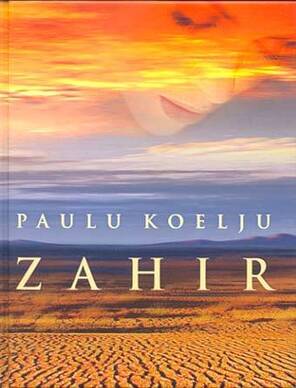
Paulo Coelho - The Zahir
One wants to read books when feeling a little lonely and sad. A conversation arises with the characters the author has created, a conversation with the angel and the demon within oneself. Another insight: we do not truly choose books - they choose us. The right book arrives like a sign, like an answer to your questions, arrives at the right moment when you can devote enough attention to it.
One wants to read books when feeling a little lonely and sad. A conversation arises with the characters the author has created, a conversation with the angel and the demon within oneself. Another insight: we do not truly choose books - they choose us. The right book arrives like a sign, like an answer to your questions, arrives at the right moment when you can devote enough attention to it.
".. one need only pay a little attention; knowledge comes when you are ready for it - if you notice and correctly interpret the signs of fate, you will learn everything needed for the next step."
The book opens with reflections on freedom from the bonds of marriage, from the everyday routine of a long-term relationship in which every couple without exception becomes mired - it is only a matter of how successfully each one deals with it, and that is precisely this story. The protagonist's wife suddenly disappears; he is left in uncertainty and struggles with conflicting feelings.
The sense of freedom, which now allows him to disregard the other person, to meet, make love and celebrate life, gradually grows into a deep feeling of loneliness, and the Zahir (from Arabic - the present, the visible) appears in the man's life. Over two years he ceaselessly tries to unravel the mystery of Esther's (his wife's) disappearance, sees her on the street in chance women, hears her voice and lingers in memories. He begins cohabiting with another woman, but the Zahir - as he privately names the image of his wife - becomes an obsession.
".. suffering is born from the desire to be loved in the way that suits us. But love has its own laws - it is free, it does not impose itself, yet it guides with its own force and does not allow one to draw breath for a single moment."
".. love is like an illness from which no one wishes to recover. Those who have caught it make no effort to get well, and those who suffer because of love refuse all treatment."
The story is about the path of love that must be travelled in order to come to know one's life partner anew. This can be a physical journey - for instance, to a remote village on the Kazakh steppe - or a spiritual journey that demands complete renunciation of one's past and complete openness to the energy of love. The author compares it to Ulysses' return to his Penelope.
".. and on foot I covered those hundred metres that separated me from the woman who had once been my wife and had become the Zahir and once more - the beloved. The woman whom every man, returning from war or from work, hopes to find waiting."
However, one must say that this is the path of a creative and strong, though doubt-tormented, person - an artist, philosopher, writer, priest, shaman - and not a path comprehensible or walkable by everyone. I have read several of his books, but in this one in particular there is a great deal, an especially great deal, of Paulo's own life and personality. This struck me vividly after reading his life story in Alexander Mironenko's article "Signs Met Along the Way" (Lilit, April 2011 issue). But, as the author himself says, what else can a true writer write about, if not about himself.
"The Universe points to our mistakes by taking away the most important things - our friends."
[video-desert]
Source: paulocoelhoblog.com

comments